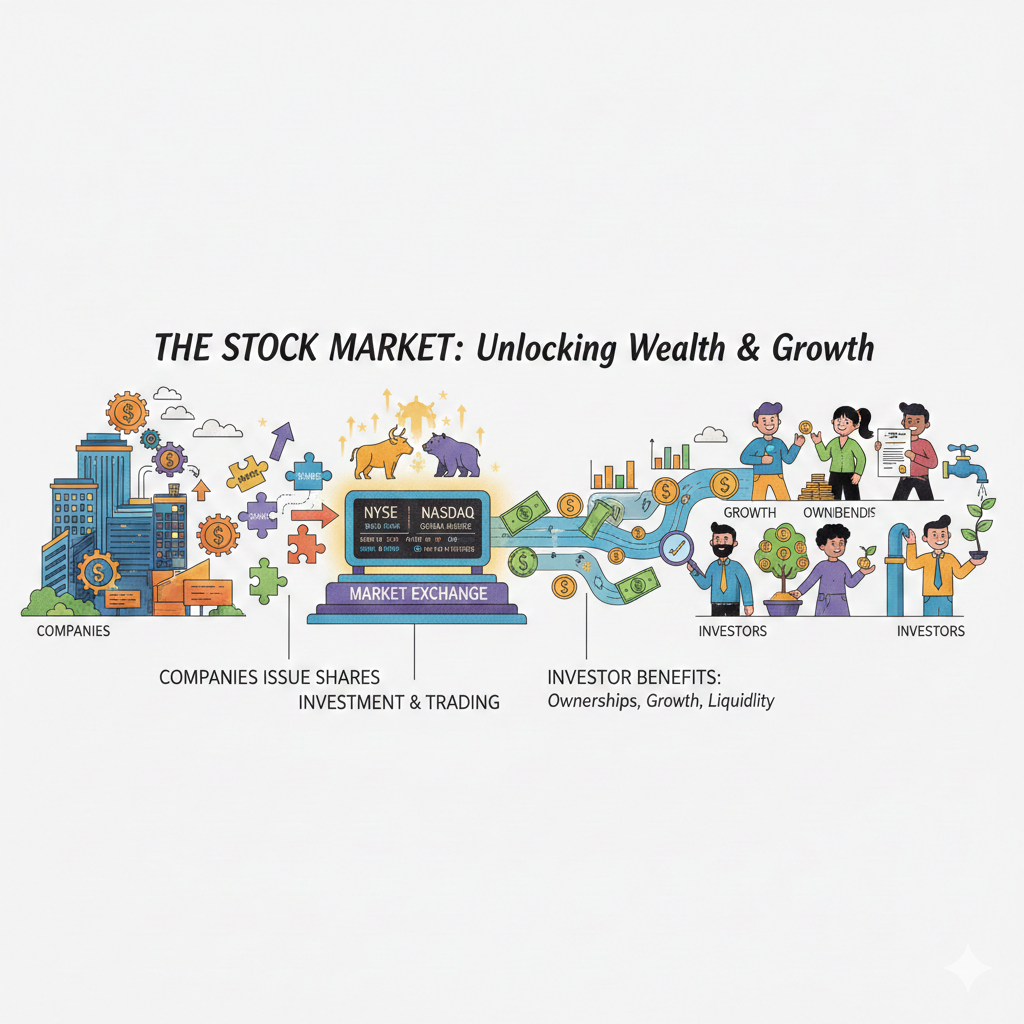
Many people hear about the stock market when a major index rises sharply, or during a financial downturn, or whenever experts predict that “the markets are nervous.” But what exactly is the stock market? Why does it play such a large role in business, investing, and even everyday life? Although the term sounds complex, the basic idea behind the stock market is surprisingly understandable once it’s broken down into simple concepts.
The stock market is essentially a marketplace where the ownership of companies is exchanged between investors. When companies need money for expansion, innovation, or new projects, they can offer a portion of their ownership to the public in the form of shares. In return, they may benefit from rising share prices, potential profits, and sometimes dividend payments.
Even though many think of financial experts, brokers, or Wall Street traders when picturing the market, anyone with a basic understanding of investing can take part in stock trading today through online platforms. That accessibility is part of the reason the stock market is considered one of the most common ways for individuals to build long-term wealth.
A marketplace made of multiple exchanges
One of the biggest misunderstandings about the stock market is the idea that it’s a single location. Instead, the stock market is made up of several stock exchanges and electronic trading networks spread across different countries. For example, in the United States, the two most well-known exchanges are the New York Stock Exchange and the Nasdaq. Similar exchanges exist in India, Europe, Asia, and almost every major economy.
Each exchange lists different publicly traded companies and provides a regulated environment where buyers and sellers meet. Modern stock exchanges operate mostly through digital trading systems, which means transactions happen in a fraction of a second rather than through traditional shouting or hand signals, as was common in earlier decades.
The primary market and why companies go public
Before a company’s shares become available for public trading, the business must first offer them for sale on what is known as the primary market. This usually happens through something called an initial public offering, or IPO. During an IPO, investors purchase shares directly from the company, and the money raised helps the business expand.
Going public allows a company to access a large amount of capital that might be difficult to get through traditional loans. In exchange, the company gives up a portion of its ownership to investors who now share in its success (or failure). From a business growth perspective, this system fuels innovation, helps new industries emerge, and keeps the global economy moving forward.
The secondary market – where most investing really happens
Once shares are listed, they become available for everyday trading. This is what people usually refer to as “the stock market.” In the secondary market, investors buy and sell shares among themselves. The company whose shares are being traded does not receive money from these transactions; instead, one investor sells ownership to another investor.
Prices fluctuate constantly during trading hours as investors react to news, earnings results, economic projections, and future expectations. When buyers are more interested in owning a company than sellers are in giving up their shares, the stock price tends to rise. When more sellers want to sell and fewer buyers are interested, the price falls.
What does buying a stock really mean?
When someone buys a stock, they are purchasing a share in the company’s ownership. That ownership generally comes with the possibility of receiving dividends, which are a portion of company profits shared with investors. Not all companies pay dividends, but many established firms do.
Shareholders also benefit when the value of the company increases. If the business grows and becomes more profitable, the market price of its shares often rises. Investors can then sell their shares at a higher price than they paid and make a profit.
Some shares provide voting rights, allowing investors to vote on company matters like leadership changes or major decisions. While individual investors usually hold only a tiny portion of voting power, institutional investors may influence corporate policies significantly.
The stock market provides liquidity and confidence
A major advantage of the stock market is liquidity. That means shares can usually be bought or sold easily, at fair prices, and without waiting months like one might for large assets such as real estate. Liquidity gives investors confidence that they can convert their investments into cash whenever necessary.
This constant availability of buyers and sellers is what keeps prices efficient and markets functioning smoothly. Without liquidity, investing would become slow, risky, and less appealing.
How the stock market benefits the economy
The stock market has a crucial job in the global financial system. It helps capital flow from investors toward businesses that need funding. When companies have access to money through stock sales, they can increase production, expand into new markets, invest in technology, and hire more workers. In this way, stock markets indirectly support job creation, innovation, and economic growth.
Additionally, the market helps distribute financial resources more efficiently. Investors evaluate companies based on their potential, and businesses that appear promising are rewarded with more investment. That means capital moves toward ideas and industries that have the greatest ability to grow and contribute to the economy’s future.
Market indexes show overall performance
To understand how well the stock market is performing, investors look at stock market indexes, which represent a collection of major companies. These indexes act like scorecards that show whether markets are rising or falling.
If indexes go up, it generally indicates optimism, strong business activity, and improving economic conditions. If they fall, it may suggest that investors are worried about slow growth, financial uncertainty, or global risks.
Emotions and expectations drive market behavior
One important aspect of the stock market is that prices are not based only on what companies earn today. Investors constantly think ahead and try to predict future results. This means stock prices often move according to expectations, confidence levels, or concerns about the future.
Because of this, markets sometimes rise even when economic news is average, or fall despite strong earnings. Human emotions such as fear and excitement can influence buying and selling patterns, contributing to short-term volatility.
Why understanding the market matters
Even people who never buy a single stock are influenced by the stock market. Pension funds, retirement accounts, insurance companies, and mutual funds rely heavily on stock investments. A rising market often benefits savings and retirement plans, while market downturns can affect long-term financial security for millions of people.
Understanding the fundamentals of the stock market doesn’t require advanced knowledge—it only requires knowing how ownership works, how company performance relates to share prices, and why demand and supply shape the market every day.
2 thoughts on “A Beginner’s Complete Guide to Understanding the Stock Market and How It Really Works”
Comments are closed.