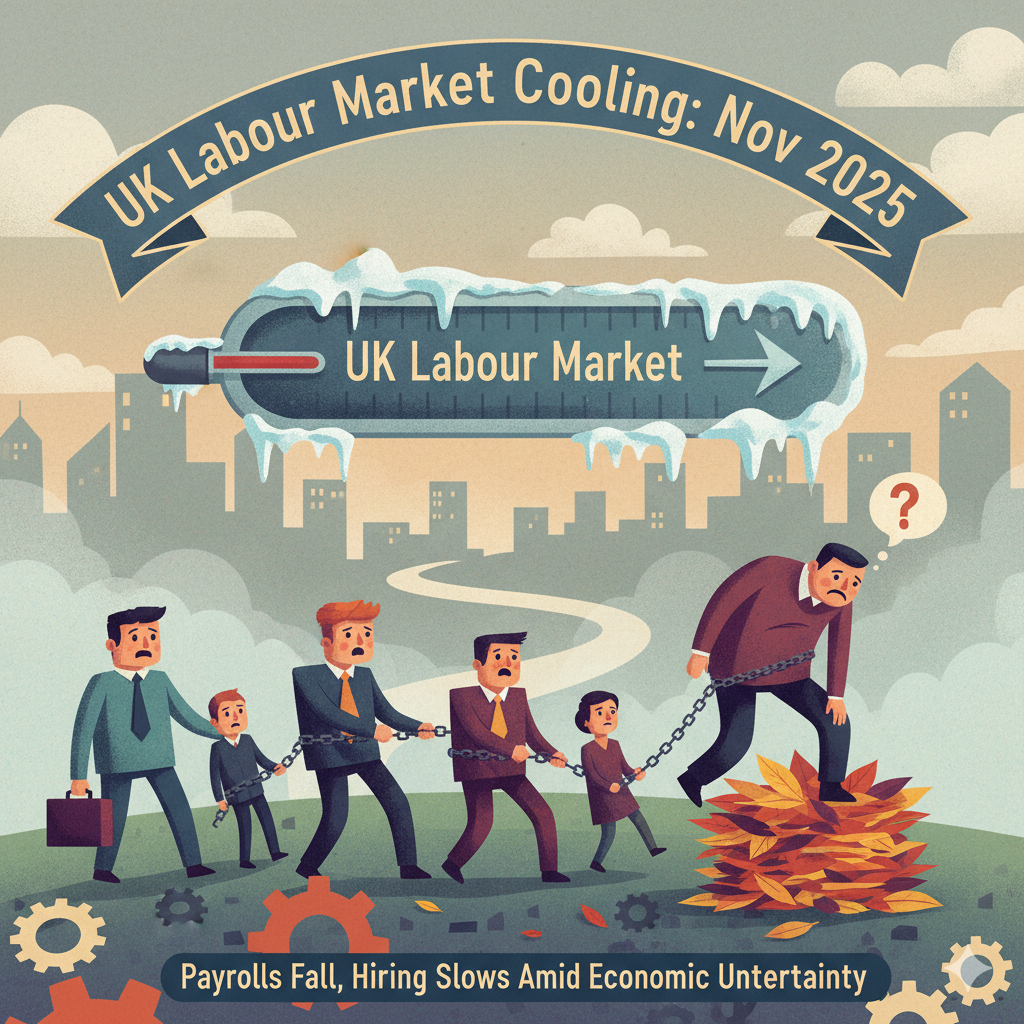
UK Labour Market Overview – November 2025: Signs of a Cooling Employment Landscape
The UK labour market, long considered a resilient pillar amid global uncertainty, is now showing clearer signs of cooling. The latest data from the Office for National Statistics (ONS), published in November 2025, paints a nuanced picture — one of slowing job creation, marginal drops in payroll numbers, and caution among employers as economic headwinds persist. While the numbers do not yet point to a deep employment crisis, they do signal that the post-pandemic hiring boom has firmly plateaued, and the nation’s labour dynamics are entering a more measured, possibly fragile, phase.
Gradual Decline in Payrolled Employees
One of the most striking takeaways from the November 2025 report is the continued fall in payrolled employees across the United Kingdom. The total number of employees on company payrolls fell by 117,000 between September 2024 and September 2025, marking a 0.4% annual decline. The same trend was observed on a month-to-month basis, with a reduction of 32,000 workers (0.1%) between August and September 2025.
Though modest, this consistent fall suggests that employers are increasingly cautious about expanding their workforce. The decline is particularly notable when compared with the robust job growth observed between 2021 and 2023, a period marked by post-lockdown recovery and aggressive recruitment. The current slowdown, therefore, reflects a rebalancing act — one in which companies are reassessing labour needs amid shifting demand, rising costs, and ongoing inflationary pressures.
A Softer Quarter Reflecting Broader Economic Tensions
The quarterly comparison between July and September 2025 reinforces this trend. During this three-month period, payrolled employees fell by 109,000 (-0.4%) on the year and by 26,000 (-0.1%) on the quarter. Such figures highlight that the weakening is not isolated to a single month but rather part of a broader slowdown spreading across multiple sectors.
Economists attribute this softening to several overlapping factors. A combination of higher borrowing costs, persistent inflation, and subdued consumer spending has dampened business confidence. The Bank of England’s relatively tight monetary policy, aimed at keeping inflation under control, has made it more expensive for firms to invest or hire aggressively. Additionally, some industries — particularly retail, manufacturing, and construction — are feeling the squeeze from weaker demand and rising input costs.
While some employers are holding on to staff to avoid skill shortages later, others are implementing “soft freezes” on hiring or not replacing roles vacated through attrition. This cautious sentiment suggests that businesses are waiting for clearer economic signals before making long-term employment commitments.
Early October Estimates Point to Further Easing
The early, provisional data for October 2025 adds another layer to the picture. The ONS estimates that the number of payrolled employees stood at around 30.3 million, representing a drop of 180,000 (-0.6%) year-on-year and 32,000 (-0.1%) month-on-month. This continuation of downward momentum indicates that the slowdown seen through the summer likely persisted into the autumn.
Analysts view this as an early warning sign of potential stagnation in the job market if the trend continues through winter. Seasonal employment, particularly in retail and hospitality, could provide temporary relief, but structural issues remain. The ONS report doesn’t specify sectoral breakdowns in this overview, but anecdotal data from previous months suggest that small and medium-sized enterprises (SMEs) have been disproportionately affected by reduced hiring and higher operating costs.
Data Methodology Updates: A Note of Caution
An important aspect of the November 2025 labour market bulletin is the emphasis on methodological changes in how the ONS collects and interprets data. The estimates from January–March 2025 onward incorporate improvements in the Labour Force Survey (LFS) — particularly in data collection techniques and sampling approaches introduced from early 2024.
These refinements were designed to improve accuracy following concerns about low response rates in earlier surveys. However, the ONS itself has cautioned that these transitions may temporarily distort comparisons with older datasets. As a result, short-term fluctuations should be interpreted carefully, as part of the observed change could be statistical rather than purely economic.
This reminder is crucial for policymakers and investors who rely heavily on ONS data to guide decisions. The labour market has been one of the most closely watched indicators of the UK’s economic health, and understanding how these revisions affect long-term trends is vital. The updated LFS is expected to provide more reliable insights over time, but for now, comparisons between pre-2024 and post-2025 figures should be made with caution.
Increased Volatility and Survey Challenges
Another challenge highlighted by the ONS is greater volatility in Labour Force Survey data, largely due to ongoing adjustments and lower household response rates. Since 2023, survey participation has declined, making it harder to capture a fully representative snapshot of the workforce. To compensate, the ONS has applied weighting and modelling adjustments, but this introduces more variability into monthly estimates.
Such volatility complicates policy discussions. A single month’s data may not accurately reflect the underlying trend, meaning analysts must look at longer-term averages or alternative indicators such as payroll data from HMRC, vacancy rates, and unemployment benefit claims.
This uncertainty underlines a broader issue: as traditional survey-based labour data becomes harder to collect, statistical agencies worldwide are shifting toward administrative and digital sources for a more complete view. The UK’s ONS is at the forefront of this transition, but the process will take time to stabilize.
Broader Implications for the UK Economy
The overall message from the November 2025 UK labour market overview is that the economy remains under mild but persistent pressure. While the unemployment rate has not spiked dramatically, the steady erosion in payrolled employment suggests reduced momentum in hiring and possibly a softening demand for labour.
This shift could have mixed effects. On one hand, slower job growth may help ease wage inflation, which has been a concern for the Bank of England in its efforts to control overall price rises. On the other hand, weaker labour market conditions can dampen consumer spending, further slowing economic growth. A delicate balance now exists between maintaining employment stability and curbing inflationary risk.
The ONS data also reinforce the importance of productivity improvements. As businesses hesitate to expand their workforce, future economic gains may depend more on automation, digital transformation, and efficiency gains rather than raw employment growth. For policymakers, the key will be supporting investment in skills and technology to ensure that productivity rises even as job growth slows.
A Turning Point in Labour Dynamics
Taken together, these findings signal a turning point in the UK’s labour dynamics. The remarkable resilience of the job market through 2023 and early 2024 has given way to a period of moderation. Recruitment activity has cooled, vacancy postings have fallen, and the balance between labour supply and demand is gradually normalizing.
For workers, this means slightly less bargaining power in wage negotiations, especially in sectors where hiring has slowed. For employers, it may offer a chance to stabilize costs after years of upward wage pressure. And for policymakers, it underscores the need for data-driven flexibility — ensuring that fiscal and monetary measures align with real-world employment conditions.
Outlook Ahead
Looking forward, analysts expect employment growth to remain subdued through early 2026, particularly if economic activity stays weak and borrowing costs remain elevated. However, the picture is far from uniformly negative. The UK’s service sector continues to show resilience, and the technology and healthcare industries still report skill shortages that could cushion the labour market from deeper declines.
If inflation continues to fall and interest rates begin to ease in mid-2026, hiring could rebound gradually. Much will depend on consumer confidence, global trade stability, and the pace of recovery in business investment.
In summary, the UK Labour Market Overview for November 2025 reflects a period of adjustment rather than crisis. Employment levels are edging lower, but the foundations of the labour market remain intact. The data tell a story of cooling momentum — one shaped by cautious employers, evolving data methodologies, and a broader economy seeking equilibrium after years of turbulence.
It is, in essence, a reminder that even in a slowing market, stability can coexist with change — and that understanding the nuances behind each figure is key to interpreting the health of the nation’s workforce.
One thought on “UK Labour Market Cools in November 2025 as Employment Growth Slows and Business Caution Rises”
Comments are closed.