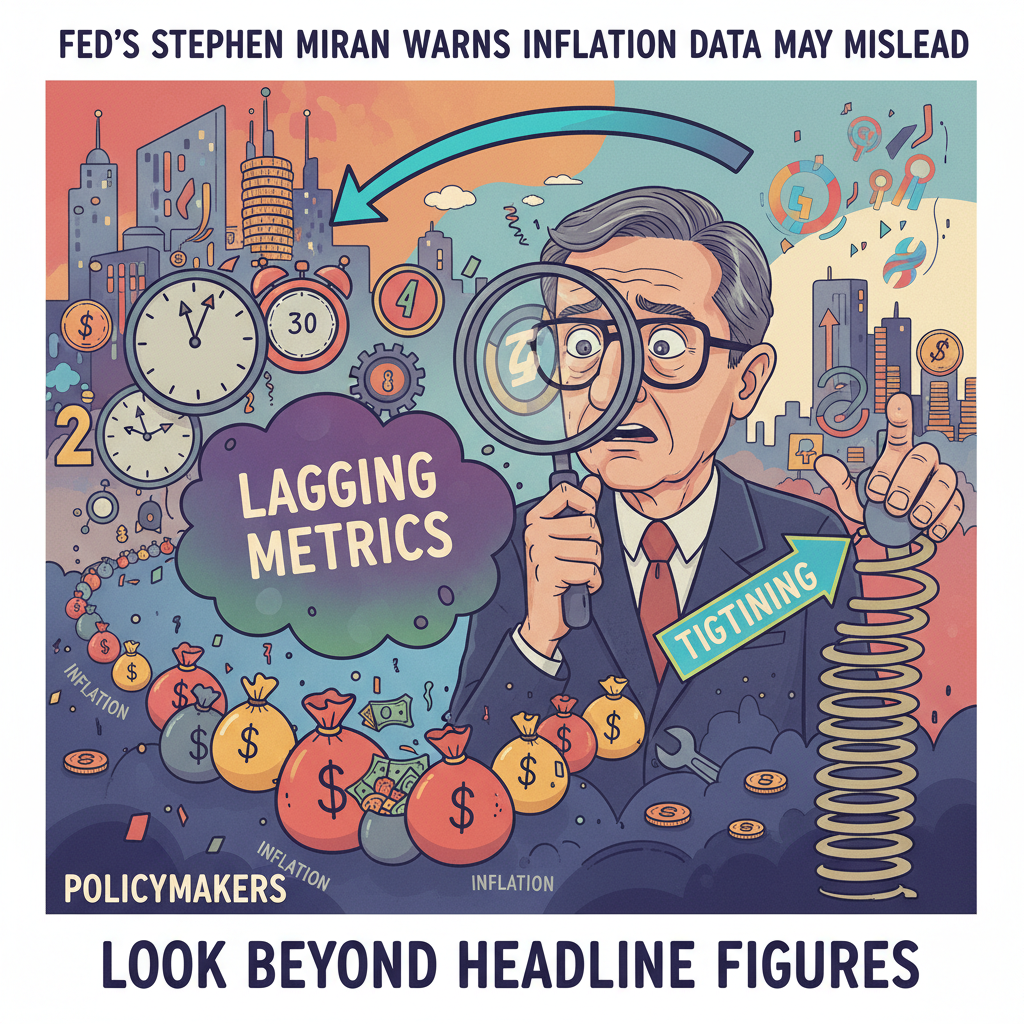
In a time when inflation remains one of the most closely watched economic indicators, Federal Reserve official Stephen Miran has struck a cautionary tone. According to him, the current inflation readings might not be telling the whole truth. He argues that policymakers and the public should be careful not to take these figures at face value because of how inflation is measured and reported. Miran’s remarks highlight a growing debate within the Federal Reserve over how much weight should be given to traditional data and whether the current restrictive stance on interest rates could risk slowing the economy more than necessary.
The Nature of Inflation Data: Why It Can Mislead
Inflation data is often viewed as the most important guide for central bankers setting monetary policy. However, Miran suggests that the numbers can be misleading because of the lagging nature of certain components, particularly in housing and rental costs. These categories make up a large portion of the Consumer Price Index (CPI) and the Personal Consumption Expenditures (PCE) price index—the two primary measures of inflation in the U.S. economy.
He explained that housing costs are typically measured using rents or “owners’ equivalent rent,” which tends to move more slowly than real-time market trends. This means that even if housing prices or rental rates have already cooled in the real world, official inflation data may still reflect outdated increases. As a result, inflation appears stickier than it actually is, potentially leading policymakers to keep interest rates higher for longer than necessary.
Miran pointed out that this lag effect was already visible in the data, with rental price growth slowing substantially in private-sector surveys, even as official inflation readings remained elevated. “If the data doesn’t reflect the actual trend, we risk misjudging the economy’s true state,” he warned.
Monetary Policy Already Restrictive
Stephen Miran also emphasized that the Federal Reserve’s monetary policy is already restrictive. The Fed has raised interest rates significantly over the past few years to combat high inflation, making borrowing more expensive for businesses and consumers alike. Higher rates tend to slow economic activity by reducing spending and investment, which can cool inflation—but they can also put jobs and growth at risk.
In Miran’s view, the current stance may already be tight enough to ensure inflation continues to ease. He believes that if policymakers focus too heavily on the headline inflation numbers, which are affected by temporary or delayed factors, they might keep rates too high for too long. That could lead to unnecessary harm to the labor market, with potential job losses and weaker consumer demand.
His comments come as other Fed officials signal patience in adjusting policy. While the majority prefer to wait for clear, sustained evidence of inflation returning to the 2% target before cutting rates, Miran seems more open to the idea that policy might already be doing its job.
A Different Perspective Inside the Fed
Miran’s position sets him apart from many of his colleagues within the Federal Reserve. Some policymakers, including the more hawkish members, maintain that inflation remains too high and that lowering rates too soon could reignite price pressures. But Miran believes the risk balance has shifted—that is, the danger of keeping policy overly tight now outweighs the risk of inflation rebounding.
He argues that, given the lagging nature of inflation measurement, the real economy might already be feeling the effects of restrictive policy more strongly than current data suggests. “We are likely underestimating the cooling in price growth that is already taking place,” he noted in a recent discussion.
His remarks echo those of several independent economists who argue that traditional inflation metrics were designed for a slower-moving economy. In today’s world of real-time data, online pricing, and rapid market shifts, these measures may fail to capture the true dynamics of price changes as they happen.
Potential for Rate Cuts Sooner Than Expected
If Miran’s interpretation proves correct, the Federal Reserve could find itself with room to cut interest rates sooner than expected. His reasoning is that if the apparent persistence in inflation is largely a data artifact—caused by measurement delays—then inflation is already moving closer to target in real terms.
That would justify a modest easing of monetary policy to prevent overtightening and safeguard employment. While Miran stopped short of calling directly for immediate rate cuts, he did suggest that the Fed should remain flexible and open to revising its stance as more accurate, forward-looking data becomes available.
For market participants, Miran’s comments could be significant. Investors and analysts closely watch any shift in tone from Fed officials, as such statements can influence expectations around rate decisions. A perception that rate cuts may come earlier could lead to changes in bond yields, stock valuations, and currency movements.
Conditional Optimism: Data Still Matters
Despite his cautious optimism about the inflation outlook, Miran emphasized that his view is conditional. He remains open to changing his assessment if new data suggest inflationary pressures are returning. In particular, he is watching housing and rent trends closely. If those costs begin to rise again, it could signal that inflation’s underlying momentum is not yet fully contained.
He also noted that factors such as energy prices, supply chain disruptions, or shifts in consumer spending could still affect inflation in unpredictable ways. Therefore, while he warns against overreacting to lagging data, he also recognizes that the inflation fight is not over.
A Call for Deeper Analysis
Ultimately, Stephen Miran’s message is that headline inflation numbers should be analyzed carefully rather than taken literally. Policymakers, investors, and even the public should understand what drives these figures before drawing strong conclusions. “Data should guide us, not mislead us,” he said.
By encouraging a more nuanced view of inflation, Miran is contributing to a broader discussion about how economic data should inform policy in the 21st century. His remarks suggest a need for more real-time measurement tools that better reflect current conditions, rather than relying solely on backward-looking indicators.
Balancing Inflation and Growth
The debate Miran highlights touches the core of the Federal Reserve’s dual mandate—price stability and maximum employment. The challenge for policymakers is finding the right balance between controlling inflation and supporting growth.
If inflation is overstated due to measurement distortions, keeping rates too high could unnecessarily suppress job creation and economic output. Conversely, moving too quickly to ease policy could risk inflation flaring up again. Miran’s approach advocates a middle ground—remaining data-dependent but also critical of the data’s limitations.
Conclusion: A Reminder to Look Beneath the Surface
Stephen Miran’s warning serves as a reminder that economic data is not infallible. Behind every statistic lies a complex set of assumptions, methodologies, and timing issues that can distort the picture. As he urges the Federal Reserve and the public not to take inflation data at face value, Miran underscores the importance of context, critical thinking, and flexibility in economic policymaking.
In an era of rapid change, relying solely on traditional measures could lead to outdated conclusions. Miran’s message is clear: before acting on inflation figures, understand what they truly represent. Only then can policy decisions achieve the right balance between stability, growth, and the long-term health of the U.S. economy.
One thought on “Stephen Miran Urges Caution: Inflation Data Shouldn’t Be Taken at Face Value”
Comments are closed.