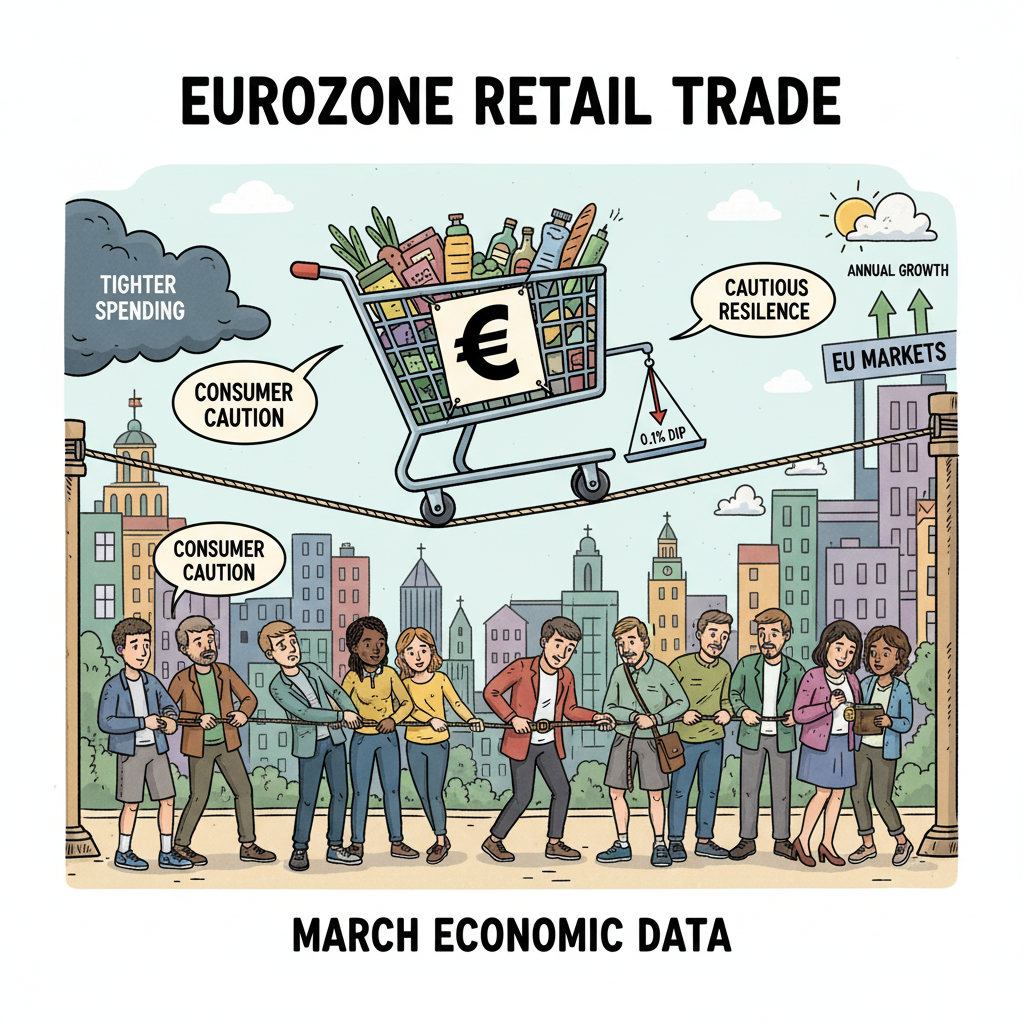
The latest Eurostat data has offered another glimpse into Europe’s fragile economic balance — one that continues to dance between recovery and stagnation. According to the report, the volume of retail trade in the euro area and the European Union declined by 0.1% in March 2025 compared to February. While this may seem like a minor contraction, the subtle shift speaks volumes about the challenges facing consumer spending, inflationary pressures, and market sentiment across the continent.
As a stock market observer, such seemingly modest data points often act as early tremors of larger economic movements. When the backbone of the economy — the consumer — starts to show fatigue, the ripples are soon felt in corporate earnings, currency trends, and even central bank policy outlooks.
A Closer Look at the Numbers
The headline figures from Eurostat reveal a 0.1% month-on-month fall in retail trade volume in both the euro area and the broader EU. This marks a small but telling reversal following periods of mixed performance earlier in the year.
Breaking it down:
- Sales of food, drinks, and tobacco showed a mild decline, pointing to possible belt-tightening among consumers even on essential items.
- Non-food sales — typically an indicator of discretionary spending — also dipped, reinforcing concerns about weakening household confidence.
- The only bright spot came from automotive fuel, which saw a 0.4% rise, hinting at increased travel or transport activity despite broader consumption softness.
These details may seem granular, but they reveal a nuanced story: while European households are still spending, their behavior has shifted toward necessity and away from indulgence.
Annual Data Shows a Resilient Yet Uneven Recovery
Interestingly, the year-over-year comparison paints a more positive picture. In March 2025, retail trade volumes rose by 1.5% in the euro area and by 1.4% in the EU compared to March 2024.
This suggests that despite short-term softness, the overall consumer economy remains stronger than it was a year ago. Inflation has cooled from the highs of 2022–2023, and wages have seen gradual improvement in several European economies. This combination has lent some breathing space to households — though not enough to trigger a robust rebound in consumption.
The takeaway? The European retail story is not one of collapse, but of cautious recalibration. Consumers are spending, but prudently. They are saving more, comparing prices, and waiting for discounts. It’s an environment that favors value-oriented retailers and challenges high-end discretionary brands.
Country Breakdown: Diverging Consumer Trends
The Eurostat data also highlights striking regional differences.
- Slovenia (-2.0%), Estonia (-1.3%), and Slovakia (-0.9%) posted the sharpest monthly declines in retail trade.
- Western European economies like France, Germany, and the Netherlands showed smaller movements, indicating relative stability.
- Southern European countries, often more sensitive to tourism-driven spending, recorded marginal variations as the spring travel season began.
These disparities underscore how uneven the recovery remains. Smaller economies with tighter credit conditions and higher inflation are seeing quicker slowdowns in consumer demand. Larger economies, on the other hand, are cushioning the decline through government support and stronger labor markets.
For investors, this divergence is crucial. It suggests that the European retail landscape will remain fragmented — creating selective opportunities rather than a broad-based consumer rally.
What’s Driving the Weakness?
There are several intertwined factors behind the 0.1% decline:
- Persistent Inflationary Effects – Although inflation has moderated, the cost of living remains elevated. Many households are still prioritizing rent, utilities, and essentials over leisure and non-essential shopping.
- Higher Interest Rates – The European Central Bank’s previous rate hikes continue to weigh on borrowing and credit availability. With higher loan and mortgage costs, consumers are becoming more cautious with discretionary purchases.
- Geopolitical Uncertainty – Ongoing conflicts and supply chain disruptions have added a layer of unpredictability to household spending decisions. Consumers are simply not confident enough to splurge.
- Transition in Consumption Habits – Post-pandemic, there’s a noticeable shift toward experiences, travel, and digital services — areas not fully captured in traditional retail sales data.
These headwinds together explain why even a 0.1% decline is worth watching. In a low-growth, high-cost environment, small numbers often mask bigger behavioral shifts.
Market Implications: Reading Between the Lines
From a market standpoint, the retail trade data ties directly into monetary policy expectations, consumer stock valuations, and economic forecasts.
- For equity markets, retail and consumer goods stocks may face renewed volatility. Companies dependent on household spending — from fashion to electronics — could see lower sales momentum reflected in upcoming earnings.
- Bond markets might interpret the soft retail numbers as a signal that economic growth is cooling, potentially increasing bets on future ECB rate cuts.
- Currency traders could see this as mildly bearish for the euro in the short term, as slower spending points to weaker GDP growth prospects.
However, it’s equally important to note the resilience in annual data. The fact that retail volumes remain above last year’s levels suggests Europe’s consumer sector isn’t collapsing — it’s merely pausing for breath. For long-term investors, this could mean a period of accumulation rather than panic selling.
Sectoral Outlook: Winners and Losers
Within the retail ecosystem, trends are becoming clearer:
- Value Retailers and Discounters are gaining traction. As consumers hunt for deals, companies like Lidl, Aldi, and other low-cost chains are likely to benefit.
- Luxury and Non-Essential Retailers may experience softness, particularly in Central and Eastern Europe where inflation has bitten hardest.
- E-commerce Platforms continue to hold an advantage, especially with consumers comparing prices and opting for convenience.
- Fuel and Mobility-related Businesses remain resilient, thanks to rising travel demand and a rebound in logistics.
For stock investors, diversification within the consumer segment is now more important than ever. Betting on high-end retail alone could expose portfolios to downside risk if spending tightens further.
A Delicate Balancing Act for Policymakers
The European Central Bank and national governments now face a familiar challenge — balancing the need to control inflation without strangling growth.
If weak retail data continues for a few more months, it could prompt a softer monetary tone from the ECB, particularly if other sectors show similar fatigue. On the other hand, policymakers remain wary of cutting rates too early, fearing a resurgence of inflationary pressures.
This creates a narrow corridor for decision-making. The next few months of consumer and employment data will be critical in shaping that path.
Final Thoughts: A Pause, Not a Panic
A 0.1% decline in retail trade volume may not make headlines, but it serves as a quiet reminder that Europe’s economic recovery remains fragile. Consumers are adjusting — not retreating — as they navigate inflation, interest rates, and uncertainty.
From an investor’s perspective, this environment calls for selectivity, patience, and perspective. Value-oriented retailers, essential goods producers, and diversified consumer companies are likely to emerge stronger, while high-growth discretionary names could face temporary pressure.
Europe’s story today isn’t one of crisis, but of cautious recalibration — a phase where stability matters more than speed, and resilience takes precedence over rapid growth.
In summary, the latest Eurostat figures tell a subtle yet important story: Europe’s consumers are still standing, just a little more careful with every euro they spend. And in the grand chessboard of the markets, that restraint might just shape the next few moves for stocks, currencies, and central bankers alike.