The Essential Guide to Understanding Forex Trading Risks: What Every Trader Must Know

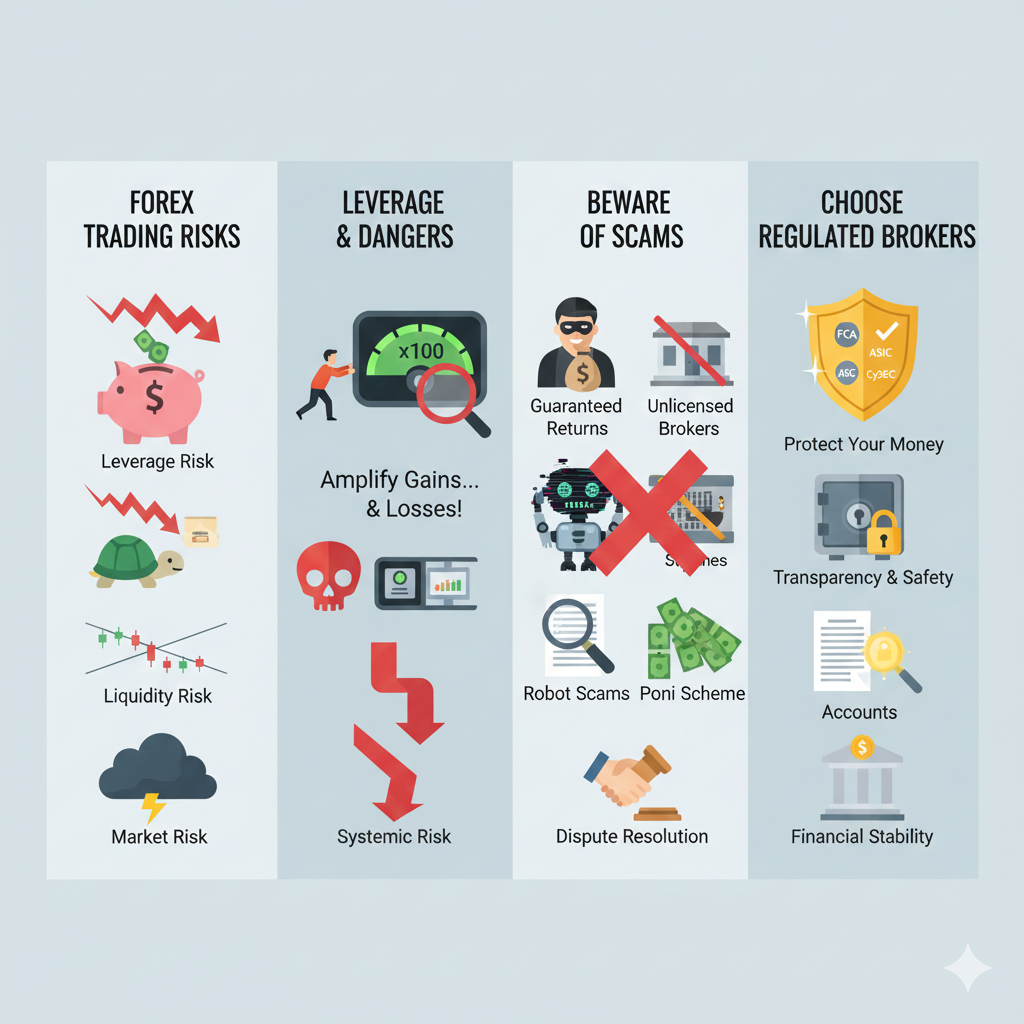
Trading runs 24 hours a day, attracts millions of traders worldwide, and offers the alluring possibility of substantial profits. But while the idea of making money by predicting currency movements sounds straightforward, the reality is far more complex. The U.S. Commodity Futures Trading Commission (CFTC) regularly warns individuals about the significant risks tied to forex trading, especially for retail traders.

This article explains those key risks in a clear, human-friendly manner, helping traders understand how to protect themselves, avoid scams, and make better-informed decisions. By the end, you’ll have a well-rounded understanding of what truly goes on in the forex market and what precautions you should take before risking your money.


Forex Trading Is Not Suitable for Everyone

One of the core messages from the CFTC is that forex trading is highly speculative and not appropriate for all investors. Unlike traditional investing—where you might buy stocks, bonds, or mutual funds—forex trading involves predicting short-term movements in currency pairs. Even small price changes can lead to major gains or losses because forex trading often uses leverage.

New traders often underestimate how volatile currency markets can be. While leverage can magnify profits, it can also amplify losses just as quickly. Many retail traders end up losing more money than they initially invest, especially when using high leverage without proper risk management.

It’s important to assess your financial condition, risk tolerance, and trading knowledge before diving into forex. Simply put: If you cannot afford to lose the money you plan to trade, you should not be trading forex in the first place.


Beware of Fraudulent Forex Firms and Individuals

The CFTC stresses that forex-related fraud has grown significantly over the years. Scammers often target inexperienced traders with promises of guaranteed profits, risk-free trading, or proprietary trading systems that allegedly produce high returns.

Common red flags include:

  • Firms promising unusually high returns with no losses
  • “Traders” claiming they can double or triple money quickly
  • Pressure to deposit funds immediately
  • Unregulated brokers operating from offshore locations
  • No transparency regarding trading platforms or fees
  • “Managed accounts” where you hand over money to someone who trades for you

Fraudsters frequently use social media ads, WhatsApp groups, Telegram channels, and flashy websites to lure victims. The CFTC emphasizes verifying whether a broker is registered before depositing funds. In the United States, forex dealers must register with the CFTC and be members of the National Futures Association (NFA).

A quick search in the NFA BASIC database can help confirm whether the firm or individual is legitimate. If the broker is not registered, that’s a major warning sign.


Understand How Leverage Works

Leverage is one of the biggest attractions—and biggest dangers—of forex trading. For example, with 50:1 leverage, a $1,000 deposit allows you to control a $50,000 position in the market.

But this magnification cuts both ways.

A currency pair moving just 1% against you can wipe out your entire balance under high leverage conditions. Many traders lose money not because the market is unfair, but because they underestimate how fast losses can accumulate.

Professional traders usually use much lower leverage and strict risk management rules. Retail traders, however, often get seduced by the possibility of turning small amounts of money into large profits quickly—only to blow up their accounts.

Before trading, it’s crucial to:

  • Use low leverage
  • Set stop-loss levels
  • Never risk more than you can afford to lose
  • Avoid emotional or impulsive trading

Leverage can be a useful tool, but misused leverage is one of the main reasons retail traders lose money.


Forex Trading Has Significant Costs and Complex Terms

Another major point in the CFTC advisory is that forex trading comes with several costs and conditions traders often overlook.

These include:

  • Spreads: The difference between the buying (ask) and selling (bid) price.
  • Commissions: Some brokers charge fees per trade.
  • Overnight financing fees: Holding positions overnight may incur extra charges.
  • Margin calls: If your balance falls below the required margin, the broker may close your positions automatically.

Many traders jump into forex without understanding these details, only to find their profits reduced or losses increased by fees they didn’t account for.

Moreover, forex trading involves complex terminology—like pips, lots, margin, rollover rates, and liquidity—that traders must grasp to navigate the market safely. Failing to understand these may cause confusion and poor decision-making.


Regulation Matters—Choose Only Registered Forex Dealers

The CFTC emphasizes that choosing a regulated broker is one of the most important decisions a trader can make. Regulation ensures that the firm follows specific financial standards, maintains separate accounts for client funds, and adheres to ethical practices.

In the U.S., legitimate forex dealers must register with:

  • CFTC (Commodity Futures Trading Commission)
  • NFA (National Futures Association)

These organizations monitor brokers, enforce rules, and provide channels for dispute resolution in case something goes wrong.

Unregulated or offshore brokers may offer high leverage, bonuses, or attractive trading conditions, but they come with significant risk. If such a broker shuts down suddenly or refuses to process withdrawals, recovering your money becomes nearly impossible.

Always verify a broker’s registration status before trading. It’s your first line of defense against fraud.


Know the Warning Signs and Protect Yourself

The CFTC urges traders to stay alert and protect themselves from unnecessary risks and scams. Some of the most important protective measures include:

  • Checking broker registration on NFA BASIC
  • Reading all terms and agreements carefully
  • Understanding the broker’s fee structure
  • Testing the platform through a demo account
  • Avoiding “too good to be true” promises
  • Being cautious with individuals offering trading signals or account management
  • Never giving remote access to your devices
  • Keeping personal and banking information safe

Forex trading requires education, discipline, and skepticism. Being prepared and vigilant goes a long way in preventing losses.


Final Thoughts

Forex trading can be an exciting way to participate in global financial markets, but it is also full of risks. The CFTC’s advisory reminds traders that success requires deep understanding, careful research, and realistic expectations.

Whether you’re just exploring forex or already trading, the most important principles remain the same: stay informed, remain cautious, use regulated brokers, and never risk more money than you can afford to lose. When approached responsibly, forex trading can be an educational and potentially rewarding experience—but only when done with proper knowledge and risk management.
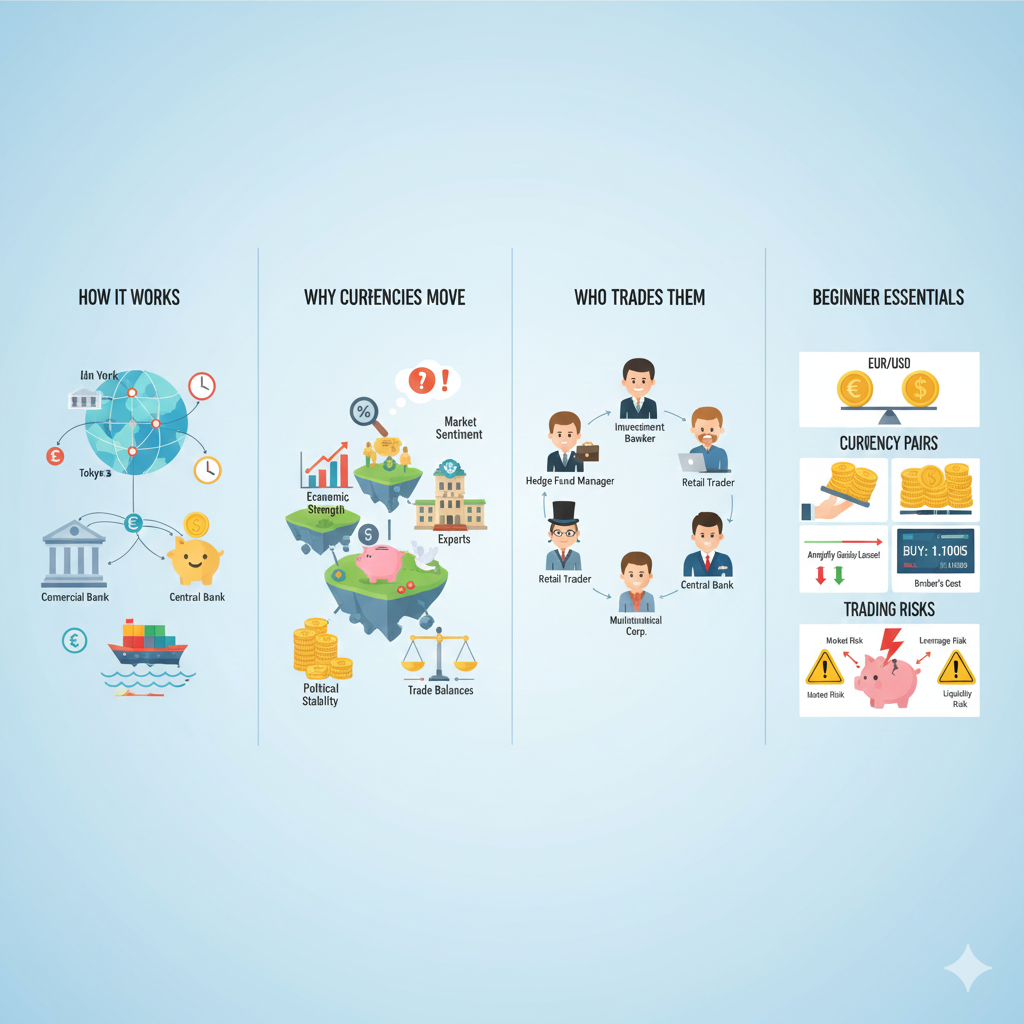

A Beginner’s Guide to What Forex Is and How It Really Works

Foreign exchange, or forex, is one of the most active and influential markets in the financial world. If you’ve ever traveled to another country, bought an imported product, or watched global financial news, you’ve already brushed against the forex market without even realizing it. Behind the scenes, currencies are constantly being exchanged, and these movements determine how much your money is worth in another country. For traders, forex also represents a massive opportunity to speculate, invest, and diversify.

This guide breaks down what forex is, how the market functions, who participates in it, and what beginners should understand before stepping in. Everything is explained in simple, human language so you can build a solid foundation.


What Exactly Is Forex?

At its core, forex is the process of converting one currency into another. It could be as simple as exchanging dollars for euros before a trip or as complex as a multinational corporation hedging millions of dollars to protect itself from fluctuations in exchange rates.

But forex trading is not limited to basic transactions. Most of the daily activity in this market—running into trillions of dollars—comes from traders who buy and sell currencies to profit from changes in price. They don’t want the actual currency in hand; they simply want to benefit from its rising or falling value.

With daily trading volumes exceeding every other financial market, forex is truly global. It has no central exchange and operates through a network of banks, institutions, and brokers spread across the world.


A Market That Never Sleeps

One of the reasons forex is so appealing is that it runs almost nonstop throughout the business week. Because trading passes from one major financial hub to another—Tokyo, London, New York, Sydney—the market remains open 24 hours a day from Monday to Friday.

This constant availability benefits traders in several ways:

  • You can trade at a time that suits your lifestyle.
  • News events from different regions can create opportunities around the clock.
  • Market gaps are less common than in stock trading because prices continuously update.

For people with busy work schedules, forex offers flexibility that many other markets don’t.


Who Actually Trades in the Forex Market?

Beginners sometimes assume forex is only for banks or large companies, but the market is filled with a wide variety of participants:

1. Major Banks

Large international banks form the core of the forex market. They handle huge volumes on behalf of clients and for their own trading desks. Their transactions help determine the real market price at any given moment.

2. Corporations

Multinational companies that do business globally need to convert currencies regularly. For example, a tech company earning in euros but paying suppliers in yen must constantly manage exchange rates.

3. Central Banks

National central banks influence their own currency through monetary policy. Interest rate decisions or direct interventions can cause major currency movements.

4. Hedge Funds and Financial Institutions

These players often trade forex to speculate or balance their portfolios, taking advantage of market volatility.

5. Retail Traders

Thanks to online brokers and trading platforms, individual traders like you now participate in the forex market with ease. Even though retail traders make up a small portion of total volume, they are active and influential in certain trading sessions.

Altogether, these participants create one of the most liquid, active, and competitive markets worldwide.


Currency Pairs: The Building Blocks of Forex Trading

Unlike stocks, which you buy individually, forex transactions always involve two currencies. These are called currency pairs. Each pair consists of:

  • Quote currency – the second currency

For example, in the pair EUR/USD:

  • EUR is the base currency
  • USD is the quote currency

If you buy EUR/USD, you’re buying euros while simultaneously selling dollars. If you sell the pair, you’re doing the opposite.

The price displayed represents how much of the quote currency is needed to buy one unit of the base currency. So if EUR/USD is 1.09, it means one euro equals 1.09 US dollars.

Understanding pairs is essential because forex trading is always about comparison—how one currency performs relative to another.


How Do You Actually Trade Forex?

Trading forex involves predicting whether a currency pair will rise or fall. To participate, traders generally use online platforms that provide real-time charts, analysis tools, and order execution.

Here are the key concepts beginners should understand:

1. The Spread

It serves as the main cost of trading. Lower spreads are cheaper and generally better for traders.

2. Margin

Margin is the deposit you need to open and maintain a leveraged position. You don’t pay for the full value of your trade upfront; instead, you put down a small percentage as collateral.

3. Leverage

Leverage allows you to control a large trade size with a relatively small amount of capital. For example, leverage of 1:30 lets you trade $30,000 with just $1,000 in your account.

While leverage can multiply your potential profits, it also increases your losses at the same rate. This is why understanding risk is essential for new traders.


What Makes Currencies Move?

Currency prices are influenced by a combination of economic, political, and market factors. Some of the most important include:

Interest Rates

One of the biggest drivers in forex. Higher interest rates tend to strengthen a currency because they attract foreign investment.

Economic Indicators

Reports like GDP, inflation data, unemployment figures, and manufacturing indices can all cause currency values to rise or fall.

Political Events

Elections, geopolitical tensions, trade agreements, and unexpected announcements can have immediate market impact.

Market Sentiment

Sometimes traders react based on expectations rather than facts. Speculation plays a major role in daily price movements.

The constant flow of news and data is what makes forex exciting but also unpredictable.


The Opportunities and Risks of Forex Trading

Forex offers exceptional liquidity, meaning you can enter and exit trades quickly. The market’s size and volatility create frequent opportunities for profit.

But trading also comes with risks:

  • High volatility can cause rapid price swings.
  • Leverage magnifies both gains and losses.
  • Slippage increases costs during fast-moving markets.

Because of this, risk management tools such as stop-loss orders, limit orders, and careful position sizing are essential. Successful traders focus as much on managing risk as finding opportunities.


Final Thoughts

Forex is a fascinating market that connects every corner of the global economy. Understanding how it works—what drives price movements, how pairs are structured, what trading costs look like, and who participates—gives you a clear foundation for exploring trading with confidence.

For beginners, starting with education, practice accounts, and disciplined strategies is the smart path. With time, patience, and experience, you can decide whether forex trading fits your financial goals.

A Complete Beginner’s Guide to Understanding Forex Trading

Foreign exchange, or forex, is one of the most dynamic financial markets in the world. Every day, trillions of dollars move across global currencies as traders, institutions, and governments buy and sell different forms of money. For beginners, this market can look intimidating—charts move fast, currencies react sharply to economic events, and the terminology often feels unfamiliar. But once you break it down, the mechanics of forex are straightforward, and the market becomes easier to approach.

This article explains the basics of forex trading in a human, beginner-friendly style—covering what the market is, how currency pairs work, how trading actually happens, what drives currency movements, and how new traders can practice without risking money.


What Makes the Forex Market Unique?

The foreign exchange market is the largest financial marketplace on Earth. On an average day, about $6 trillion changes hands. That number alone shows how enormous the market is compared to stocks, commodities, or bonds. Forex exists primarily to facilitate global business—companies need to convert currencies for imports, exports, travel, and international investments. But over time, individual traders have also become active participants.

Another defining feature of forex is that it operates 24 hours a day during the trading week. Because financial centers from Tokyo to London to New York open at different times, there’s almost always a market open somewhere. Unlike stock markets that open and close at specific hours, forex continues rolling throughout the day, creating constant opportunities and movement.

This around-the-clock nature gives traders enormous flexibility. Whether you’re someone who likes trading early morning in Asia, mid-day in Europe, or late evening in America, you can find active market hours that suit your schedule.


Understanding Currency Pairs: The Heart of Forex

Forex trading always involves two currencies, not one. That’s because you’re comparing the value of one currency to another. When you buy a pair, you are buying the first currency and selling the second. When you sell the pair, you’re doing the opposite.

For example, consider the currency pair EUR/USD. If EUR/USD is quoted at 1.10, it means 1 euro is worth 1.10 US dollars.

This paired system is simple but powerful. It helps you understand that forex is always relative—one currency rising often means the other is falling. It’s like a seesaw where the balance constantly shifts based on economic news, interest rates, and global sentiment.


Different Ways You Can Trade Forex

There isn’t just one marketplace for trading currencies. Beginners should understand the two main methods:

1. Forex Futures

Since they’re regulated, traders get more transparency and strict oversight. However, futures require more capital and are often used by more experienced traders, corporations, or institutions.

2. Spot Forex (Through Retail Brokers)

Most new traders participate in the over-the-counter spot forex market through retail brokers. These brokers act as a bridge between individual traders and the massive institutional “interbank” network where currencies are exchanged in large volumes.

Retail forex platforms offer:

  • Small capital requirements
  • Flexible trade sizes
  • Access to major, minor, and exotic currency pairs
  • High leverage (varies by region and regulations)

For beginners, spot forex is easier to access and understand. Modern platforms also provide sophisticated charts, indicators, and tools that help traders learn the market step-by-step.


Why Do Currency Prices Move?

One of the most important concepts in forex is understanding why prices change. Unlike stocks, which often react to the performance of individual companies, currency movements reflect the bigger picture—an entire nation’s economy.

Here are some of the key factors driving currency fluctuations:

1. Interest Rates

Currencies tend to rise when a country’s central bank increases interest rates and fall when rates are cut. Higher rates attract foreign capital, boosting demand for that currency.

2. Inflation

If inflation rises rapidly, the currency may weaken because its purchasing power declines. Central bank policies around inflation also influence currency values.

3. Economic Growth

Strong GDP growth, rising employment, and healthy business activity generally support a stronger currency. Economic weakness usually does the opposite.

4. Political and Global Events

Markets react strongly to unexpected events—elections, geopolitical tensions, trade agreements, natural disasters, and major policy shifts. A good example is the sharp drop in the British pound following the Brexit referendum, which was driven by uncertainty over future economic conditions.

5. Market Expectations

Forex is not only about what happens today—it’s about what traders believe will happen in the future. Often, currencies move because of speculation based on upcoming data, speeches, or policy announcements.

Since every trade involves two currencies, understanding how both countries are performing is essential. A strong economy in one nation doesn’t guarantee its currency will rise if the other country is doing even better.


The Role of Overnight Interest (Carry) in Forex

Forex has a unique feature called the net financing rate, often referred to as the “carry.” When you hold a position overnight, you effectively pay interest on the currency you’re selling and earn interest on the currency you’re buying.

Here’s why:

If you’re long (buying) a currency with a higher interest rate and short (selling) a lower-rate currency, you may earn interest. But if the situation is reversed, you may pay interest.

These small daily interest adjustments can add up over time. For some advanced traders, this “carry trade” becomes a strategy itself—seeking positive interest differentials while also expecting price appreciation.


Why Beginners Should Start with Simulated Trading

Before committing real money, it’s wise for beginners to practice using a demo account or simulated trading platform. Many brokers offer virtual accounts that mimic real market conditions but use fake money.

Practicing in a simulated environment helps you:

  • Learn how to place trades
  • Understand how currency pairs react to news
  • Experiment with strategies
  • Build confidence without financial risk

Platforms such as paper trading tools allow new traders to develop skills and test ideas in a safe environment. It’s like learning to drive in an empty parking lot before hitting the highway.


Final Thoughts

Forex trading offers endless opportunities, but it also requires patience, discipline, and continuous learning. Understanding the basics—how currency pairs work, what moves the market, how trading is executed, and why interest rates matter—gives beginners a strong foundation. With the help of a simulated trading platform, new traders can explore the market safely, build experience, and gradually move toward real trading once they’re ready.

By starting slow, learning steadily, and staying disciplined, anyone can build a solid understanding of the forex market and decide whether it fits their trading goals.

Is Your Personality Affecting Your Trading?

When most people start trading, they focus heavily on strategy. They search for the right indicators, study chart patterns, and look for the perfect entry and exit rules. But very few traders pause to examine something far more important — their own personality. The truth is, your personality plays a huge role in how you behave in the market. It shapes your decisions, influences your risk appetite, and determines how well you handle pressure, losses, and sudden opportunities.

Understanding your personality is one of the most underrated steps toward becoming a better trader. You could have a solid strategy, a well-designed plan, and good market knowledge, but if your personality pushes you into emotional decisions, all of that can go to waste. The more you understand who you are, the better you can adjust your trading style to fit your natural tendencies.

Your Personality Influences Your Trading More Than You Realize

Trading is essentially decision-making under uncertainty. Every buy or sell order reflects not just your analysis but also your personal traits — your patience, your discipline, your confidence, your emotional stability, and even your tolerance for risk. If someone is naturally impulsive, they may enter trades too quickly. A cautious person might hesitate and miss opportunities. Someone who hates being wrong may hold losing trades longer than necessary because closing them feels like admitting defeat.

These natural tendencies do not disappear just because you’re trading. They show up in your habits, your mistakes, and your reactions. The best traders are not those who try to change their entire personality, but those who learn how to manage it.

Discipline: The Backbone of Successful Trading

Discipline is a trait every trader hears about, yet very few fully master. In trading, discipline means more than just staying calm — it’s the ability to stick to your strategy even when emotions try to pull you in another direction.

A disciplined trader:

  • follows their trading plan without improvising
  • exits losing trades when the stop loss is hit
  • avoids chasing the market
  • resists the urge to overtrade
  • takes profits according to plan instead of greed

Without discipline, even the best strategy becomes ineffective. Imagine a trader who has a well-tested system but cannot resist closing trades early whenever the market moves slightly against them. Or someone who increases position size after a win because they feel unstoppable. Lack of discipline leads to inconsistent behavior, and inconsistent behavior leads to inconsistent results.

The good news is discipline can be trained. It’s built through practice, self-control, and regular reflection. But first, you must understand whether discipline comes naturally to you or whether it’s something you struggle with.

Confidence: Helpful in Moderation, Dangerous in Excess

Confidence is a powerful trait in trading — without it, you wouldn’t have the courage to take a position or stay in a trade long enough to let it grow. A confident trader trusts their strategy, executes without fear, and recovers from losses more easily.

But like many personality traits, confidence has a dark side. Overconfidence makes traders believe they know more than the market. It causes them to take oversized positions, ignore warning signs, or trade impulsively because they believe they’re “on a streak.” Overconfidence is one of the fastest paths to big losses.

On the other hand, lack of confidence has its own problems. Traders who doubt themselves hesitate too long, exit too early, or avoid taking good opportunities. They rely too heavily on others’ opinions and struggle to trust their analysis.

The key is finding the balance. Confidence should support your trading — not blind you or paralyze you.

Rational Thinking vs Emotional Trading

One of the biggest challenges in trading is staying rational when money is involved. Humans naturally react emotionally to gains and losses. Fear, excitement, frustration, and hope can easily hijack your decision-making.

Rational thinking means:

  • making decisions based on facts and analysis
  • planning for the possibility of losses
  • avoiding emotional impulses
  • sticking to your strategy during volatility
  • focusing on probability rather than outcome

For example, a rational trader might close a losing position as planned, while an emotional trader might move the stop loss further away hoping the market will reverse. Rational thinking protects you from unnecessary risk, while emotional decisions often magnify losses.

The ability to remain logical varies from person to person. Some people naturally stay calm under pressure, while others react strongly to uncertainty or money-related stress. Knowing your tendencies helps you adjust your trading style accordingly.

Why Practicing on Demo or Through Backtesting Helps

One of the most effective ways to manage your personality in trading is to practice in an environment where emotions are minimized. This is where demo trading and backtesting become extremely valuable.

A demo account lets you experience market conditions without the pressure of real money. You can:

  • test how well you follow a strategy
  • understand your emotional reactions
  • practice discipline
  • refine your entries and exits
  • build confidence in your system

Backtesting also helps by showing how a strategy performs in different conditions. Reviewing historical results builds trust in the system, making it easier to follow during real trading.

Practicing without financial stress helps reveal which personality traits are helping and which are hurting. It provides a safe space to correct mistakes before they become costly.

Personality Traits Can Be Managed and Improved

The most encouraging part of the article is that your personality does not have to limit your success in trading. Once you understand your natural tendencies, you can take steps to manage them.

Here are some ways traders can work on their personality-driven habits:

  • Write a detailed trading plan so you don’t rely on emotion.
  • Use strict risk management to prevent fear or overconfidence.
  • Journal trades to identify recurring emotional mistakes.
  • Set realistic goals to avoid frustration or unreasonable expectations.
  • Take breaks during stressful periods instead of forcing trades.
  • Reflect regularly on what went right and what went wrong.

Each of these practices helps build emotional resilience and self-awareness.

Final Thoughts

Your personality is not separate from your trading — it is at the center of it. The way you think, react, decide, and handle pressure directly influences every trade you make. Instead of fighting your personality or ignoring it, the smarter approach is to understand it and build your trading habits around who you are.

The more aware you are of your strengths and weaknesses, the better you’ll become at managing emotions, controlling impulses, and staying consistent. Success in trading is not just about strategies or charts — it’s about the trader behind them. By learning to work with your personality instead of against it, you give yourself one of the most powerful advantages in the market.

Building a Trading System That Truly Matches Your Personality (1100-word Human Rewrite)

One of the biggest misconceptions in trading is the belief that success depends on finding the perfect indicator or stumbling upon a secret strategy that consistently beats the markets. Many new traders jump from system to system, feeling certain that the next one will finally deliver reliable profits. But the reality is very different: the best trading system is the one you can actually follow, and the only way to follow a system consistently is if it’s built to match your personality, your mindset, and your way of thinking.

This idea forms the heart of the discussion on building a trading system that fits who you are. It’s not just about charts or signals — it’s about psychology, discipline, self-awareness, and designing a trading approach that aligns with your strengths rather than works against them.

Discipline Matters More Than Indicators

It doesn’t take long for traders to realize that indicators alone do not create success. What truly matters is discipline — the discipline to follow rules, maintain a trading plan, manage risk properly, journal trades, and keep emotions under control.

Without discipline, even the most profitable system will fail you. You may exit too early, hold trades too long, or skip valid signals out of fear. But when discipline is strong, even an average system can perform well because it’s executed consistently. The author emphasizes that discipline should apply to everything: how you learn, how you test strategies, how you choose markets, how you manage risk, and how you review performance.

Your Personality Is Central to Your System

A major theme in the discussion is that trading is not one-size-fits-all. What works brilliantly for one trader may be disastrous for another. Each person brings different strengths, weaknesses, fears, and comfort levels.

For example, some traders are extremely patient and can hold long-term positions without stress. Others prefer fast-paced environments and enjoy trading intraday volatility. Similarly, some traders are comfortable with ambiguity and can make discretionary decisions based on chart patterns, while others feel safest with a rigid, mechanical approach that removes guesswork.

If your system goes against your natural tendencies, you will consistently struggle with following it. That’s why self-awareness becomes one of the most valuable trading tools. Knowing who you are allows you to design a system that you can actually execute during real-world trading conditions, especially when the market becomes stressful or unpredictable.

The Importance of a Detailed Trading Plan

A trading system cannot exist without a well-structured trading plan. A plan is more than a list of rules — it acts as a map that guides every decision you make. It defines not only how you enter trades but also why you trade in the first place.

A solid trading plan should include:

  • Your long-term and short-term goals
  • The markets you will trade (forex, commodities, stocks, etc.)
  • The timeframes that fit your schedule and personality
  • The risk management rules you will follow
  • The type of system you prefer (trend-following, breakout, mean reversion, etc.)
  • How often you expect signals
  • Your acceptable level of drawdown
  • How you will evaluate performance

Writing all this down gives clarity. It eliminates impulsive decisions and provides structure during moments of pressure.

Understanding System Properties and Performance Metrics

Once a trader starts developing or selecting a system, it becomes important to evaluate its statistical characteristics. These performance parameters show whether the system is realistic and reliable.

Some of the key factors include:

1. Profit Factor
The ratio of total profits to total losses. A higher profit factor typically means a stronger system, but it must be evaluated alongside risk.

2. Recovery Factor
This shows how well the system recovers from drawdowns. A system with a high recovery factor usually handles losses more gracefully.

3. Payoff Ratio
The average size of winners compared to losers. Some systems rely on high win rates with small wins, while others prefer larger wins with fewer signals.

4. Win Rate
The percentage of trades that are profitable. This must be understood in the context of reward-to-risk; a system with a low win rate can still be profitable if the payoff ratio is strong.

5. Drawdown Level
This indicates how much equity is typically lost during losing streaks. Traders struggle emotionally with drawdowns, so it’s essential to choose a system whose drawdowns you can psychologically tolerate.

Evaluating these properties helps traders understand whether the system’s expectations align with their emotional and financial tolerance.

Mechanical or Discretionary? Finding Your Style

Another key decision is choosing between:

  • A mechanical system, where rules are fixed and followed exactly
  • A discretionary system, where the trader interprets certain conditions

Neither is inherently better. What matters is which approach suits your personality.

A mechanical system may be ideal if you prefer structure, precision, and reduced emotional decision-making. Discretionary systems may fit traders who are comfortable analyzing charts, recognizing patterns, and making decisions based on context.

Some individuals enjoy blended systems — mechanical for entries, but discretionary for exits or trade management. The right choice reduces stress and increases consistency.

Self-Assessment: The Foundation of a Personalized System

Developing a trading system that fits your personality requires deep self-reflection. This includes analyzing:

  • Your emotional characteristics
  • Your ability to handle risk
  • Your beliefs about the market
  • Your strengths (patience, analytical ability, discipline)
  • Your weaknesses (impulsiveness, fear, perfectionism)
  • Your available time and lifestyle
  • Your tolerance for drawdowns, losses, or uncertainty

Honest self-assessment ensures that the system you build is realistic. It helps avoid the frustration of forcing yourself into a style that doesn’t feel natural.

For example, if you dislike holding trades overnight, a swing-trading system won’t suit you. If you become stressed by fast market movements, scalping might be the wrong fit. If you don’t enjoy watching charts all day, automated systems or higher timeframes may be better.

Building a System You Can Follow During Tough Times

Every trading system faces tough periods. Even a profitable one goes through drawdowns, losing streaks, and frustrating phases. If your system does not match your personality, you are more likely to abandon it during those difficult moments.

But when the system aligns with who you are, sticking to it becomes easier. You trust it. You understand its strengths and weaknesses. You trade it with confidence — not because it’s perfect, but because it feels right for you.

Final Thoughts

The ultimate message is simple: successful trading systems are personal. They are not copied, not blindly followed, and not found by chance. They are designed through self-awareness, discipline, and thoughtful planning. When you build a system that genuinely matches your personality, trading becomes more controlled, more confident, and far more consistent. Indicators and strategies matter — but the trader behind them matters even more.

Trading Psychology: Understanding the Emotions and Biases That Shape Your Trading Decisions (1100-Word Human Rewrite)

Trading in financial markets is often viewed as a numbers game. Charts, indicators, price patterns, and economic data dominate most discussions, giving the impression that trading success depends entirely on strategy and technical skill. But experienced traders know something extremely important: your mind can either be your greatest strength or your biggest weakness in the markets. No strategy can save you if your psychology is unstable, and no signal is reliable if the person using it is emotionally influenced. This is where the concept of trading psychology becomes essential.

Trading psychology refers to the emotional and mental framework that influences how traders behave. It includes everything from fear and greed to confidence, discipline, mindset, and emotional intelligence. Every decision — entering a trade, holding it, cutting it, or taking profit — is deeply affected by a trader’s emotional state. Understanding this hidden layer is one of the keys to long-term success in trading.

The Powerful Role of Emotions in Trading

The markets constantly trigger emotional reactions. Prices rise and fall rapidly. News events shake sentiment. Losses sting. Wins excite. Traders who cannot manage this emotional roller coaster often experience inconsistent results.

Fear and greed are the two emotions most commonly associated with trading, but they’re not the only ones. Stress, frustration, overconfidence, anger, and panic can also influence a trader’s ability to make sound decisions.

For example, fear often leads traders to close positions too early, even when the trade has room to grow. On the other hand, greed convinces them to hold on for too long, hoping for unrealistic gains. Overconfidence after a few wins may push someone to take oversized risks, just as frustration from losses might push them into revenge trading — taking impulsive trades in the hope of recovering quickly.

The biggest trap is believing you can completely avoid emotions. You can’t. What you can do is learn to understand and manage them so they don’t interfere with rational decision-making.

Behavioral Biases Every Trader Should Know

Trading psychology is not only about emotions; it’s also shaped by cognitive biases. These are mental shortcuts or patterns of thinking that influence how we interpret information. Most traders fall victim to these biases without even realizing it.

Here are some of the common ones:

1. Confirmation Bias
This happens when traders look only for information that supports their existing opinion. If someone believes a stock or currency pair will rise, they tend to ignore warnings or contradictory signals and focus only on positive news.

2. Loss Aversion
Humans feel the pain of loss more intensely than the pleasure of gains. Traders affected by loss aversion often hold losing trades far longer than they should, hoping the market will eventually turn in their favor. Cutting losses becomes psychologically difficult.

3. Anchoring Bias
Anchoring occurs when a trader becomes fixated on a particular price level or target. Even when conditions change, they keep holding on to that number, making decisions based on outdated or irrelevant information.

4. Recency Bias
Many traders get influenced by the most recent events instead of the bigger picture. A few winning trades might convince someone they are on a hot streak, while a sudden loss might make them overly fearful even when their strategy is working.

5. Overconfidence Bias
Dangerous but extremely common, overconfidence makes traders believe they are more skilled than they actually are. This often leads to excessive risk-taking and increased exposure.

Biases operate quietly in the background and distort perception. The problem is not that they exist — it’s that traders rarely realize when they’re controlling decisions.

How Biases and Emotions Impact Trading Results

When emotions and biases dominate decisions, trading becomes unpredictable. Even traders with strong strategies can fail because they struggle to follow their own rules.

Emotional and psychological challenges often lead to:

  • Closing winning trades too early because of fear
  • Holding losing trades too long due to hope or denial
  • Taking more trades than necessary
  • Trading larger positions after a winning streak
  • Exiting trades impulsively after a sudden move
  • Ignoring well-designed risk management rules

These behaviors destroy consistency. Markets reward discipline, not emotional reactions. The difference between a good trader and a struggling trader often comes down to psychological strength rather than superior strategies.

Strengthening Your Trading Psychology

Improving trading psychology is not about eliminating emotions; it’s about developing the mindset to recognize and manage them. Here are some of the most effective ways to build strong psychological discipline in trading:

1. Create and Follow a Trading Plan
A trading plan serves as a roadmap. It defines when to enter, exit, and manage risk. Following a plan removes much of the emotional uncertainty from trading and keeps impulsive decisions in check.

2. Use Strict Risk Management
Risk management is essentially emotional management. When you risk only a small percentage per trade, fear decreases dramatically. Knowing you cannot lose too much on a single trade gives you the confidence to follow your strategy without panic.

3. Trade Smaller to Reduce Pressure
Many psychological issues arise because traders risk more than they comfortably can. By reducing position size, decision-making becomes clearer and emotionally stable.

4. Keep a Trading Journal
A trading journal is one of the most powerful tools for improving mindset. It helps track not just entries and exits but also emotional states during trades. Over time, this helps identify patterns and weaknesses.

5. Develop Patience and Consistency
The best traders are patient. They wait for high-probability setups instead of forcing trades. Consistency creates confidence, and confidence reduces emotional volatility.

6. Review and Reflect Regularly
Regular reflection helps traders understand why things went wrong or right. It breaks the cycle of repeating psychological mistakes.

Trading Psychology and Behavioral Finance

Trading psychology aligns closely with the field of behavioral finance, which studies how people make financial decisions under pressure. This research confirms something traders have known for decades: humans are not always rational when money is involved. Market movements themselves often reflect collective emotions — fear-driven selloffs, euphoric rallies, and panic-driven volatility.

Understanding these psychological forces not only helps improve personal performance but also offers insights into broader market behavior.

Final Thoughts

Trading psychology is not a secondary skill — it is central to a trader’s success. Strategies, indicators, and tools matter, but they can only work when used with discipline, emotional control, and self-awareness. The market rewards traders who understand themselves as well as they understand price charts. Mastering your psychology takes time, but it is one of the most valuable investments you can make on your trading journey.

What Is a Dividend in the Stock Market? A Simple Guide With Examples


Dividend in the Stock Market

When you invest in the stock market, you earn money in two main ways—one is through the increase in share price, and the second is through dividends. Many new investors often hear the word “dividend” but don’t fully understand what it means. In simple terms, a dividend is a reward companies give to their shareholders from their profits. It is like saying “Thank you for investing in our company.”

This article explains dividends in an easy way, with examples, so you can clearly understand how they work and how they become a source of income.


What Exactly Is a Dividend?

A dividend is a portion of a company’s profit that is shared with people who own its shares. Not every company gives dividends, but most ** financially strong, stable, and profitable companies ** distribute dividends regularly. For example, companies like ITC, Infosys, HDFC Bank, TCS, and many others have a long history of paying dividends to their investors.

When a company earns profit, it has two options:

  1. Reinvest the profit back into the business (to expand).
  2. Share a part of that profit with shareholders in the form of dividends.

If a company chooses the second option, shareholders receive money directly in their bank accounts. This makes dividends a form of passive income.


Why Do Companies Pay Dividends?

You might wonder, “Why would a company give away its profit?”
There are several reasons:

1. To Reward Investors

Shareholders support the company by investing their money. Dividends are a way of showing appreciation.

2. To Build Trust

Regular dividend payments show that the company is financially healthy and stable.

3. To Attract Long-Term Investors

Many people prefer companies that give regular dividends. This brings stability to the stock price.

4. To Maintain Reputation

Companies that pay dividends for many years become known as “trustworthy and consistent,” which helps their brand.


Types of Dividends

There are mainly three types of dividends an investor should know:

1. Cash Dividend

This is the most common type.
Cash dividend means the company transfers money directly into your bank account.

2. Stock Dividend

Instead of giving cash, the company gives additional shares.
For example, if you receive a 10% stock dividend, you get 10 extra shares for every 100 shares you hold.

3. Special Dividend

This is a one-time big payout.
Companies give special dividends when they have extra profits or have sold an asset.


How Do You Receive Dividends?

To receive a dividend, you must own the share before the ex-dividend date. The company announces a few dates when it declares dividends:

Declaration Date

The day the company announces the dividend.

Ex-Dividend Date

You must buy the share before this date to be eligible.

Record Date

On this date, the company checks its list to see who should receive dividends.

Payout Date

The day dividend money is actually sent to your bank.

If you buy the share on or after the ex-dividend date, you will NOT get the dividend.


Example to Understand Dividend Income

Let’s understand with a very easy example.

Suppose you buy 100 shares of ITC Ltd.

Now the company announces a dividend of ₹10 per share.

So your dividend income will be:

100 shares × ₹10 = ₹1,000

This ₹1,000 will credit directly to your bank account on the payout date.

This means you earned income without selling your shares. You still own the 100 shares, and they can also grow in value in the future.

That is why dividends are considered extra income + long-term wealth creation.


Why Are Dividends Important for Investors?

Many smart investors prefer stocks that pay regular dividends. Here’s why:

1. Regular Income (Passive Income)

You earn money every year or every few months without doing anything.

2. Helps in Financial Stability

Even if the market falls, dividend-paying companies usually remain strong.

3. Long-Term Wealth Creation

If you reinvest your dividends, your wealth grows much faster (this is called compounding).

4. Lower Risk

Companies that pay dividends are usually profitable and stable.


Do All Companies Give Dividends?

No. Many growing companies do not give dividends because they prefer to reinvest profits to expand their business fast.
For example, young tech startups or newly listed companies focus on growth instead of dividends.

This doesn’t mean they are bad investments. It simply means their priority is expansion rather than cash rewards.

On the other hand, mature companies with steady cash flow regularly give dividends.


Dividend Yield — Another Important Concept

Dividend yield tells you how much return you are getting from the dividend compared to the share price.

Dividend Yield = (Dividend per Share ÷ Share Price) × 100

Example:
Dividend per share = ₹20
Share price = ₹400

Dividend Yield = (20 ÷ 400) × 100 = 5%

This means you earn 5% annual return in the form of dividends alone.


Final Thoughts

Dividends are one of the simplest and most reliable ways to earn income from the stock market. They reward investors for staying invested and offer steady cash flow along with long-term wealth creation. Even if you are a beginner, understanding dividends can help you choose better companies for stable income.

Just tell me!

Ashish Kacholia’s Portfolio: A Detailed 1100-Word Human-Written Analysis

Ashish Kacholia, often referred to as the “Big Whale of Midcaps,” has long held a reputation for identifying high-potential companies before they catch mainstream attention. Known for finding multibaggers in niche sectors—ranging from manufacturing and chemicals to engineering and speciality businesses—Kacholia’s portfolio is followed closely by retail investors, analysts, and fund managers. His ability to consistently spot under-the-radar opportunities makes each quarterly portfolio change worth studying.

The latest disclosures from Trendlyne and financial research platforms highlight several important updates: new additions, stake increases, strategic reductions, and changes driven by market conditions. Together, these moves offer valuable insights into Kacholia’s current priorities and market outlook.

Portfolio Value Rises Despite Market Volatility

In the most recent update, Kacholia’s disclosed portfolio witnessed a 4.7% increase in value, bringing his net worth to nearly ₹2,854.64 crore. This rise comes during a period marked by uneven performance in mid-cap and small-cap stocks—segments Kacholia is heavily invested in.

A portfolio uptick in such conditions points to strong selection within his holdings. Many of his companies operate in sectors with improving fundamentals or in industries benefiting from long-term structural growth such as manufacturing, infrastructure, defence engineering, and speciality chemicals. This resilience reflects Kacholia’s trademark approach: backing fundamentally strong businesses capable of growing through market cycles.

Fresh Buy: Significant Increase in Man Industries

One of the key highlights this quarter is his fresh and sizeable increase in Man Industries, where he raised his stake by 1.01%. Man Industries operates in the steel pipe manufacturing space and supplies to sectors like oil & gas, water infrastructure, and utilities.

The company has seen steady order inflows and improving business visibility, especially with the government focusing on expanding pipeline networks and strengthening national infrastructure. By increasing his position, Kacholia appears to be betting on rising demand for steel pipes, long-term infrastructure spending, and the company’s improving margins.

Such a decisive purchase suggests he sees significant value ahead. Kacholia often makes large moves when he identifies strong earnings visibility or a sectoral tailwind—this addition mirrors that pattern.

Trimming Exposure in Dhabriya Polywood

On the sell side, Kacholia trimmed his holdings in Dhabriya Polywood Ltd., cutting his position by about 0.88%. Dhabriya Polywood, which manufactures PVC and WPC-based building materials, has witnessed volatility due to fluctuating raw material prices and demand pressures in the real estate supply chain.

The reduction appears strategic rather than a complete shift away from the company. Kacholia typically trims positions to rebalance weightages, control risk, or redirect capital toward higher-conviction opportunities. Given that he has not exited the company entirely, it suggests he still sees potential but prefers a reduced exposure given market conditions.

Aggressive Buying During the March Quarter Selloff

A standout aspect of his recent behaviour is his willingness to buy aggressively during market corrections. During the March-quarter selloff—a period when broader markets dipped and small caps faced pressure—Ashish Kacholia added nine new companies to his portfolio.

The new additions included:

  • DU Digital Global
  • Infinium Pharmachem
  • C2C Advanced Systems
  • BEW Engineering
  • and several others across manufacturing, technology, and industrial services.

This aggressive buying reflects a classic Kacholia trait: using periods of panic to accumulate fundamentally solid companies at favourable valuations. Unlike investors who wait for clearer trends, Kacholia often steps in early when prices are depressed but business fundamentals remain strong.

His selection during the selloff also shows his preference for smaller companies with scalable business models. Most of these names operate in industries benefiting from long-term structural growth such as digital services, pharmaceutical intermediates, and precision engineering.

Increasing Stakes in Existing High-Conviction Stocks

Along with nine fresh additions, Kacholia also increased his holdings in five of his existing companies during the same downturn. This signals two key aspects of his strategy:

  1. High conviction during volatility — He does not hesitate to add more to quality companies even when markets are falling.
  2. Long-term focus — Temporary declines do not deter him from strengthening positions in fundamentally strong businesses.

For Kacholia, market dips are not periods of fear but opportunities to deepen exposure to his best ideas. This is a hallmark of many successful investors.

Portfolio Reshuffle in the September 2025 Quarter

In another important update, Kacholia reshuffled his ₹2,675 crore portfolio during the September 2025 quarter. This reshuffle included both new entries and stake reductions.

He added four new companies, signalling new strategic bets:

  • V-Marc India
  • Pratham EPC Projects
  • Jain Resource Recycling
  • Vasa Denticity

These companies operate in diverse sectors such as electrical cables, EPC contracting, recycling solutions, and dental consumables. The combination shows Kacholia’s ability to diversify across industries while still maintaining a focus on niche, rapidly expanding business models.

At the same time, he trimmed his stakes in:

  • Xpro India
  • Brand Concepts
  • Dhabriya Polywood

The reductions suggest careful rebalancing and profit booking after significant past gains, especially in companies that saw rapid appreciation. Kacholia often fine-tunes his portfolio to maintain an optimal mix between growth potential and valuation comfort.

What the Latest Moves Reveal About His Strategy

When viewed together, Kacholia’s recent activities reveal several important aspects of his investment philosophy:

1. Continued preference for mid-caps and small caps
He remains focused on companies that have large addressable markets and room for multi-year compounding.

2. Aggressive buying during corrections
Market panic does not deter him; he uses downturns to accumulate promising stocks cheaply.

3. Strategic trimming but not abrupt exits
Reductions in holdings like Dhabriya Polywood are calculated and based on valuation or rotation needs rather than sudden loss of conviction.

4. Sectoral diversification
New additions span manufacturing, engineering, recycling, digital, financial services, and speciality chemicals.

5. Focus on long-term structural themes
Most additions are aligned with India’s broader growth story—manufacturing expansion, digital adoption, infrastructure spending, and supply-chain modernisation.

Conclusion

Ashish Kacholia’s latest portfolio activities reflect his dynamic and research-driven style. Whether it’s adding high-potential new companies, increasing stakes in existing winners, or trimming overvalued positions, each move is methodical and conviction-led. His portfolio’s rise to nearly ₹2,854 crore demonstrates not just market recovery but the strength of his carefully chosen holdings.

By adding companies across multiple sectors, boosting exposure during downturns, and resetting weights where required, Kacholia showcases a disciplined approach to long-term investing. His portfolio remains a masterclass in identifying niche opportunities poised for growth in the Indian economy.

Ashish Dhawan’s Latest Portfolio Update: A Detailed 1100-Word Human-Written Analysis

Ashish Dhawan, one of India’s most respected and intellectually driven investors, continues to be closely tracked by market watchers who look to his portfolio for signals about emerging opportunities in the Indian equity landscape. Known for his long-term thinking, deep research, and ability to identify scalable businesses early, Dhawan’s investment decisions often reflect a balance of conviction, caution, and strategic diversification.

The founder of ChrysCapital and a leading philanthropist, Dhawan has long been admired for his sharp understanding of business cycles and structural trends. His portfolio evolves steadily over time, shaped by a mix of high-conviction bets and tactical adjustments. The latest Trendlyne data shows several interesting movements—both in terms of new entries and stake changes—that provide insight into his current market outlook.

A Decline in Portfolio Value but Not in Confidence

One of the biggest highlights from the latest disclosure is a 16% decline in Dhawan’s portfolio value, which currently stands at approximately ₹2,799 crore. Markets over recent quarters have seen volatility across sectors like pharmaceuticals, financial services, and selected mid-cap segments, all of which form a meaningful part of Dhawan’s exposure.

However, seasoned investors like Dhawan often treat market dips as opportunities to consolidate their holdings or add new picks at attractive valuations. Therefore, while the headline figure may appear concerning, it is essential to understand that such temporary drawdowns are common in long-term portfolio strategies. More importantly, a later quarter shows his net worth rising again, proving the resilience of his holdings.

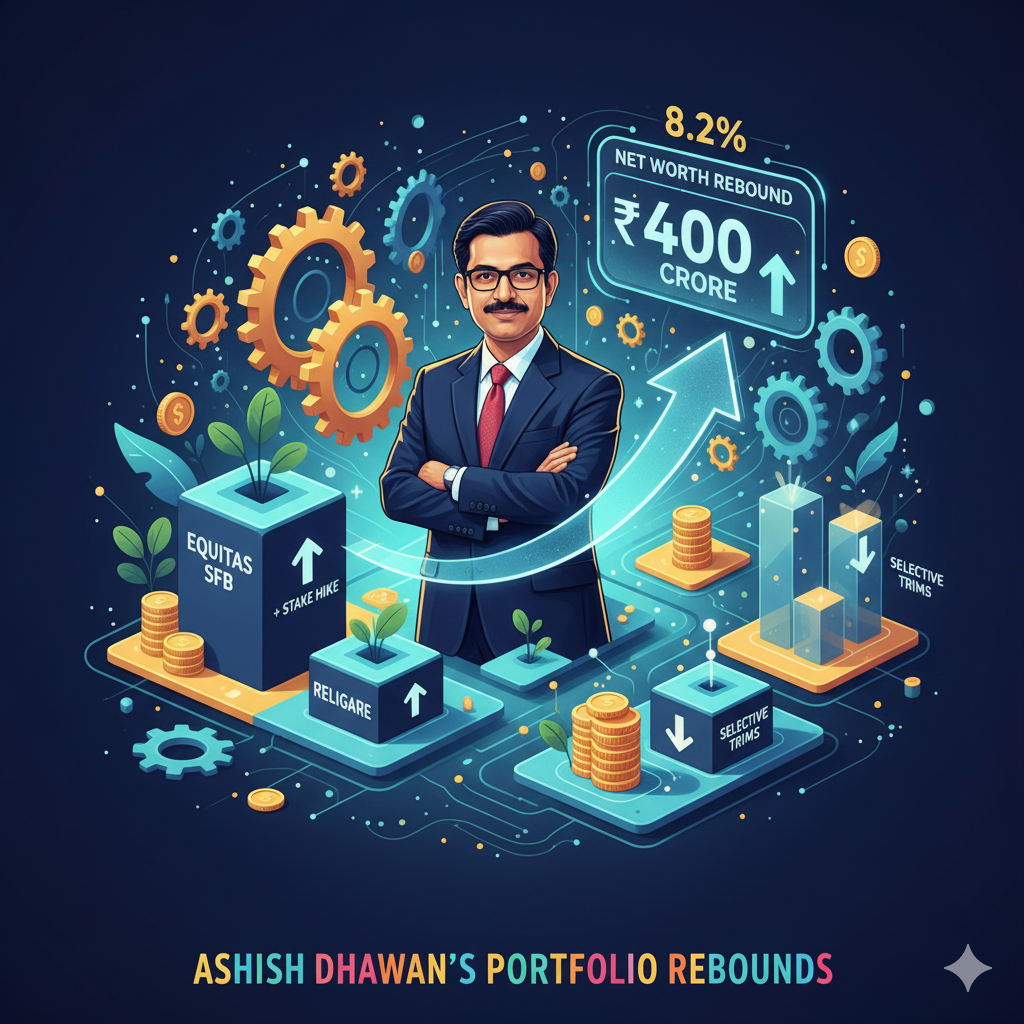
In fact, in Q2 2025, Dhawan’s portfolio rebounded by 8.2%, pushing his net worth back up to around ₹3,281.96 crore. This recovery reflects improved performance in some of his major stocks, better macroeconomic sentiment, and a bounce-back in mid-cap names.

Increasing Stake in Equitas Small Finance Bank

One of the notable moves in his latest activity is his decision to increase his stake in Equitas Small Finance Bank (SFB) by around 0.11%.

Equitas SFB has shown strong financial growth over the last few years, driven by expansion into microfinance, vehicle loans, and small businesses. The bank has improved its asset quality, widened its lending base, and increased deposit mobilisation. Dhawan’s increased investment indicates confidence in the bank’s future performance, especially at a time when India’s credit cycle is strengthening and small finance banks are widening their presence in underserved markets.

Investors like Dhawan typically increase stakes when valuations are attractive and the long-term growth trajectory appears promising. The incremental buy suggests that Equitas SFB remains a high-conviction financial sector pick for him.

Reducing Exposure to Glenmark Pharmaceuticals

While he added to Equitas SFB, Dhawan also trimmed his stake in Glenmark Pharmaceuticals, reducing his exposure by about 0.53%.

The pharmaceutical sector has faced challenges including pricing pressure in global markets, regulatory headwinds, and slower-than-expected recovery in the generics space. Glenmark, despite its strong research focus and product pipeline, has not been immune to these issues.

A reduction in stake does not necessarily imply that Dhawan has lost confidence in the company. Rather, it may reflect portfolio rebalancing, profit booking, or a shift of funds toward sectors with better near-term prospects. This approach aligns with Dhawan’s investing style—consistent monitoring and recalibration based on business conditions.

Four New Companies Added to His Portfolio

A major highlight of the June 2025 quarter was Dhawan’s addition of four new companies, signalling his interest in emerging opportunities across sectors. The new entries are:

  • RPSG Ventures
  • Northern ARC Capital
  • Digitide Solutions
  • Bluspring Enterprises

Together, these new holdings represent investments exceeding ₹400 crore—a sizeable addition and a clear indication of his strategic expansion.

RPSG Ventures reflects interest in diversified business models with exposure to fast-growing consumer and service segments.
Northern ARC Capital, focused on structured finance and lending to under-served segments, aligns with Dhawan’s keen understanding of financial inclusion and credit markets.
Digitide Solutions and Bluspring Enterprises are part of India’s rapidly evolving technology and digital transformation space.

By adding these companies, Dhawan is broadening his participation in both traditional and new-age business models. This move also highlights his willingness to explore high-potential early-stage listed opportunities—something he has successfully done throughout his career.

Increasing Stakes in Existing Favourites

Apart from new additions, Dhawan also increased his positions in some of his existing holdings, particularly in Religare Enterprises and Equitas SFB. The combined value of these increased stakes is estimated to be over ₹15 crore.

Religare Enterprises has been undergoing a multi-year turnaround, strengthening its financial services ecosystem and improving governance standards. With new management at the helm and improving performance in its health insurance and lending subsidiaries, the company appears to be on a revitalisation path. Dhawan’s increased investment signals continued belief in the company’s structural revival.

Meanwhile, adding more to Equitas SFB further consolidates his conviction in India’s financial inclusion story—one of the key long-term themes driving lending growth across rural and semi-urban regions.

Portfolio Outlook and Investment Philosophy

Despite quarterly fluctuations, Dhawan’s long-term investment philosophy remains clear and consistent. He typically follows a value-driven approach with a strong emphasis on management quality, scalability, and durability of growth. His interests span across sectors such as finance, pharmaceuticals, consumer services, technology, and industrials.

The latest updates show that Dhawan:

  • remains committed to his high-conviction stocks,
  • selectively trims positions where valuations may be stretched or near-term volatility is high,
  • and continues exploring new opportunities in emerging companies with strong long-term potential.

This multi-pronged strategy helps balance risk while ensuring participation in India’s economic growth story.

Conclusion

Ashish Dhawan’s latest portfolio changes offer valuable insight into the mind of a seasoned investor who blends deep research with disciplined execution. Despite a temporary 16% decline in portfolio value, his holdings recovered strongly in the next quarter, proving the long-term strength of his choices. His recent activities—adding new companies, increasing stakes in financial firms, and trimming exposure in select stocks—highlight a portfolio that is both dynamic and strategically grounded.

With new bets in RPSG Ventures, Northern ARC Capital, Digitide Solutions, and Bluspring Enterprises, along with increased exposure to Equitas SFB and Religare Enterprises, Dhawan continues to position himself for future growth opportunities. His approach remains a masterclass in thoughtful, patient, and research-backed investing.

Sunil Singhania’s Latest Portfolio: A Detailed 1100-Word Human-Written Analysis

Sunil Singhania, one of India’s most respected equity investors and the founder of Abakkus Asset Manager LLP, continues to attract attention with his strategic stock-picking approach and consistent performance in the small-cap and mid-cap space. His portfolio, updated in the latest shareholding disclosures, reveals not just the companies he believes in but also the evolving market themes he is aligning with. With decades of market experience and a reputation built from his long association with Reliance Mutual Fund, Singhania’s investment style blends strong fundamentals, valuation comfort, and long-term conviction.

As per the latest available data, Singhania publicly holds 26 stocks, forming a diversified and high-value portfolio worth nearly ₹2,719 crore. This makes him one of the most closely tracked investors in the Indian markets. The most recent quarter has also been a positive one for him, with the portfolio recording approximately 16.4% growth. Such a sharp quarterly rise indicates that his mid-cap and small-cap bets have performed strongly, driven by sectoral tailwinds, improving business momentum, and the broader rally in high-growth companies.

Increasing Stake in Mastek Ltd.: A Vote of Confidence

One of the more interesting updates this quarter is his decision to increase his stake in Mastek Ltd., a well-known digital engineering and cloud transformation company. The increase, though modest at around 0.04%, reflects the continued conviction he has in the company. Mastek has been on an expansion journey, strengthening its global client base and focusing on high-value digital solutions. Investors like Singhania often increase their holdings gradually to average their cost or reinforce their long-term belief in a business.

Mastek has benefited from strong order flows, digital transformation mandates across industries, and increasing participation in government technology initiatives. Even a small incremental buy from a seasoned investor like Singhania sends a signal that he expects continued growth momentum in the company. For the market, this typically strengthens sentiment around the stock.

Reducing Exposure to Sarda Energy & Minerals Ltd.

In contrast, Singhania trimmed his stake in Sarda Energy & Minerals Ltd. by about 0.39%. This small reduction is not necessarily a bearish signal; such portfolio adjustments often stem from profit booking or rebalancing rather than a loss of conviction. Sarda Energy operates in the steel, ferro alloys, and hydropower businesses—sectors where price cycles can be volatile.

Given the global uncertainties surrounding metal prices and energy markets, Singhania may simply be redistributing his funds to sectors with higher risk-adjusted potential. Successful investors frequently rotate capital into newer opportunities while continuing to hold quality businesses even after trimming stakes. Thus, this move should be seen as tactical rather than a fundamental shift in view.

Top Holdings That Define His Core Strategy

A look at his major holdings offers insights into his investment philosophy. Some of the standout names in his portfolio include Dynamatic Technologies, Jubilant Pharmova, Technocraft Industries, Himatsingka Seide, Rupa & Company, and Suven Life Sciences. Each of these companies represents a different sector, but together they highlight Singhania’s preference for strong management, operational turnaround potential, and companies with deep niche strengths.

Dynamatic Technologies, one of his top bets, operates in the aerospace, automotive, and hydraulic components segments. The company’s specialised engineering capabilities and long-term defence manufacturing prospects have made it a favorite among high-conviction investors. The defence sector in India has been gaining momentum due to increasing government orders and the push toward self-reliance, creating a favourable backdrop for companies like Dynamatic.

Jubilant Pharmova, another key holding, has navigated a challenging period in the pharmaceutical industry but remains a strong player with diversified segments in pharma, drug discovery, and contract manufacturing. Singhania’s confidence in such a company suggests he believes in its long-term growth revival supported by global pharmaceutical demand and India’s rising position in the drug supply chain.

Technocraft Industries and Rupa & Company reflect his interest in manufacturing-led businesses with solid export potential. Indian textile, apparel, and industrial product companies have seen improved demand and better valuation comfort in recent years, making them attractive picks for value-oriented investors.

Meanwhile, Suven Life Sciences, which is deeply focused on research-driven pharmaceutical innovation, aligns well with his belief in specialised niche segments. The company’s strong pipeline and position in contract research manufacturing give it long-term upside, making it a compelling component of his portfolio.

A Diversified, Balanced, and Sector-Agnostic Approach

One of the strengths of Singhania’s portfolio is the diversified nature of his holdings. While many high-profile investors concentrate heavily on a few stocks, Singhania spreads his bets across multiple sectors including engineering, chemicals, pharmaceuticals, consumer wear, IT services, textiles, and industrial manufacturing. This reduces downside risk, especially in volatile markets.

What stands out is his inclination toward small-cap and mid-cap companies. These businesses often operate in niche markets with strong growth runways and relatively lower institutional coverage. As a result, they offer significant value discovery opportunities—precisely the kind of environment Singhania is known to thrive in. His ability to identify early-stage potential in growing companies has been one of the foundations of his long-standing success.

This diversified strategy also shows that he avoids over-concentration in any single sector. Instead, he stays sector-agnostic and focuses mainly on companies with strong fundamentals, capable management, and attractive valuations. This is a classic long-term approach that blends value investing with growth potential.

Consistent Long-Term Vision Behind Every Move

The recent performance of his portfolio and changes in stake ownership reflect his disciplined investment process. His buys and sells are rarely impulsive; they typically represent thoughtful evaluation based on market conditions, business performance, and long-term trends.

His incremental increase in Mastek, for example, shows continued confidence in technology-led companies. And the minor trimming of Sarda Energy reveals a balanced risk management approach. The combination of both actions demonstrates a portfolio that is both dynamic and steady.

Conclusion

Sunil Singhania’s latest portfolio update offers a clear window into how one of India’s most respected investors navigates an evolving market landscape. With 26 stocks, an impressive ₹2,719 crore portfolio size, and over 16% growth this quarter, he continues to maintain his reputation as a sharp, insightful investor who knows how to strike harmony between risk and reward.

His portfolio choices emphasize a long-term mindset, strong fundamentals, and a keen eye for value in less-explored corners of the market. Whether it is buying more of Mastek, trimming Sarda Energy, or holding high-conviction picks like Dynamatic Technologies or Suven Life Sciences, every move reflects clarity of thought and conviction built on decades of market wisdom.