Mukul Agrawal: The Dynamic Investor Behind One of India’s Most Active Portfolios

In India’s equity markets, a few names stand out for their conviction, consistency, and sheer hunger for discovering new opportunities. Among them, Mukul Agrawal has carved a distinct identity as one of the most active, aggressive, and sharp stock-market investors of recent times. His portfolio activity, quarter after quarter, reflects not only his confidence in India’s growth story but also his unique ability to identify high-potential companies at relatively early stages.

While many investors tend to build a compact list of long-term holdings, Agrawal has taken a different route. His portfolio is vast, diverse, and constantly evolving. With over 70 publicly disclosed holdings and a portfolio value crossing ₹7,500 crore, he represents the new generation of Indian investors who blend traditional research with a modern, opportunity-seeking mindset.

A Portfolio That Mirrors India’s New Growth Wave

 Few individual investors in India actively hold more than 70 listed companies—and even fewer manage them with such strategic clarity. His publicly declared holdings include large caps, mid caps, and a significant number of small and emerging companies.

This wide spread isn’t random. It reflects his belief that India’s true wealth creation lies not only in established giants but also in young, fast-growing sectors powered by domestic consumption, industrial expansion, and technology adoption. Whether it’s manufacturing, engineering, chemicals, healthcare, or banking, his investments show a broad understanding of India’s evolving business landscape.

Aggressive Buying in the Latest Quarter

The most recent quarter has been one of his busiest. Agrawal added 10 new stocks to his portfolio, reaffirming his long-term bullishness on the markets. Along with these new entries, he also increased his stakes in 5 existing holdings, showing conviction in themes he believes will outperform in the coming years.

This level of activity highlights his dynamic approach. Instead of following a rigid plan, he continuously studies changing market conditions, new business models, and early growth trends. When opportunities arise—whether due to attractive valuations, sectoral shifts, or strong quarterly numbers—he is quick to act.

Sector Exposure: A Strategic Spread Across the Economy

One of the most notable strengths of Agrawal’s portfolio is its diversification across industries. His new picks in recent quarters reveal a clear preference for sectors that are gaining momentum in the current economic cycle.

Some of the sectors he has added or increased exposure to include:

Real Estate: With India experiencing a housing boom, his investment in companies like Valor Estate reflects confidence in long-term structural demand.

Banking and Financials: The inclusion of stocks like Jammu & Kashmir Bank shows belief in regional banks benefiting from credit growth and expanding balance sheets.

Specialty Chemicals: By increasing positions in chemical names, he aligns with India’s rising role as a manufacturing hub for global chemical supply chains.

Healthcare: Investment in hospital chains and pharmaceutical companies highlights confidence in India’s expanding healthcare infrastructure.

This level of diversification is not merely for risk reduction—it is a conscious strategy to stay exposed to India’s next-generation sectors that can deliver outsized returns.

High-Conviction Stakes in Select Companies

While Mukul Agrawal’s portfolio is broad, several companies stand out where he holds significant stakes. These positions reflect his highest conviction and long-term belief in their business models.

For example:

He owns over 1% of IFB Industries, a consumer-durables company with a strong legacy in appliances.

He holds more than 7% of Osel Devices, a niche high-growth small-cap that manufactures LED lighting, electronic devices, and hearing-aid products.

Such large stakes reveal not only confidence but also a long-term vision. He typically enters these companies early, often when they are still under-researched or in expansion phases.

Focus on High-Growth Small and Mid Caps

One of the defining features of Agrawal’s investment approach is his sharp eye for promising small and mid-cap stocks. He increased holdings in several emerging companies in the latest quarter, including:

ASM Technologies – A tech engineering firm where he increased his stake significantly.

Tatva Chintan Pharma – A specialty chemicals player with global demand.

Zota Healthcare – A fast-growing pharma company focusing on affordable and accessible healthcare.

WPIL – A leader in pumping solutions for industrial and infrastructure applications.

Investors often struggle with identifying high-potential small caps, but Agrawal excels in spotting early trends. His strategy is built on:

Strong promoter quality

Solid business models

Expanding market share

High entry barriers

Scalable operations

A Dynamic Approach to Portfolio Management

Unlike investors who adopt a buy-and-hold approach for every stock, Mukul Agrawal maintains a blend of conviction-based holding and active rebalancing. He is not afraid to trim or exit positions if the valuation becomes stretched, if earnings disappoint, or if better opportunities emerge.

In the latest quarter, he exited or reduced holdings in select companies, including environmental engineering firms and smaller industrial names. This shows he exercises discipline—not becoming emotionally attached to any holding, but making decisions based on evolving market realities.

His approach balances agility with long-term thinking—a combination that is rare and difficult to master.

Why Investors Track Mukul Agrawal Closely

There are several reasons why market participants, analysts, and retail investors closely watch his portfolio updates:

High Activity Levels: He buys and sells more frequently than most superstar investors.

Sharp Understanding of Small Caps: His picks often spot emerging trends before others.

Diverse Sectors: He covers sectors that reflect real shifts in India’s growth cycle.

Strong Conviction: When he believes in a company, he takes meaningful positions.

Performance Track Record: Many of his calls have delivered impressive long-term returns.

A Modern Investor with a Growth Mindset

Raamdeo Agrawal: The Investor Who Turned Discipline Into a Billion-Dollar Journey

Raamdeo Agrawal’s story is one of discipline, vision, and the quiet confidence that long-term conviction can create extraordinary wealth. Today, he stands among India’s most respected investors, widely admired for his transparent approach, powerful investment frameworks, and his ability to convert research-driven decisions into long-term wealth creation. It started in a small town, with modest means, and with a determination that would eventually lead him to co-found Motilal Oswal Financial Services—an institution now synonymous with trust, research quality, and wealth creation in India.

Early Life and Humble Beginnings

Raamdeo Agrawal’s early years were not marked by privilege. He came from a simple background, where ambition had to be built through effort rather than inheritance. His academic journey led him into the world of finance and accounting, and this turned out to be the foundation for what would become a lifelong passion: understanding businesses and analyzing numbers.

When he entered the financial markets in the mid-1980s, India’s markets were nowhere near as developed or accessible as they are today. Information was scarce, tools were limited, and brokerage services were still evolving. Yet, Agrawal saw possibilities. With strong analytical skills and a deep curiosity about how companies grow, he set out to build a career in equities—at a time when very few people in India believed equity investing could lead to serious wealth.

The Birth of Motilal Oswal Financial Services

In 1987, Raamdeo Agrawal partnered with Motilal Oswal to start what would later become one of India’s most respected financial services groups. At the beginning, the duo operated from a very small office, handling sub-broking activities and building trust with clients one conversation at a time. The early years were demanding, with markets still in their infancy and systems far less organized than today.

But what set the founders apart was their focus on research long before the rest of the industry recognized its importance. They believed that informed decision-making—not speculation—would drive investor confidence. Over the years, this philosophy became the backbone of their entire business model.

Today, Motilal Oswal Financial Services spans brokerage, asset management, wealth management, private equity, and investment banking. It is known for its research reports, detailed company studies, and the ability to identify winners early—values that trace directly back to Agrawal’s mindset and discipline.

A Deeply Researched Investment Style

Raamdeo Agrawal is not just a businessman. He is, at heart, an investor. His personal investing philosophy is built on patience, deep research, and a willingness to understand the “soul” of a business before putting money into it.
He does not chase momentum, short-term noise, or market excitement. Instead, he focuses on fundamentals—management capability, competitive edge, business performance, and long-term scalability.

His famous mantra “Buy Right, Sit Tight” captures his entire approach. To him, wealth is not created by trading frequently but by finding a set of high-quality companies and holding onto them long enough for their growth to reflect in one’s portfolio.

This philosophy has worked brilliantly for him. Over decades, he has identified companies that delivered massive compounding returns, helping him grow his wealth into the billions.

QGLP: A Framework That Changed Indian Investing

One of Raamdeo Agrawal’s most impactful contributions to India’s investment community is the QGLP framework—Quality, Growth, Longevity, and Price.

  • Quality focuses on the strength of management, corporate governance, and the overall durability of the business model.
  • Growth examines how consistently the company can expand revenues and profits.
  • Longevity measures how long the company can maintain competitive advantages and growth momentum.
  • Price ensures that the investment is made at a reasonable valuation relative to long-term potential.

This approach is not just theoretical. It has been used in Motilal Oswal Asset Management’s portfolio construction, shaping some of the firm’s most successful strategies. It also resonates with investors across India who seek a structured, reliable method to evaluate companies.

Influence of Warren Buffett

Raamdeo Agrawal openly acknowledges that Warren Buffett has been his biggest influence. He has studied Buffett’s letters, investment principles, and philosophies deeply. Buffett’s focus on quality, patience, and value resonated with Agrawal early in his career, long before value investing became fashionable in India.

However, Agrawal did not copy Buffett blindly. Instead, he adapted the wisdom to Indian market realities. Indian companies operate in a fast-growing, dynamic economy with steep competition and evolving consumer behavior. Agrawal tailored his strategies to account for these factors—an approach that helped him identify several high-growth Indian companies at early stages.

Wealth Creation and Net Worth

Decades of disciplined investing have made Raamdeo Agrawal a self-made billionaire. His estimated net worth stands at around $1.7 billion, a testament to decades of commitment to long-term value creation. Unlike many investors who made money through speculation, Agrawal’s wealth is almost entirely the result of patient equity investing and business building.

His story serves as proof that long-term thinking can create phenomenal wealth, even if one starts with modest means.

Leadership, Ethics, and Corporate Culture

Beyond numbers and markets, Raamdeo Agrawal places strong emphasis on ethics, transparency, and corporate governance. His leadership philosophy is rooted in integrity—both personal and organizational.

He believes that trust is the foundation of the financial services industry. This belief has guided Motilal Oswal’s culture for decades. Whether dealing with clients or managing employees, the firm’s structure reflects clarity, honesty, and professionalism.

Additionally, Agrawal has built a leadership pipeline within his company that ensures the organization can thrive beyond his own lifetime. Professional management, decentralized decision-making, and merit-based growth are key elements of the firm’s culture.

Philanthropy and Giving Back

Raamdeo Agrawal is also known for his philanthropic efforts. Through initiatives linked to the Motilal Oswal Foundation, he supports education, skill development, healthcare, and community upliftment programs. His belief is simple: as wealth grows, responsibility should grow with it. He sees philanthropy as a natural extension of success, not an optional add-on.

A Legacy in Indian Investing

Today, Raamdeo Agrawal is not just a successful investor but a teacher to millions. His interviews, books, and annual wealth creation studies have shaped the way countless Indian investors analyze markets. His frameworks are used in classrooms, investment clubs, and corporate training programs across the country.

He represents a rare combination: a world-class investor who remains grounded, transparent, and committed to sharing knowledge. His journey shows that disciplined investing, ethical business, and relentless learning can together build not only wealth but also a lasting legacy.

DMart: The Retailer That Redefined Value Shopping in India

In a country where retail competition is fierce and consumer expectations are constantly evolving, DMart has managed to carve out a unique identity—one built on consistency, affordability, and trust. Over the years, the brand has risen from being just another supermarket chain to becoming one of India’s most admired retail success stories. People across states rely on DMart not just for groceries but for a wide range of essentials, confident that they will find both quality and value under one roof.

DMart, owned and operated by Avenue Supermarts Ltd, reflects the philosophy of its founder, Radhakishan Damani. Known for his quiet demeanor and sharp business acumen, Damani envisioned a retail format that focused on everyday needs, stable pricing, and operational discipline. That foundation remains the backbone of DMart’s impressive growth story.


A Retail Format Built Around Everyday Needs

From the beginning, DMart was designed to serve the Indian household. Unlike high-end supermarkets or hypermarkets that may focus heavily on premium categories, DMart took a different approach—prioritize essential daily-use items and offer them at prices customers can consistently trust. This philosophy allowed the brand to become a go-to shopping destination for families.

The stores carry a vast assortment of products across multiple categories. Groceries and staples form the core of DMart’s offerings: rice, wheat, pulses, spices, and cooking essentials—everything a family needs for its kitchen.

DMart also stocks a wide range of home and lifestyle products. These include kitchenware, plastic storage, steel utensils, appliances, home linen, apparel for men, women, and children, and even basic electronics. Because of this broad assortment, customers do not need to visit multiple stores—DMart becomes their one-stop solution for monthly, weekly, and even daily needs.


The Everyday Low Price Strategy: DMart’s Winning Edge

One of the biggest reasons shoppers repeatedly choose DMart is its pricing strategy. The company follows a philosophy known as “Everyday Low Cost – Everyday Low Price,” often referred to as EDLC-EDLP. What this means is simple: DMart aims to keep operational costs as low as possible so that savings can be passed on to customers in the form of lower prices.

Unlike retailers who host frequent discount events or offer inconsistent promotions, DMart’s prices stay low throughout the year. Customers know they will receive great value no matter when they shop. This builds trust and eliminates the dependency on festival sales or limited-time offers.

DMart achieves this through disciplined business practices. It minimizes overheads, optimizes store layouts, and purchases goods in bulk directly from manufacturers whenever possible. The company also avoids heavy spending on advertising, choosing instead to let word of mouth and customer loyalty drive growth.


Distinct Expansion Strategy: The Cluster Model

DMart has never believed in aggressive, scattered expansion just for the sake of opening more stores. Instead, it follows a cluster-based growth model. Before moving into a new region, the company ensures it has built a strong supply chain network and a solid customer base in nearby locations.

By building clusters of stores within close geographic proximity, DMart greatly reduces its logistical burden. This allows it to move products efficiently between warehouses and stores, reducing waste, fuel costs, and overall operational complexity.

This approach not only supports DMart’s low-cost strategy but also enhances availability of products. Stores seldom run out of stock because the supply chain supporting them is well-planned and regionally optimized.


Building a Strong Nationwide Presence

Over the years, DMart has expanded into many Indian states and continues to grow steadily. Its stores span urban centers, suburban areas, and even emerging towns where modern retail is still developing. Families across regions trust DMart as a reliable partner for their household needs.

The brand’s presence extends over hundreds of stores across India, covering millions of square feet of retail space. But what’s even more remarkable is the consistency with which DMart manages its vast network. Whether a customer visits a store in Mumbai, Hyderabad, Pune, Indore, or Bengaluru, the experience remains consistent—clean aisles, well-stocked shelves, friendly staff, and value-driven pricing.

This uniformity reflects the company’s disciplined approach to retail operations. DMart insists on owning most of its store properties instead of renting them, ensuring long-term stability and cost control. While this strategy increases upfront investment, it helps maintain margin stability in the long run, one of the reasons the company remains profitable even in a challenging retail environment.


A Shopping Experience Tailored for Everyday Consumers

DMart stores are designed with practicality and convenience in mind. Instead of flashy decorations or elaborate visual merchandising, the focus is on clear layout, efficient movement, and easy product access. Shelves are stacked in ways that help customers quickly find what they want.

The company pays close attention to customer behavior and consistently updates store formats based on what shoppers prefer. Their aisles are wide, signage is clear, and product placement is intuitive. The idea is to reduce shopping time while ensuring customers can explore a wide variety of choices in each category.

The checkout experience is also designed to be quick and efficient, with multiple counters and well-trained staff to handle high footfall. During peak hours, DMart deploys additional staff members to ensure smooth operations.


A Culture of Efficiency and Discipline

Behind DMart’s success lies a strong culture centered on efficiency, value creation, and customer trust. Employees are trained to maintain high standards of cleanliness, product availability, and service. Suppliers also form an integral part of DMart’s ecosystem. Over the years, the company has built long-term relationships with manufacturers and distributors, ensuring steady supply, fresh inventory, and favorable pricing.

DMart does not chase glamour or unnecessary expansion. Its long-term focus on efficiency, cost control, and customer satisfaction has allowed it to stand firm even as competition intensifies from online players and other retail chains.


The Vision of Radhakishan Damani

At the core of DMart’s philosophy is the vision of its founder, Radhakishan Damani. Known for his humility and low-profile personality, Damani brought a deep understanding of India’s consumer behavior to the retail business. His belief was simple: If you offer reliable products at consistently low prices, customers will keep coming back—and that is precisely what happened.

Today, DMart is one of India’s most respected retail formats, admired for its transparency, discipline, and long-term approach. The company continues to grow steadily, staying committed to the values that shaped its foundation.


Conclusion

DMart’s journey is a perfect example of how disciplined execution, customer-centric thinking, and a strong value proposition can build a retail empire. Whether it is affordable pricing, wide product range, efficient supply chain, or humble store design, everything revolves around meeting the needs of the Indian family. As the company expands further, its core mission remains unchanged: to make everyday shopping affordable, reliable, and convenient for millions of people across India.

Inside the Rakesh Jhunjhunwala Portfolio: A Deep Look at India’s Most Influential Investment Legacy

Few names in the Indian stock market command as much respect and admiration as Rakesh Jhunjhunwala. Often referred to as India’s Warren Buffett, he was known for his unmatched conviction, long-term vision, and ability to identify multibagger stocks long before they caught the market’s attention. Even after his passing in 2022, his investment philosophy continues to guide millions of traders and investors across the country.

Today, the portfolio managed under Rakesh Jhunjhunwala & Associates still stands as one of the most closely watched in India. Its structure, stock choices, sector preferences, and recent changes offer deep insights into what made Jhunjhunwala a legend—and how his legacy continues to evolve. With a portfolio value of over ₹63,000 crore, it remains one of the most powerful investment portfolios in India.

This article explores the major themes, top holdings, buying and selling patterns, and underlying strategy shaping this iconic portfolio.


A Portfolio That Continues to Grow After His Passing

Despite the emotional blow of losing its visionary leader, the portfolio has continued to perform strongly in the years following Jhunjhunwala’s demise. The total value now stands at around ₹63,453 crore, showing steady growth with a recent 6.6% rise.

This growth is not accidental. The portfolio continues to be managed by his long-time investment team, often referred to as Rare Enterprises, named after the first two letters of Rakesh and Rekha Jhunjhunwala. The team still follows the principles and frameworks laid down by him—patience, research-based conviction, and a preference for high-quality businesses.

This adherence to a proven philosophy has kept the portfolio stable and profitable, even in challenging market cycles.


Recent Buying Activity: Strengthening Betting on Banking

One of the most noticeable moves in the portfolio recently is the increased stake in Federal Bank. The portfolio added around 0.94% more shares, signaling continued confidence in the Indian banking sector.

This aligns with Jhunjhunwala’s long-term belief that:

“India grows when its banks grow.”

Federal Bank, known for its steady asset quality and strong retail presence, fits perfectly into the kind of reliable businesses Jhunjhunwala traditionally favored. The increase in stake suggests a firm conviction that banking will remain one of the pillars of India’s long-term economic story.


Selective Selling: Trimming Va Tech Wabag

Just as buying reveals conviction, selective selling provides insight into shifting priorities. The portfolio trimmed its holdings in Va Tech Wabag, a global water treatment company.

This does not necessarily indicate a loss of faith in the business. Instead, it may represent:

  • Portfolio rebalancing
  • Profit-booking
  • Strategic movement toward higher-conviction bets
  • Adjustments based on valuations

Jhunjhunwala’s team has always maintained that staying flexible and disciplined is essential. Selling small portions of mid-cap positions is consistent with their typical approach to optimizing risk and reward.


Diversification: The Heart of the Portfolio’s Stability

One of the defining characteristics of the Rakesh Jhunjhunwala portfolio is its thoughtful diversification. Rather than loading up on a single sector or theme, the portfolio spreads across industries that reflect both India’s current economic strengths and its future potential.

Major Sector Allocations Include:

  • Financial Services: Banks, NBFCs, and insurance
  • Consumer Retail: A reflection of India’s booming middle-class consumption
  • Healthcare: A long-term structural story driven by demographics
  • Industrials & Manufacturing: Benefiting from India’s rising domestic production
  • Technology & Services: Selective picks driven by long-term efficiency trends

This balanced allocation allows the portfolio to weather volatility while still capturing growth opportunities. The emphasis on core sectors also reflects Jhunjhunwala’s belief that returns come from understanding the India growth story—not chasing fads.


Top Holdings: The Core That Drives the Portfolio

The real strength of this portfolio lies in its top holdings—companies that Jhunjhunwala backed for years and which continue to deliver strong performance.

Some of the Major Holdings Include:

1. Titan Company

Titan is perhaps the most iconic part of Jhunjhunwala’s legacy. He once famously said:
“Titan is like my child.”
His early investment in the company turned into a multibagger worth thousands of crores.

2. Star Health & Allied Insurance

Jhunjhunwala was one of the early backers of Star Health, recognizing the massive untapped potential in India’s insurance sector.

3. Tata Motors

He believed strongly in India’s auto growth story and held a long-term conviction in Tata Motors’ leadership and electrification goals.

4. CRISIL

A high-quality business offering consistent cash flows and strong market leadership in ratings and analytics.

5. Other Select Businesses

IT, retail, pharma, manufacturing, and specialty companies that reflect both stability and high-growth potential.

These holdings demonstrate a powerful combination of blue-chip reliability and long-term compounding—cornerstones of the Jhunjhunwala investing philosophy.


Strategic Management After His Passing

A key question for investors after 2022 was: What happens to the portfolio now?

The reassuring answer is that the team he built is still managing it with the same discipline. There have been visible signs of strategic rebalancing over the years:

  • Reducing stakes in mid-cap positions where valuations ran ahead
  • Strengthening positions in banking and financials
  • Maintaining strong exposure to high-quality large caps
  • Evaluating new opportunities with the same framework

The portfolio today is not static—it is dynamic, evolving, and pragmatic. This shows that the philosophy lives on, not just the portfolio.


What the Portfolio Says About His Philosophy

Every stock in the portfolio tells a story. And together, they form a blueprint of how Jhunjhunwala thought about businesses and wealth creation.

His approach was built on:

  • Long-term conviction, not short-term action
  • Strong fundamentals over hype-driven momentum
  • High-quality management teams
  • India-focused growth themes
  • Humility, patience, and discipline

His portfolio remains a testament to these principles. Even years after his passing, the structure reflects the same clarity he always displayed.


Conclusion: A Legacy That Lives Through Every Holding

Rakesh Jhunjhunwala may no longer be physically present in the markets, but his influence remains as strong as ever. His portfolio continues to inspire investors, teach valuable lessons, and demonstrate the timeless power of long-term conviction.

From Titan to Federal Bank, from insurance to autos, from buying to strategic trimming—the portfolio is a living expression of his unmatched understanding of markets and businesses.

As Rare Enterprises continues to manage his holdings, the essence of Jhunjhunwala’s philosophy stays alive:
Invest in India, believe in growth, stay patient, and back great companies.

Radhakishan Damani: The Quiet Billionaire Who Built India’s Most Admired Retail Empire

In a country known for its flamboyant business personalities, Radhakishan Damani stands out for being the complete opposite. He rarely speaks in public, avoids media interviews, and maintains a lifestyle that is understated even by ordinary standards. Yet behind this quiet exterior lies one of India’s sharpest business minds—a man who transformed the retail landscape with DMart, influenced some of the biggest names in the stock market, and built a multi-billion-dollar empire with remarkable discipline and clarity.

Today, Damani and his family command a net worth of over $28 billion, placing him among the richest individuals in India. But his journey is not one of sudden leaps or high-profile risks. Instead, it is a masterclass in patience, humility, and razor-sharp business sense. To understand why Damani is regarded as one of India’s most respected business leaders, we must look at how he built his fortune, the principles guiding his decisions, and the quiet power he wields through DMart and his investment philosophy.


A Low-Profile Billionaire in a High-Profile World

Most billionaires are known personalities—quoted in media, seen at corporate events, and often participating actively in public debates. Damani, however, is the exact opposite. He is famously private, rarely photographed, and almost never gives interviews. It is often said that even many people in the business ecosystem have never heard him speak publicly.

This quiet persona is not a strategy—it is simply who he is. People who know him describe him as calm, observant, and intensely focused. His dislike for attention allows him to spend his time where he believes it has real value: studying businesses, understanding consumer behavior, and planning long-term growth.

Despite never seeking the spotlight, Damani commands deep respect in business and investing circles. His influence is so significant that some of India’s top traders and investors—even billionaires—have credited him as a mentor.


The Making of a Master Investor

Before he became a retail tycoon, Damani was known as one of India’s most successful stock market investors. He began his career in the markets during the 1980s, a time when trading was far from the structured environment it is today. Damani gained a reputation for being rational, analytical, and fearless when necessary.

His approach to investing was shaped by simplicity. He believed in buying strong businesses at fair valuations and holding them for long periods. This long-term approach, rare in the trading-dominated markets of the time, earned him enormous profits and immense respect.

This philosophy later became the foundation upon which DMart was built.

During his investing years, Damani also mentored several prominent market participants, including the late Rakesh Jhunjhunwala, who went on to become an investing legend himself. Jhunjhunwala often spoke about Damani’s wisdom and his ability to stay calm even in the most volatile conditions.


The Birth of DMart: A Retail Revolution

The turning point in Damani’s career came in 2002 when he decided to shift his focus from the stock market to building a retail business. At a time when organized retail in India was still in its infancy, Damani launched the first DMart store in Mumbai. Unlike many businesses that burn cash for years trying to capture market share, DMart grew in a slow, steady, and profitable manner.

Damani’s strategy was simple yet extremely effective:

1. Everyday Low Prices

DMart avoided flashy promotions. Instead, it offered consistently low prices that built customer trust.

2. Operational Efficiency

Every store was optimized to maximize efficiency—from store layout to inventory management.

3. Controlled Expansion

Unlike competitors who expanded aggressively, DMart opened new stores only when financially and operationally ready.

4. Company-Owned Stores

Instead of leasing properties, DMart preferred to buy land. This ensured lower long-term costs and stability.

5. Understanding the Middle-Class Consumer

Damani’s deep understanding of Indian customers allowed DMart to stock exactly what people need at prices they appreciate.

This disciplined strategy helped DMart grow from one store to more than 430 stores across India. The company’s IPO in 2017 was one of India’s most successful listings, with shares doubling on the first day and continuing to deliver long-term value.

Today, DMart is widely considered India’s most efficient retail chain—profitable, debt-conservative, and trusted by millions.


A Diverse Investment Portfolio

Even after becoming a full-time retail entrepreneur, Damani has remained a savvy investor. His portfolio includes significant holdings in companies that reflect his trademark conservative yet high-conviction style.

Some of his notable investments include:

  • VST Industries, a major tobacco company with consistent cash flows
  • Avenue Supermarts, the parent company of DMart
  • Blue Dart Express, a leading logistics firm
  • India Cements, which he exited strategically when valuations no longer matched his expectations

His investment decisions continue to be guided by long-term thinking and an eye for strong fundamentals. It is this consistency that has helped him preserve and grow his wealth across decades.


The Billionaire with Major Real Estate Holdings

Besides stocks and retail, Damani has also built a noteworthy real estate portfolio. One of his prominent assets is the Radisson Blu Resort in Alibag, a 156-room luxury property known for its prime location and high-end clientele.

He also made headlines when he purchased 28 luxury apartments in Mumbai’s prestigious Three Sixty West project—a record-breaking real estate deal even by Mumbai’s high standards.

These investments reflect his confidence in long-term asset classes and his preference for stability over speculation.


Influence and Legacy Beyond Wealth

What sets Damani apart is not just his wealth but the profound respect he commands. Many traders, entrepreneurs, and investors see him as a role model—not only for his financial success but for his humility, integrity, and disciplined way of thinking.

His mentorship of Rakesh Jhunjhunwala is a testament to his influence. Jhunjhunwala often called him one of the most intelligent and grounded investors he had ever known. Even today, Damani’s principles continue to guide many in the Indian investing ecosystem.


Conclusion

Radhakishan Damani’s story is a powerful reminder that greatness does not always come wrapped in loud personalities or media attention. He built one of India’s largest retail empires, shaped the careers of legendary investors, and created wealth through clarity, patience, and discipline.

From his early days in the stock market to the rise of DMart and his diversified investments, Damani’s journey reflects foresight and deep understanding of Indian consumers and businesses. His quiet strength and thoughtful approach make him a rare figure—someone who proves that success can be achieved not through noise, but through mastery.

Premji & Associates: A Deep Dive into the Investment Philosophy and Portfolio Strategy Behind Azim Premji’s Wealth Legacy

In India’s corporate landscape, few names inspire as much respect as Azim Premji. Known both as the visionary behind Wipro and as one of the country’s most generous philanthropists, Premji has spent decades shaping industries, influencing leadership, and transforming millions of lives through his charitable initiatives. But behind his personal success story lies an investment arm that quietly plays a crucial role in sustaining both wealth creation and social impact: Premji & Associates.

This investment entity is not just another financial portfolio—it is a carefully built ecosystem designed to reflect discipline, long-term thinking, and the belief that wealth must ultimately serve society. The firm’s strategy, sector choices, and stock preferences give us an interesting look at how a top-tier, socially-driven investor balances returns with responsibility. In this article, we explore their philosophy, holdings, and broader vision in a human, easy-to-understand narrative.


A Legacy Rooted in Values

Premji & Associates exists within a larger legacy that Azim Premji has created over the years. Unlike many investment firms that simply focus on returns, this entity mirrors the personal values of its founder—ethics, responsibility, and patience.

Where many investors chase short-term market cycles or react sharply to volatility, Premji’s philosophy is grounded in stability and long-term compounding. The organization follows a conservative but highly disciplined approach, driven by the belief that real wealth builds quietly over decades, not months. Their investments are designed to remain resilient, not flashy.

This foundation has enabled Premji & Associates to create a portfolio that steadily grows while supporting the much larger social mission of the Azim Premji Foundation, one of India’s most impactful philanthropic institutions.


A Portfolio Designed to Support Social Impact

One of the most unique aspects of Premji & Associates is its purpose. Wealth generated here does not merely accumulate—it is used to power large-scale social work across India. The Azim Premji Foundation focuses on improving education, enhancing learning quality, and empowering communities in underserved areas.

This means that the portfolio carries an additional responsibility: to be consistently profitable, stable, and long-lasting. Unlike speculative funds driven by high-risk bets, Premji & Associates invests in businesses that offer durability.

Every choice—from sectors to individual stocks—is influenced by a long-term view that prioritizes sustainable impact. The firm ensures that its investments steadily contribute to a pipeline of funds that enable educational programs, teacher training, and large-scale social initiatives that have transformed millions of lives.


Top Holdings: A Mix of Stability and Strategic Bets

When analyzing the holdings of Premji & Associates, one thing becomes clear: the portfolio is diversified but conservative. The largest and most prominent holding is unsurprisingly Wipro, the iconic IT firm that helped Premji build his empire. This is not merely a legacy-driven investment—it continues to remain a valuable asset in India’s technology sector.

Beyond Wipro, the firm has invested in companies that represent durable business models and strong fundamentals. Some notable names include:

  • Balrampur Chini Mills – A major sugar producer with consistent earnings strength
  • Trent – Tata Group’s retail arm, showing robust growth in India’s consumer sector
  • Tube Investments of India – A diversified engineering powerhouse
  • Sterling & Wilson Renewable Energy – A forward-looking investment in the growing renewable energy space

This mix shows an intelligent balance: traditional sectors that provide steady performance and emerging sectors that position the portfolio for future growth.


A Disciplined Investment Strategy

Premji & Associates’ strategy can be summed up in a few core principles—but each represents decades of experience and discipline.

1. Long-Term Approach Over Quick Gains

The firm avoids the temptation of market timing or speculation. Their holdings typically remain in the portfolio for years, sometimes decades. Stability and compounding matter more than short-term surges.

2. Strong Fundamentals First

They invest only in companies with solid financials, reliable leadership, and transparent governance practices. If a business lacks strong fundamentals, no trend or market hype will attract their capital.

3. Diversification With Purpose

Rather than spreading investments randomly across industries, the firm builds a carefully curated portfolio that balances traditional revenue-generating sectors with future-ready industries.

4. Risk-Adjusted Decision Making

Instead of chasing high-risk opportunities, the firm prefers predictable, well-governed companies. Even their bets on emerging sectors, like renewable energy, are made with calculated caution.

This strategy sets the firm apart from trend-driven investment houses and showcases a sophisticated philosophy—returns should grow steadily without undue exposure to volatility.


Balanced Sector Allocation for Sustainable Growth

Another impressive aspect of the Premji & Associates portfolio is its thoughtful sector allocation. Unlike portfolios weighted heavily toward a single industry, this one spreads across:

  • Consumer goods
  • Engineering and manufacturing
  • Agriculture and commodities
  • Retail
  • Renewable energy
  • Telecom and technology

This careful diversification ensures that the portfolio remains resilient even when certain sectors face downturns. For example, agricultural and consumer-oriented companies provide defensive strength, while renewable energy and infrastructure offer growth opportunities.

The strategy reflects a realistic understanding of the Indian economy—where traditional sectors provide consistent returns, and new-age sectors deliver long-term potential.


Responsible Wealth Creation as a Core Principle

Perhaps the most defining characteristic of Premji & Associates is its philosophy. The portfolio is not solely a wealth-building tool—it is a means to sustain a mission rooted in helping society progress. Wealth, in this framework, is a resource meant to uplift millions, not merely accumulate.

This is what makes the organization truly unique. Many investment houses talk about ethics and responsibility, but few have integrated them so deeply into their decision-making process.

Through stable investments, thoughtful sector choices, and disciplined strategy, Premji & Associates demonstrates that financial success and social responsibility can coexist. It is a reminder that wealth, when created responsibly, can create ripple effects far beyond the stock market.


Conclusion

Premji & Associates is more than an investment firm—it is an extension of Azim Premji’s values, discipline, and commitment to the nation. The portfolio showcases long-term thinking, careful decision-making, and a philosophical belief that wealth should ultimately serve society.

In a world where markets are often driven by hype and speculation, Premji & Associates stands as a powerful example of how steady, principled investing can create enduring impact, not just profits.

Beneath the $95K Floor: Bitcoin’s Worst Week Since March Signals a Macro-Driven Market Reset

Bitcoin ($\text{BTC}$), the bellwether of the cryptocurrency world, concluded a brutal week of trading by plunging below the psychologically and technically significant $95,000 mark. The downturn was not a minor blip, but the cryptocurrency’s worst performance in eight months, dragging prices down to levels not seen since the spring. This severe correction has stripped the market of billions in value, forcing analysts to confront the uncomfortable reality that $\text{BTC}$’s short-term trajectory is being dictated less by its inherent fundamentals and more by a crippling combination of macroeconomic uncertainty and stark technical signals.

The current market malaise is a perfect storm where political gridlock in Washington meets fading expectations of immediate monetary easing from the Federal Reserve. As Bitcoin struggled to find a floor, analysts scrambled to redefine support levels, with one prominent chief investment officer setting a cautionary downside target that could see the asset slide further toward the $84,000 range. This moment serves as a painful but necessary market reset, flushing out weak hands and realigning expectations after a long period of hopeful, yet ultimately failed, consolidation.

The Anatomy of the Sell-Off: A Nine-Percent Plunge

The price action of Bitcoin over the past week was unambiguously bearish. The coin was on track to record a punishing 9% loss for the week, an alarming performance that represented its weakest showing since a major sell-off in March. By holding at session lows below $95,000, Bitcoin fell to its lowest valuation point since May.

Crucially, this collapse occurred even as major U.S. stock indices managed to cling to minor gains late in the trading day, highlighting a sharp decoupling where $\text{BTC}$ was significantly underperforming traditional risk assets. The crypto sector, which often takes its directional cues from the tech-heavy Nasdaq, was instead seeing its own concentrated pain.

This slide has had immediate, cascading effects on publicly traded crypto-related equities. Firms deeply invested in the $\text{BTC}$ ecosystem, such as MicroStrategy ($\text{MSTR}$), the largest public holder of the cryptocurrency, saw their stock slide another 4% to trade below $200—a level not breached since October of the previous year. Similarly, miners and other ecosystem players, including Bullish ($\text{BLSH}$), BitMine Immersion Technologies ($\text{BMNR}$), and CleanSpark ($\text{CLSK}$), all registered losses in the 4% to 7% range. The concentrated selling pressure underscores the market’s fragility and the reflexive nature of the digital asset space when momentum breaks.

Technical Alarm Bells: The $84,000 Downside Target

For seasoned traders, the move below the $95,000 psychological level was a severe blow, but the technical picture suggests the pain may not be over. John Glover, Chief Investment Officer at crypto lending firm Ledn, provided a sobering technical assessment, noting that the breakdown below a key level has opened the door for a much deeper correction.

Specifically, Glover highlighted the significance of the 23.6% Fibonacci retracement level, which sat just below the $100,000 mark. The failure to hold this level, which often acts as a pivot point in a trend, effectively cleared the path to the next major line of defense. According to Glover’s analysis, that key support level now sits firmly around $84,000.

This technical outlook frames the current market action as part of a larger, ongoing bear market correction. While Glover did suggest that a brief bounce back above $100,000 might occur before any sustained move below $90,000, his longer-term forecast anticipates volatile action that could see the full correction play out across the upcoming months. The market is now staring down a potential 11% further drop, making $84,000 the most critical price point to watch for anyone tracking the cryptocurrency’s health.

The Information Vacuum: Washington’s Impact on Crypto Confidence

While technical levels illuminate where the market is going, the primary explanation for why it is sliding lies squarely in the realm of macroeconomics and political uncertainty. Analysts from Bitfinex were vocal in identifying the core culprit behind the downturn: an “information vacuum” resulting from the U.S. government’s lengthy shutdown.

The cessation of government operations, which lasted from October 1st until the current date, meant that key economic data releases—specifically, inflation and jobs reports—were suspended. These reports are the lifeblood of modern financial markets, providing the essential clarity that guides investor confidence and, critically, directs the future path of Federal Reserve monetary policy.

As the Bitfinex analysts explained in their note, the market retracement is fundamentally “the result of an information vacuum and political uncertainty.” Without reliable data to signal the economy’s direction, both the market and the Federal Reserve are left standing by, unable to confidently determine if further rate cuts or easing measures are appropriate. In finance, this lack of knowledge is often more corrosive to confidence than outright bad news. The market despises uncertainty, and the data blackout created a dense fog of confusion.

Adding to the woes, the spending bill that ultimately ended the shutdown only provided temporary relief, funding the government until January 30, 2026. This stopgap measure only postponed the political uncertainty rather than resolving it, providing another clear reason for investors to de-risk and reduce their exposure to volatile assets like Bitcoin. The lack of political and economic clarity is, for now, the single most powerful headwind facing the crypto market.

A Necessary Flush Before the Next Rally

For some market observers, the recent drawdown, while painful, is not a cause for panic but a necessary step in the market’s cyclical health. Noelle Acheson, the author of Crypto Is Macro Now, characterized the move as a “necessary correction” after months of frustrating price action.

Throughout the previous period, Bitcoin had been trapped in a range-bound consolidation that ultimately failed to sustain a breakout above the ambitious $120,000 mark. Acheson suggests that the market needed to get through this period of selling—a “flush”—before it could regain the necessary structural integrity to move higher. “We need to get through this flush before we can breathe more easily,” she wrote, adding that “Once that happens, the longer-term case for $\text{BTC}$ strengthens—but we’re not there yet.”

The long-term case, Acheson added, remains anchored to macro liquidity. While the market has scaled back expectations for an immediate Fed rate cut, now perhaps expecting one no sooner than late in the first quarter of 2026, the potential for other easing measures remains. Expectations for balance sheet adjustments, liquidity injections, or broader monetary easing could help rebuild optimism around all risk assets, including $\text{BTC}$. However, until the current market instability and political uncertainty are fully resolved, and until the flush to new support levels is complete, that long-term optimism remains on hold.

In sum, the current slide below $95,000 is a complex confluence of technical signals and macroeconomic shadows. It is the result of a political failure creating an information void that has stifled confidence and accelerated technical breakdowns. As the market enters a period of heightened volatility, all eyes will be fixed not just on the charts, but on Washington, awaiting the essential data and political clarity required for Bitcoin to finally stabilize and begin charting a course toward its next sustained rally, ideally finding solid footing around the $84,000 support level.

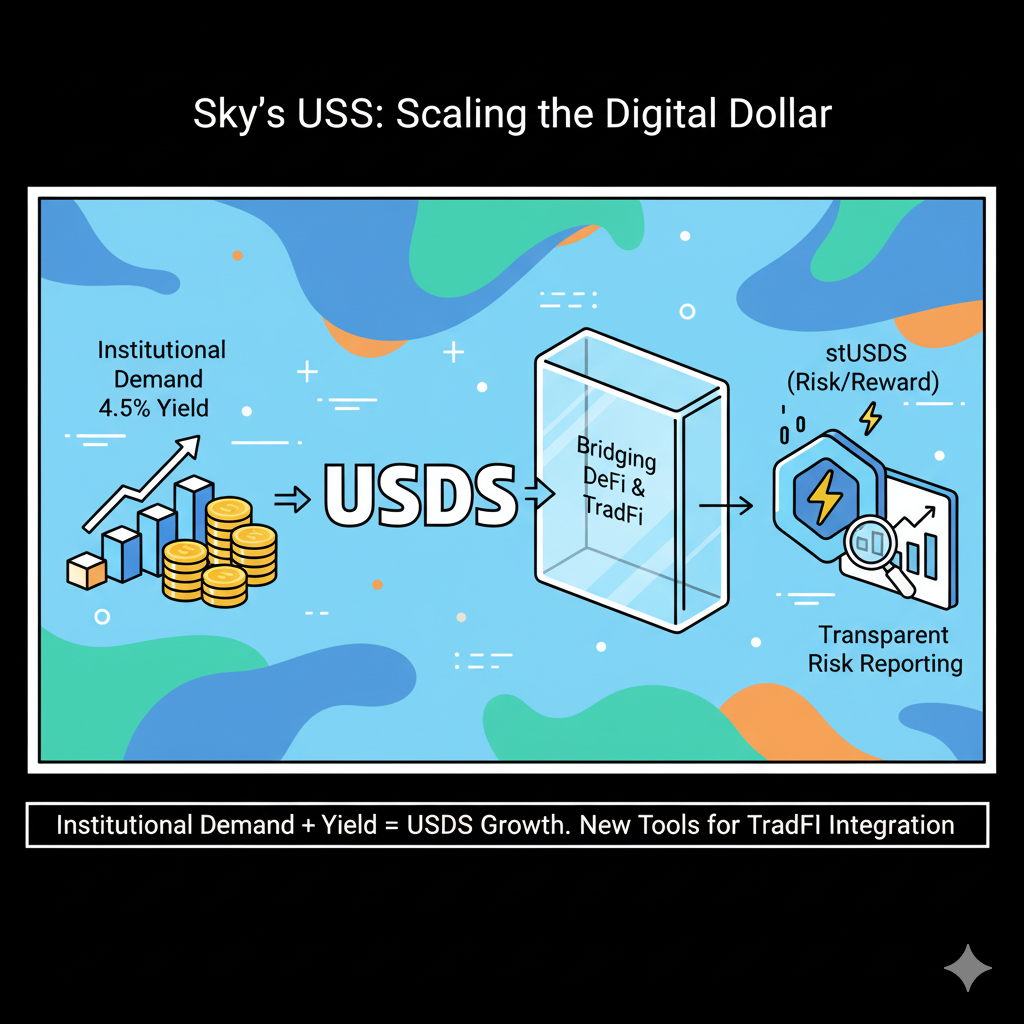
The Obsession and the On-Ramp: How Institutional Demand Is Fueling Stablecoin Scaling and Financial Transparency

The global financial landscape is undergoing a profound and irreversible shift, driven not by volatile cryptocurrencies or ephemeral memes, but by the quiet, steady rise of the digital dollar. At the epicenter of this structural change stands Rune Christensen, the founder and CEO of Sky (formerly the pioneering decentralized autonomous organization, MakerDAO), who observes an unprecedented phenomenon: the institutional world’s growing “obsession” with stablecoins. After years spent building and refining the complex decentralized architecture underpinning his protocol, Christensen asserts that the era of architectural overhaul is over, and Sky’s stablecoin, USDS, is now entering its critical scaling phase, fueled directly by a burgeoning demand for transparent, yield-bearing digital assets.

The Institutional Awakening: Stablecoins as the New Financial Obsession

Christensen’s central observation is that large, established financial institutions—commonly referred to as TradFi—are no longer viewing stablecoins as a fringe component of the crypto market. Instead, they are increasingly recognizing them as the foundational infrastructure for a future financial system.

“One thing I’m very happy about is that stablecoins have become almost an obsession for institutions,” Christensen noted. This fixation stems from the undeniable, inherent advantages stablecoins offer: they combine the stability of fiat currency with the efficiency and speed of blockchain technology. They facilitate 24/7, borderless, near-instant settlement, and offer unprecedented programmability—benefits that conventional banking systems simply cannot match. Institutions realize that stablecoins are poised to fundamentally reshape mechanisms like cross-border payments, corporate treasury management, and high-frequency trading.

However, this institutional enthusiasm is tempered by a persistent knowledge gap. While they understand the benefits of the end product, many institutional players remain “quite confused and don’t fully grasp the mechanics,” particularly concerning decentralized governance and novel risk structures. This dichotomy—intense demand coexisting with conceptual confusion—creates a unique opportunity for protocols like Sky, which are mature enough to handle institutional scale but require clarity to onboard non-crypto-native users. The challenge, therefore, is not merely to capture capital inflows but to build the capacity and the communicative interfaces necessary to safely integrate this colossal pool of institutional wealth.

The USDS Scaling Era: From Architectural Overhaul to Aggressive Growth

The current pivot to aggressive scaling for USDS marks the culmination of a multi-year, often arduous, effort to upgrade and future-proof the Sky protocol. Sky, which evolved from the original MakerDAO framework, powers USDS, which the company proudly describes as the largest decentralized yield-bearing stablecoin on the market.

Christensen explains that the protocol had reached a turning point following a comprehensive, multi-year upgrade to its decentralized risk framework. The original MakerDAO system scaled rapidly in its nascent years but eventually outgrew its initial design constraints. This necessitated a painful, yet crucial, process of “reinventing processes and infrastructure from scratch for a decentralized paradigm.”

With that deep architectural migration now complete, the focus for the protocol has unequivocally shifted. The goal for Sky over the coming years is twofold: to absorb more and more institutional capital and to do so without creating systemic risk or allowing processes to fall apart. The plan is to aggressively grow the USDS supply, deepen its integrations across the broader fintech landscape, and enable wallets and businesses globally to offer the inherent USDS savings rate directly to their end-users. This transition from a project primarily focused on resilience and architecture to one focused on growth and penetration signals a significant maturation of the decentralized finance (DeFi) space.

The Irresistible Allure of Decentralized Yield

A critical factor driving the institutional appetite for USDS is its defining feature: it is a yield-bearing stablecoin. It currently offers a competitive 4.5% savings rate, making it an attractive destination for professional allocators seeking returns. In a traditional financial environment where low-risk, dollar-denominated yield often struggles to keep pace with inflation, the on-chain return provided by USDS stands out.

Christensen emphasizes that this yield makes the protocol a highly desirable asset for funds, crypto-native institutions, and fintech platforms looking for low-risk, transparent, and digitally native dollar exposure. As the stablecoin market as a whole grows and more money flows into the digital dollar ecosystem, a portion of that capital naturally gravitates toward robust, decentralized options that can offer competitive, verifiable returns. Sky aims to be the premier destination for that capital by offering not just a stable store of value, but an integrated, automated savings mechanism.

Navigating Regulation with Radical Transparency

One of the most complex hurdles for decentralized systems like Sky is bridging the gap between their architecture and existing regulatory frameworks. Christensen points out that current global regulation is still firmly anchored to centralized financial structures, which are built around single points of failure—centralized entities, CEOs, or treasuries—that regulators can easily identify and control.

Sky’s decentralized architecture does not map neatly onto these traditional models. By design, it has no central authority, no single approval body, and no single point of control that can be easily regulated under current mandates. This lack of fit has required Sky to innovate in the realm of risk reporting and public data.

The solution, according to Christensen, lies in radical transparency. Sky has invested heavily in developing sophisticated data-exposure and risk-reporting interfaces, designed to mimic and even surpass the utility of traditional financial dashboards. This initiative aims to make the protocol’s operational health, collateral composition, and risk metrics easily consumable by TradFi institutions, risk officers, and regulators. The reliance shifts from trusting a central party to verifying the system’s explicit data. This open verification pathway is intended to provide the confidence required by institutions, while simultaneously helping to reduce the reputational drag that the decentralized ecosystem has suffered from in earlier years due to association with “scams or badly run centralised entities.” Sky’s investment in clarity and robust data is its primary regulatory strategy.

The Future of Risk: Introducing stUSDS and Tokenization

To cater to the growing sophistication of its institutional user base, Sky recently unveiled stUSDS, an instrument that introduces a new dimension of risk management and return. Christensen describes stUSDS as an “advanced, risk-aware instrument” explicitly designed for “expert users, institutions, and smart money who know what they’re doing.”

The stUSDS token provides a higher yield in exchange for taking on higher, clearly defined risk. It functions by providing funding for Sky stakers, who can borrow against their staked Sky positions. The increased yield compensates stUSDS holders for bearing the credit risk inherent in this mechanism.

This release is significant because it is intended to be the first in a broader, structured family of risk-tiered tokens. This framework is inspired by traditional finance concepts, specifically drawing on ideas from the Basel III regulatory accords, designed to efficiently structure collateral risk across different tiers. The goal is to improve capital efficiency within the protocol while strictly maintaining the protection and stability of the core USDS stablecoin holders.

The Inevitability of Transparent, Structured Finance

Christensen believes that this new model of risk tokenization is where the ultimate convergence between decentralized finance and traditional institutional markets will occur. He argues that the on-chain version of risk-tranching offers inherent advantages over its opaque TradFi counterpart.

“In TradFi, it’s very opaque, you don’t really know the risk, you just trust the regulators,” he states. Furthermore, smaller funds or institutions are often shut out of the best opportunities. By contrast, the Sky model makes risks explicit and universally accessible. The risks are clearly defined, coded into the smart contracts, and presented via the dedicated verification pathways in a way that is understandable even to less crypto-native participants.

Christensen’s ultimate vision is one where stablecoins are an inevitable, universally adopted standard, and where the structured, transparent, and real-time on-chain risk management frameworks become the standard for all complex financial instruments. This level of clarity, accessibility, and systemic resilience, he concludes, simply would not be possible without the foundational technology of stablecoins, ushering in the true future of transparent global finance.

💰 What is Bitcoin? A Simple Explanation

Have you ever wished you had a special kind of money that nobody—not even a big bank or the government—could control? That’s what Bitcoin is!

1. Digital Money, Not Paper Money

Imagine you have a shiny gold coin, but instead of holding it in your hand, it only exists on the internet.

  • Bitcoin is like Digital Gold. It’s a special kind of money you can send to anyone, anywhere in the world, as long as they have an internet connection.
  • No physical coins: You can’t put it in your piggy bank! It only lives on computers.

2. The Magic Notebook (The Blockchain)

How do we know who has which Bitcoin if there’s no bank? They use a super-smart system called the Blockchain.

  • The Shared Notebook: Think of the blockchain as a giant, public, shared notebook. This notebook records every single Bitcoin transaction that has ever happened, like: “Alice sent 1 Bitcoin to Bob.”
  • The Notebook is Everywhere: This notebook isn’t kept in one single place; thousands of computers all over the world have a copy.
  • No Cheating Allowed: If someone tries to secretly change their copy of the notebook to say they have more Bitcoin, all the other copies will spot the mistake and say, “No way! That’s not right!” This makes the system super secure and honest.

3. The Digital Detectives (Miners)

Every time someone sends Bitcoin, who writes it down in the giant shared notebook? Special computers called Miners do this work.

  • Solving Puzzles: Miners compete to solve a very hard math puzzle first.
  • Adding a Page: The winner gets to take all the recent transactions and write them onto a new “page” in the notebook (that page is called a Block). They seal it up tightly and add it to the chain of pages (the Blockchain).
  • Getting a Reward: For all that hard work, the miner gets a little bit of new Bitcoin as a prize! This is how new Bitcoin is created.

4. Why is Bitcoin Special?

Bitcoin is different from the money in your mom’s wallet because of two main ideas:

  • Decentralized (No Boss): There is no one person, no single company, and no government that is the boss of Bitcoin. The whole network of computers (the miners and users) controls it together. That’s what decentralized means.
  • It’s Limited: There will only ever be 21 million Bitcoins. That’s it! Because it’s so rare, like real gold, people think it will hold its value for a long time.

In Simple Summary:

Bitcoin is secure digital money that works using a shared, public notebook (the Blockchain), which is kept honest and running by computers solving puzzles (Miners), and no single person is in charge of it.

EUR/USD Holds Firm Near 1.1600, Despite Weekly Pullback on Trimmed Fed Rate Cut Bets

The EUR/USD currency pair has managed to hold around the 1.1600 level despite a slight pullback towards the end of the week. The pair saw a modest decline of about 0.10% on Friday but ended the week with a gain of roughly 0.51%. This price action is indicative of ongoing resilience in the euro, even as the U.S. dollar remains supported by shifting expectations surrounding U.S. Federal Reserve (Fed) policy.

Fed’s Changing Stance on Interest Rate Cuts

One of the key drivers behind the recent price movements in EUR/USD is the evolving outlook on U.S. monetary policy. A month ago, markets were largely expecting the Fed to cut interest rates by 25 basis points (bps) at its December meeting. However, that expectation has now been significantly reduced, with the market-implied probability of such a cut now standing at approximately 56%. This adjustment in market expectations follows several statements from Fed officials, which have signaled a more cautious stance toward further rate cuts.

The Fed’s shift in tone has been largely influenced by stronger-than-expected economic data from the U.S. For example, recent reports on consumer spending, inflation, and labor markets have raised doubts about the need for aggressive rate cuts. In fact, many Fed officials have stressed that monetary policy remains “modestly restrictive” and have indicated that the central bank may need to remain patient before taking any further action.

This change in outlook is significant for EUR/USD because the U.S. dollar tends to benefit when the Fed signals that interest rates will remain elevated for a longer period. Higher interest rates tend to make U.S. assets more attractive to investors, which can drive up demand for the dollar.

Eurozone’s Economic Resilience

While the Fed’s stance has been shifting, the eurozone economy has shown signs of resilience. Recent data from the European Union has provided some positive surprises, particularly in the third quarter of 2025. Eurozone GDP growth came in at 0.2% on a quarter-on-quarter basis, while the year-on-year growth was revised upward to 1.4%. This positive growth, although modest, has provided some support for the euro and helped offset the bearish pressures stemming from the dollar’s strength.

The economic performance in the eurozone has been mixed, with growth primarily driven by the services sector. The region’s manufacturing sector continues to face challenges due to ongoing supply chain disruptions, inflationary pressures, and the global economic slowdown. However, the resilience in services and consumer spending has provided a buffer for the euro, keeping it somewhat stable against the dollar.

Technical Analysis: EUR/USD at a Crossroads

From a technical perspective, EUR/USD is at an important juncture. The currency pair has been unable to decisively break above key resistance levels despite several attempts. As of now, the 50-day simple moving average (SMA) is acting as a strong resistance point, sitting just above the 1.1659 mark. This suggests that the market is finding it difficult to push the euro higher in the face of stronger U.S. economic fundamentals and a hawkish Fed.

On the downside, EUR/USD is also finding support near the 20-day SMA, which is currently positioned at 1.1583. If the pair were to break below this level, it could open the door for a deeper decline towards the 1.1500 area and potentially even the 1.1391 level. A sustained move below the 1.1583 support zone would signal a shift in momentum and could prompt more bearish sentiment among traders.

However, if the euro manages to break above the 50-day SMA at 1.1659, it could open the door for a move towards the next significant resistance level around 1.1700. This would likely be a sign of a broader recovery in the euro against the dollar, as investors may become more optimistic about the eurozone’s economic prospects, particularly if U.S. growth starts to slow down.

Global Risk Sentiment and its Impact on EUR/USD

Beyond the domestic economic outlooks in the U.S. and the eurozone, broader global risk sentiment also plays a critical role in the EUR/USD exchange rate. Over the past week, risk appetite in global markets has remained tentative, as investors continue to grapple with various geopolitical uncertainties. The ongoing trade tensions between the U.S. and China, concerns about the global supply chain, and the situation in Ukraine all contribute to a sense of unease in financial markets.

When global risk sentiment is fragile, investors tend to favor safe-haven currencies such as the U.S. dollar. This has provided a degree of support for the dollar, which, despite its recent weakness, remains a favored currency in times of market uncertainty. The euro, on the other hand, has been more vulnerable to shifts in sentiment, especially given the ongoing challenges in the European economy.

However, the euro has found some support thanks to Europe’s relatively stronger-than-expected growth figures and its efforts to address the ongoing energy crisis in the region. In particular, the European Central Bank (ECB) has been working to navigate rising inflation and slowing growth, which has kept the eurozone economy in a delicate balance. While the ECB is unlikely to follow the Fed’s path of aggressive tightening, its policy stance remains important for the euro’s outlook.

Looking Ahead: Fed, ECB, and Inflation Dynamics

As we head into the final weeks of the year, all eyes will remain on the central banks in the U.S. and Europe. The next few Federal Reserve meetings will be critical in determining the future path of U.S. monetary policy. While the central bank is likely to hold rates steady in December, further clarity on the Fed’s direction will depend on incoming data, particularly regarding inflation and employment figures.

The European Central Bank will also be facing pressure to address inflation while supporting economic growth. As the ECB deals with persistent inflationary pressures, particularly in energy and food prices, its policy decisions will play a crucial role in shaping the euro’s performance against the dollar.

If inflation in the eurozone remains elevated, the ECB may need to consider further tightening, which could support the euro. However, if growth prospects in Europe weaken further, the central bank may be more cautious in its approach, which could weigh on the euro.

Conclusion: EUR/USD Remains at a Crossroads

In summary, EUR/USD is currently at a critical point, with both technical and fundamental factors influencing its near-term outlook. The market’s shifting expectations for U.S. monetary policy have provided some support for the dollar, while economic resilience in the eurozone has helped stabilize the euro. However, the outlook for both currencies remains closely tied to the future direction of central bank policies and global risk sentiment.

From a technical standpoint, EUR/USD is facing a tough resistance zone around the 1.1659 level, with key support at 1.1583. A breakout above resistance could signal further gains for the euro, while a failure to hold the 1.1600 level could lead to deeper declines. Traders will need to keep a close eye on U.S. economic data and Fed commentary, as these will be key factors influencing the pair’s trajectory in the weeks ahead.