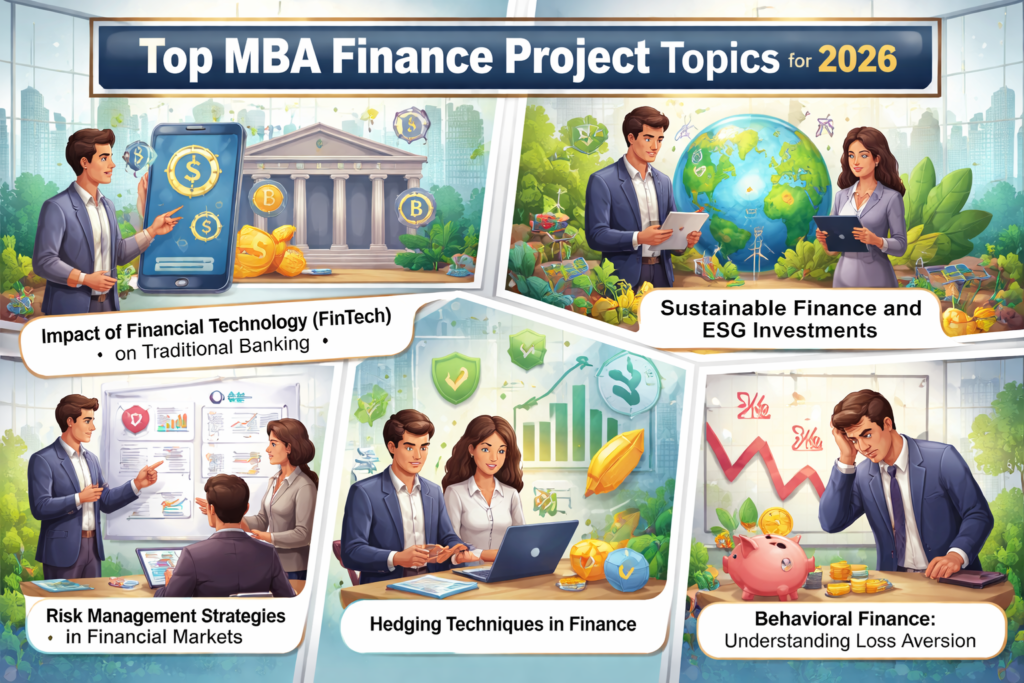
MBA Finance Project Topics for Final Year Students 2026. As an MBA finance student approaching the final year, choosing the right project topic can be a game changer. A well- researched project not only boost your academic profile but also sets the stage for a successful career path in finance, and global market shifts. Below are some of the most relevant and impactful MBA finance project topics you can explore.
Impact of FinTech on Traditional Banking Systems: How Financial Technology is Disrupting and Transforming the Banking Sector.
The rise of financial technology ( FinTech) has disrupted traditional banking systems. As FinTech solutions continue to grow, they offer new opportunities for improving financial services, enhancing efficiency, and creating value for the consumers. From blockchain to digital wallets, FinTech has reshaped the way financial transactions occur and how businesses and consumers can interact with money.
Scope of FinTech in the Banking Sector :MBA Finance Project Topics
FinTech innovations are transforming various aspects of banking. Key areas impacted include:
1. Payments and Transfers: Mobile payment platforms and peer-to-peer (P2P) services are making transactions quicker and more secure
2. Lending: Online lending platforms offer instant loans, credit scoring algorithms, and lower interest rates than traditional banks.
3. Investment services: Robo-advisors are offering personalize financial advice at a fraction of the cost of human advisors.
Impact of FinTech on traditional Banking Models
Explore how FinTech is challenging traditional banking by examining:
- The decline in branch-based banking and the rise of digital-first banking.
- The shift towards customer-centric banking, where personalized services are tailored using AI and machine learning.
- How banks are adapting to FinTech through partnerships, mergers, and investments.
Sustainable Finance and ESG Investments: The Growing Importance of Environmental, Social, and Governance Factors in Financial Decision-Making.
Understanding sustainable Finance this is also one of the best MBA Finance Project Topics
Sustainable finance involves investments that not only provide financial returns but also promote environmental and social good. In recent years, ESG ( environmental, Social, Governance) factors have become increasingly important for both the investors and companies. As sustainability issues take center stage globally, sustainable finance is becoming a crucial aspect of the financial sector.
Growth of ESG Investments
Incorporating ESG criteria into investment has become mainstream. Investors are increasingly considering the impact of their investments on the environment, Society, and corporate governance practices.
SG as a Driver for Long-Term Value
Studies show that ESG-focused investments often perform better in the long run. Companies that prioritize sustainability tend to have lower operational risks, enhanced reputation, and greater resilience against market downturns.
Challenges and Opportunities in Sustainable Finance
While ESG investing has grown, challenges remain:
- Standardization of ESG Metrics: One key issue is the lack of standardized metrics to measure ESG performance.
- Greenwashing: Some companies may falsely claim to have sustainable practices to attract investors.
However, sustainable finance offers immense opportunities for those interested in aligning financial returns with ethical and socially responsible investment goals.
3. Risk Management Strategies in Global Markets
The Importance of Risk Management in Finance
In a globalized financial market, understanding and managing risk is essential for any business or investor. Risks can come in many forms—market risks, credit risks, liquidity risks, and geopolitical risks. Developing strategies to minimize these risks is a vital part of financial planning.
Types of Risks in Global Markets
Key risk factors in global finance include: MBA Finance Project Topics
- Market Risks: Fluctuations in asset prices, commodity prices, and interest rates can affect financial stability.
- Credit Risks: The risk of default on financial obligations by borrowers.
- Geopolitical Risks: Political instability or changes in government policies can disrupt global trade and investment.
Strategies for Managing Global Market Risks
In your project, you can explore the following risk management strategies:
- Hedging Strategies: Leveraging Derivatives and Financial Instruments to Mitigate Risk and Offset Potential Losses in Investment Portfolios.
- Diversification: Spreading investments across various assets to reduce exposure to market volatility.
- Risk Adjusted Return: Evaluating investments based on their potential return relative to the risks taken.
Understanding these strategies can help businesses and investors safeguard their interests in an unpredictable global market.
4. Behavioral Finance and its Effect on Investment Decisions
Introduction to Behavioral Finance
Behavioral finance is the study of psychological influences on financial decision-making. Unlike traditional finance, which assumes rational decision-making, behavioral finance acknowledges that human emotions and biases often lead to suboptimal financial choices.
Key Psychological Biases Affecting Investment Decisions
Investors are subject to various cognitive biases, including:
- Loss Aversion Bias: The Psychological Tendency to Prioritize Avoiding Losses Over Gaining Equivalent Profits in Investment Decisions.
- Overconfidence: When investors overestimate their knowledge and abilities, leading to riskier investment choices.
- Herd Behavior: The tendency to follow the crowd, even in situations where it may not be rational.
Impact of Behavioral Biases on Market Efficiency
Behavioral finance suggests that market inefficiencies often result from these biases. You can explore how these biases lead to bubbles, crashes, and mispricing of assets in your project.
Understanding behavioral finance can help investors make better, more rational decisions, and is an interesting area of study for your MBA finance project.
5. Private Equity and Venture Capital Investment Trends
Overview of Private Equity and Venture Capital
Private equity and venture capital are two key forms of investment that provide funding to companies in exchange for equity. These investments are often high-risk but offer high returns if successful.
Trends in Private Equity and Venture Capital
- Focus on Technology Startups: In recent years, private equity and venture capital firms have increasingly invested in technology startups, especially in AI, blockchain, and FinTech sectors.
- Globalization of Investment: There has been a significant rise in cross-border investments, as venture capitalists and private equity firms look for opportunities in emerging markets.
Challenges and Opportunities in Private Equity and Venture Capital
Despite the high potential for returns, there are challenges in these markets:
- High Risk: Many startups fail to achieve profitability, which makes venture capital investing inherently risky.
- Regulatory Challenges: Changing regulations, especially in emerging markets, can create difficulties for foreign investors.
By analyzing these trends, you can create a project that helps you understand the dynamics of private equity and venture capital investing.
6. The Future of Cryptocurrencies in Portfolio Management
Introduction to Cryptocurrencies and Their Rise : MBA Finance Project Topics
Cryptocurrencies, such as Bitcoin, Ethereum, and newer altcoins, have emerged as an alternative asset class. Over the last decade, their popularity has surged, and they are increasingly being considered as part of diversified investment portfolios.
Cryptocurrencies in Modern Portfolio Theory
Modern portfolio theory (MPT) suggests that investors should diversify their portfolios to minimize risk. Cryptocurrencies, due to their high volatility, can offer significant returns but also pose a unique risk. In your project, you can explore:
- Portfolio Diversification: Assessing how cryptocurrencies can provide diversification benefits when combined with traditional assets.
- Risk and Return Analysis: Evaluating the potential for high returns against the associated risks.
Challenges of Including Cryptocurrencies in Portfolios
Despite their potential, integrating cryptocurrencies into traditional portfolios comes with challenges:
- Regulatory Uncertainty: Cryptocurrencies face regulatory scrutiny in many countries, which can affect their value and future growth.
- Price Volatility: The extreme price fluctuations of cryptocurrencies make them unsuitable for risk-averse investors.
This topic is ideal for those interested in alternative investments and the future of digital finance.
Conclusion
Choosing the right MBA finance project topic is a crucial step in your academic journey. Whether you decide to explore the growing role of FinTech, sustainable finance, risk management, or the future of cryptocurrencies, each of these topics offers a unique opportunity to gain in-depth knowledge and provide valuable insights into the evolving finance landscape. Select a topic that aligns with your interests and career goals, and you’ll be well on your way to a successful final-year project.