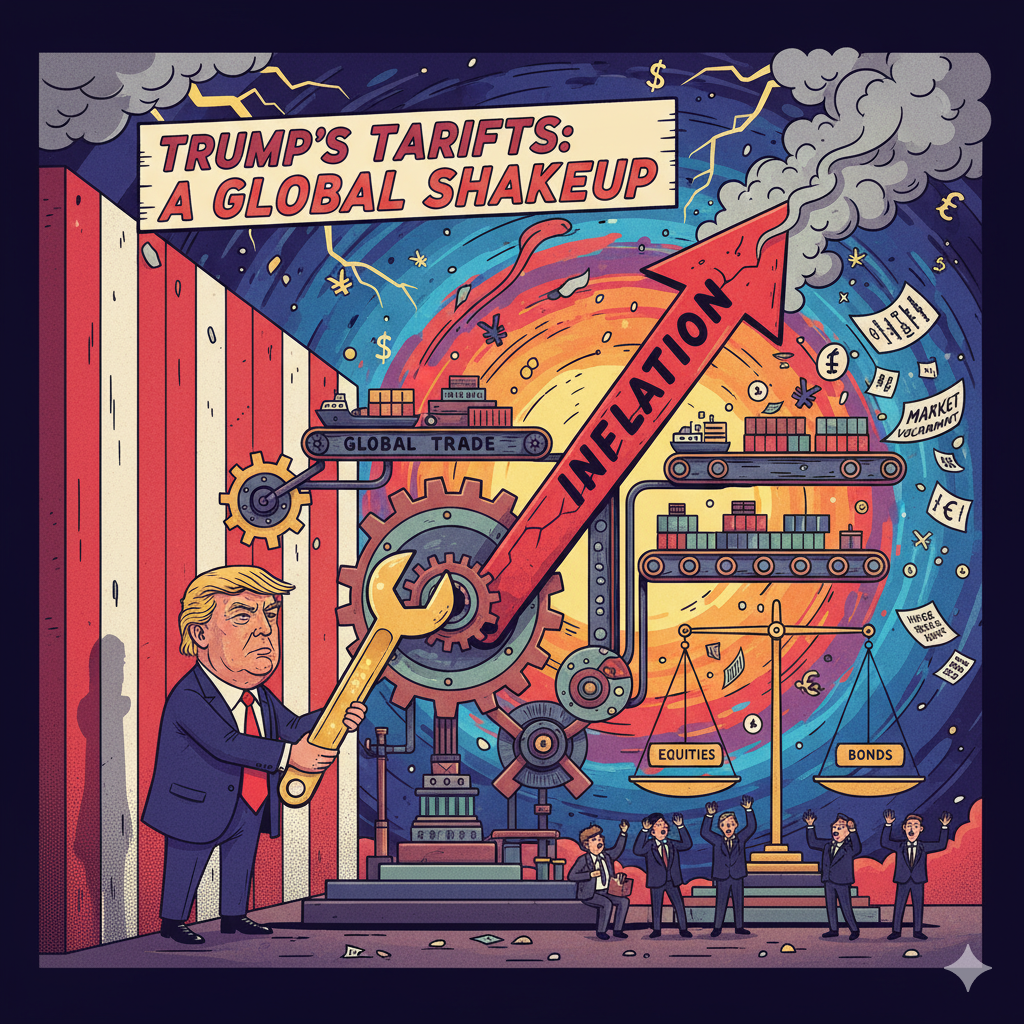
In the world of global investing, few things move markets as sharply as trade policy. With Donald Trump’s proposed tariff strategy back in focus, investors across equities, bonds, and commodities are once again recalibrating their expectations. The potential for a sweeping tariff policy—targeting both allies and rivals—raises questions about inflation, supply chains, and the future of global trade. As a market analyst, I see this as a pivotal moment where investors must balance caution with strategy.
The Tariff Ripple Effect: Inflation Concerns Return
The first and most immediate impact of Trump’s proposed tariffs lies in the inflation story. When tariffs increase the cost of imported goods, companies—particularly those in manufacturing and retail—are forced to absorb or pass on these costs. If passed to consumers, this can fuel inflation.
For an economy already wrestling with price pressures, a fresh round of tariffs could challenge the progress made by central banks in stabilizing inflation. This development could push the Federal Reserve to maintain higher interest rates for longer, curbing borrowing and investment appetite.
Market participants are already positioning themselves for this scenario. Treasury yields have inched higher, reflecting expectations that inflation might stay stickier than anticipated. For bond investors, that means being selective—favoring shorter-duration bonds or inflation-linked securities to protect real returns.
Equities Under the Microscope: Winners and Losers
Stock markets are often quick to react to changes in trade dynamics, and this time is no different. Companies with significant global exposure—particularly in technology, automotive, and consumer goods—are likely to face headwinds. Tariffs raise input costs and disrupt supply chains that have been optimized over decades of globalization.
For instance, U.S. automakers that rely heavily on imported components from Asia or Mexico may see production costs rise, squeezing profit margins. Similarly, tech giants dependent on semiconductor imports could face pricing pressure.
However, not all sectors will lose. Domestic producers and companies catering primarily to local markets might enjoy a relative advantage. Firms in defense, energy, and certain infrastructure-linked sectors could see renewed investor interest as capital shifts toward more insulated parts of the economy.
From an investor’s perspective, this is the time to reassess portfolio exposure. A tactical shift toward value-oriented sectors—such as industrials or utilities—might help offset volatility in global growth stocks.
Safe Havens in Demand: Bonds and Gold Gain Favor
Whenever uncertainty looms over trade, investors instinctively turn to safe havens. This time, government bonds and gold are reclaiming their appeal. As equity volatility rises and inflation risk re-emerges, U.S. Treasuries remain the go-to asset for risk-averse capital.
Gold, too, is showing signs of renewed strength. Historically, trade wars and tariff tensions have boosted gold prices as investors hedge against currency volatility and inflation. The recent uptick in bullion demand underscores this sentiment shift.
For traders, this period could offer opportunities in gold ETFs and inflation-protected securities (TIPS). The strategy isn’t about abandoning risk entirely but balancing it smartly—protecting capital while staying exposed to potential upside in cyclical recoveries.
The Currency Angle: Dollar Dynamics at Play
Tariffs can influence more than just goods and equities—they also reshape currency markets. When tariffs rise, global trade volumes can slow, reducing demand for certain currencies. Interestingly, the U.S. dollar often strengthens in such environments, as investors view it as a safe-haven currency amid global uncertainty.
However, a stronger dollar can create a double-edged sword. While it attracts capital inflows, it also makes U.S. exports less competitive—potentially worsening the trade balance that tariffs aim to fix. For emerging markets, a firm dollar can spell trouble, leading to capital outflows and weakening local currencies.
Currency traders, therefore, should prepare for higher volatility in USD pairs, particularly against Asian and Latin American currencies. Hedging positions or favoring stronger economies with current account surpluses could help manage currency risks effectively.
Corporate Strategy Shifts: Supply Chains and Sourcing Revisite
Beyond markets, corporate boardrooms are also bracing for impact. Global companies are reassessing their supply chains, a process already underway since the pandemic. Tariffs accelerate this trend by encouraging localization or “friend-shoring”—sourcing materials from politically aligned nations.
This strategic shift could benefit countries like India, Vietnam, and Mexico, as multinational firms diversify away from China. Investors tracking these economies might find opportunities in manufacturing, logistics, and infrastructure development.
For equity investors, exchange-traded funds (ETFs) focused on emerging markets that stand to gain from supply chain realignment could offer medium-term upside.
Policy Implications: Central Banks Caught in a Dilemma
Monetary policy could face its most complex test yet. On one hand, tariffs can dampen growth by raising costs and reducing global demand. On the other hand, they can spur inflation, forcing central banks to stay hawkish longer.
This tug-of-war means policymakers may need to balance between curbing inflation and avoiding a recession. The Federal Reserve, European Central Bank, and Bank of England will likely maintain a cautious stance, communicating a data-dependent approach.
For equity markets, this means earnings multiples may remain compressed, with growth stocks underperforming value names until policy clarity emerges.
Investor Strategy: Navigating Tariff-Driven Markets
For investors, uncertainty doesn’t necessarily mean inactivity—it calls for strategic positioning. Here are three practical approaches:
- Diversify Across Geographies: Reduce exposure to regions or sectors most vulnerable to trade disruption. Adding European or Indian equities could provide balance.
- Focus on Pricing Power: Companies with the ability to pass on higher costs to consumers—such as those in healthcare, luxury goods, or utilities—can protect margins better.
- Balance Risk with Real Assets: Exposure to commodities and real estate can offer a natural hedge against inflationary pressures.
Patience and discipline will be critical. While markets may react negatively in the short term, long-term investors can find value as volatility creates new entry points.
The Human Element: Investor Sentiment and Market Psychology
Markets are not just about numbers—they’re a reflection of collective psychology. The re-emergence of tariff fears can quickly erode investor confidence, even if fundamentals remain stable. This psychological element often drives markets to overreact, creating opportunities for those who remain calm and analytical.
Seasoned investors understand that volatility is the price of opportunity. As uncertainty unfolds, those with a clear framework—focused on long-term value rather than short-term noise—will likely come out ahead.
Conclusion: Preparing for a New Trade Reality
Trump’s tariff proposals, if implemented, could redefine the global trade order once again. The implications stretch far beyond economics—they affect politics, supply chains, and investment behavior worldwide.
For investors, this is not a time for fear, but for flexibility. Understanding how tariffs influence inflation, corporate earnings, and market sentiment will be key to navigating the months ahead. Whether you are a retail trader, institutional investor, or portfolio manager, the message is clear: stay informed, stay balanced, and stay adaptive.
As global markets adjust to the potential return of protectionist policies, those who manage risk intelligently and keep their eyes on long-term fundamentals will emerge stronger—because in markets, uncertainty isn’t a threat, it’s an opportunity waiting to be seized.
One thought on “How Trump’s Tariff Plans Could Reshape Global Markets and Investor Sentiment”
Comments are closed.