1. Chart Overview
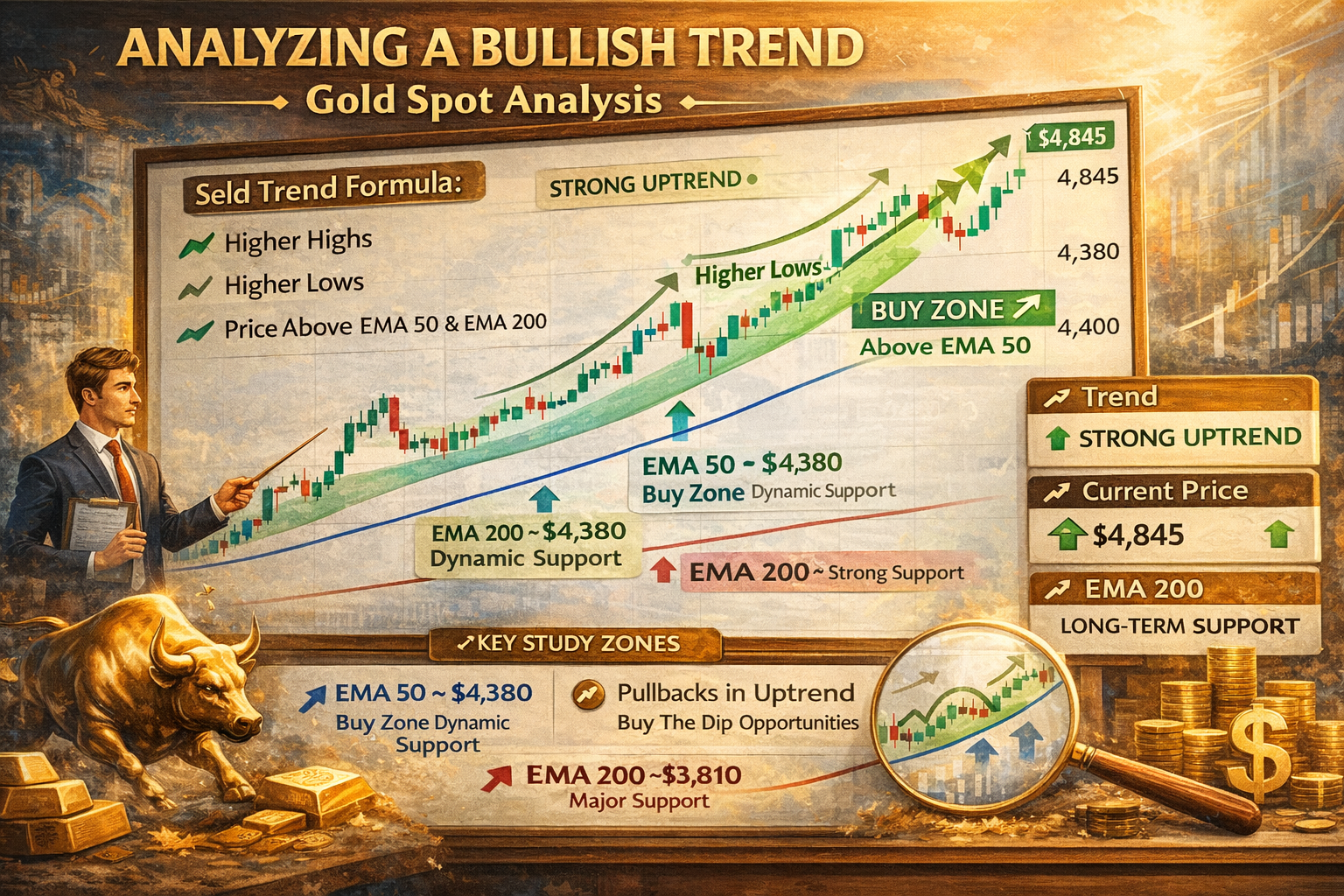
The chart represents Gold Spot vs US Dollar (XAUUSD) on the 1-Day timeframe, which is ideal for identifying medium- to long-term trends. The price is currently trading near 4,845, showing strong bullish momentum.
Two key indicators are applied:
- EMA 50 (Blue line) – ~4,383
- EMA 200 (Red line) – ~3,810
These moving averages help identify trend direction, momentum strength, and dynamic support/resistance zones.
2. Primary Trend Analysis
Strong Uptrend Structure
Gold is clearly in a strong bullish trend, defined by:
- Higher highs
- Higher lows
- Price consistently trading above EMA 50 and EMA 200
This structure confirms that buyers are in full control on the daily timeframe.
Trend Phases Visible on Chart
- Accumulation Phase (September–October)
Price moved gradually upward with small pullbacks, suggesting institutional accumulation. - Impulse Move (October)
A sharp bullish rally pushed price above previous resistance, confirming trend continuation. - Corrective Phase (Late October–November)
Price corrected but held above EMA 50, indicating healthy profit booking rather than trend reversal. - Continuation Phase (December–January)
Strong bullish candles reappeared, breaking prior highs and accelerating momentum.
Currently, gold is in a trend extension phase, often seen near psychological levels.
3. Role of EMA 50 and EMA 200
EMA 50 – Dynamic Support
- EMA 50 has acted as a buy-on-dips zone
- Each pullback towards EMA 50 resulted in fresh buying
- The steep slope of EMA 50 shows strong momentum
EMA 200 – Long-Term Bullish Confirmation
- EMA 200 is far below current price
- This wide gap indicates:
- Strong long-term bullish sentiment
- No immediate threat of trend reversal
- As long as price remains above EMA 200, the primary trend remains bullish
EMA 50 above EMA 200 = Golden Trend Condition
4. Price Action Analysis
Candle Structure
Recent candles show:
- Large bullish bodies
- Small or no lower wicks
- Consecutive green candles
This suggests:
- Aggressive buying
- Minimal selling pressure
- Breakout strength rather than exhaustion
However, extended bullish candles can also signal short-term overextension, which is important for study.
5. Support and Resistance Zones
Key Support Levels (Study Zones)
- 4,600 – 4,650
- Previous consolidation
- Likely demand zone on pullbacks
- 4,380 – 4,400 (EMA 50 area)
- Strong dynamic support
- High probability reaction zone
- 3,800 – 3,850 (EMA 200 area)
- Long-term trend support
- Breakdown below this would signal major trend shift
Resistance Levels
- 4,850 – 4,900 is a psychological resistance
- Round numbers often attract profit booking
- Break and sustain above this zone could open further upside in future
6. Momentum and Strength Assessment
Bullish Strength Indicators
- Steep EMA slopes
- Strong breakout candles
- Lack of deep pullbacks
- Price far above moving averages
These factors indicate trend strength, but also suggest the market may be temporarily overheated.
Overextension Risk (For Study)
When price moves too far away from EMA 50:
- Probability of sideways consolidation increases
- Or shallow correction towards EMA 50 occurs
This does not mean trend reversal, only momentum normalization.
7. Market Psychology Behind the Move
Gold typically rises due to:
- Global uncertainty
- Inflation expectations
- Weakness in the US Dollar
- Central bank buying
- Geopolitical tensions
The sharp move suggests risk-off sentiment globally, where investors prefer safe-haven assets.
Institutional participants usually:
- Buy during pullbacks
- Push price to new highs during low-liquidity periods
- Book partial profits near round-number levels
8. Possible Future Scenarios (Educational)
Scenario 1: Bullish Continuation
- Price consolidates between 4,750–4,850
- Breaks above 4,900 with volume
- Trend continues higher
Scenario 2: Healthy Pullback
- Price corrects towards 4,600–4,500
- Buyers step in near EMA 50
- Trend resumes upward
Scenario 3: Sideways Consolidation
- Price ranges for several sessions
- EMAs catch up
- Momentum resets before next move
For study purposes, sideways movement after strong rallies is very common.
9. Risk Management Learning Points
Even in strong trends:
- Late entries carry higher risk
- Risk-reward becomes unfavorable near tops
- Waiting for pullbacks improves probability
Key lesson:
Trend following is safest near support, not after vertical moves.
10. Key Educational Takeaways
- Gold is in a clear long-term uptrend
- EMA 50 and EMA 200 confirm bullish bias
- Price action shows strong institutional participation
- Current levels indicate strength but also short-term overextension
- Pullbacks are part of healthy trends, not weakness
- Always analyze structure + moving averages + psychology together
Final Study Conclusion
This chart is an excellent textbook example of a strong trending market. It demonstrates how price respects moving averages, forms higher highs and higher lows, and accelerates during momentum phases. For learning technical analysis, this chart perfectly illustrates trend identification, dynamic support, and bullish price action behavior.