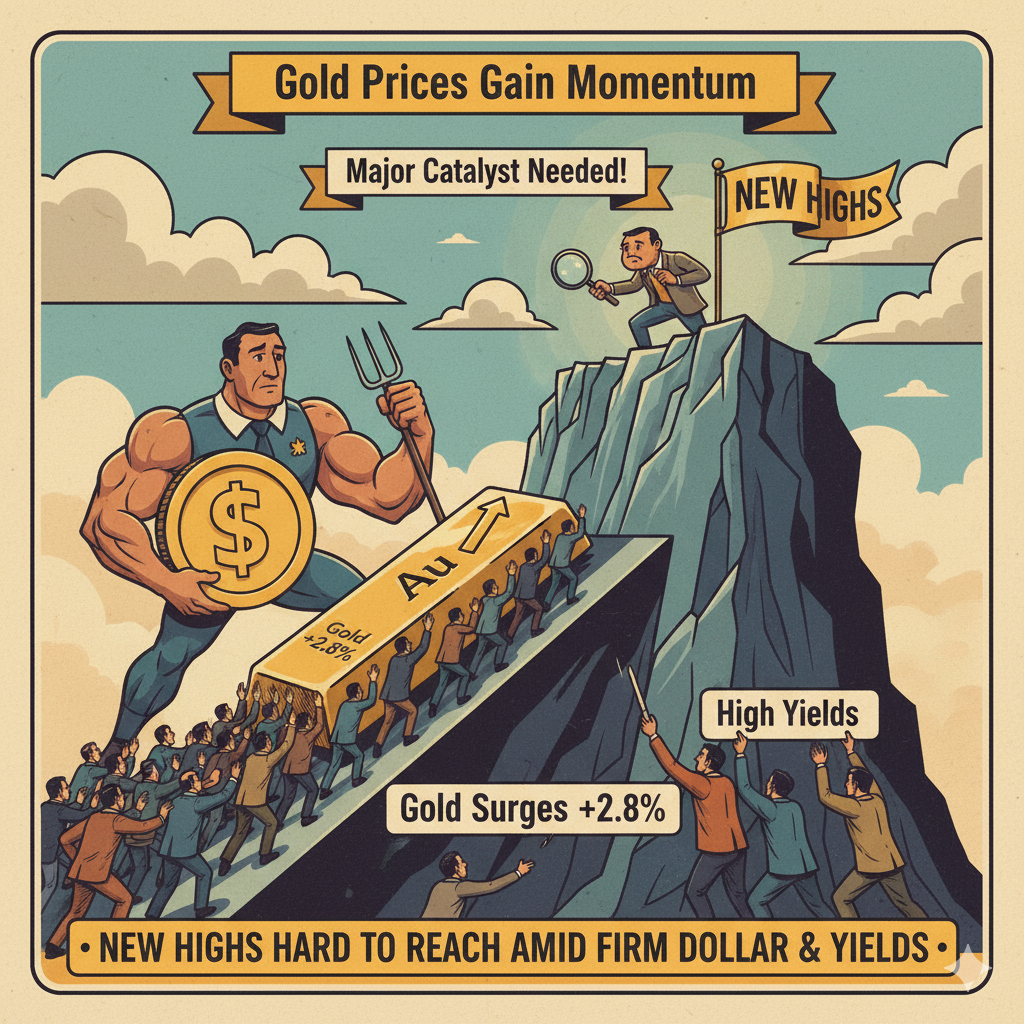
Gold prices started the week on a strong note, surging nearly 3% to deliver their best single-day performance in three weeks. The move came as investors sought safety amid ongoing global uncertainty, while expectations for a softening U.S. economy offered some support to the yellow metal. However, analysts caution that while gold’s bullish momentum is impressive, expectations for new record highs might be too optimistic without a major catalyst to fuel further gains.
A Strong Start for Gold
Gold futures climbed around 2.8% early in the week, signaling renewed buying interest after a period of consolidation. The rally reflected a combination of technical and fundamental factors. On the technical front, gold broke through short-term resistance levels, triggering momentum-based buying. Fundamentally, lingering concerns about global growth, geopolitical tensions, and fluctuating expectations for U.S. interest rates all added to gold’s appeal as a hedge.
Investors have been quick to seize opportunities in gold whenever risk sentiment weakens. Despite periods of volatility in equities and commodities, gold’s long-term narrative as a safe-haven asset remains intact. The recent rally suggests that traders still view it as a stable store of value amid shifting market dynamics.
Bullish Momentum Meets Market Reality
While the recent rally has lifted spirits among gold bulls, most analysts agree that new all-time highs remain unlikely in the immediate future. The metal’s previous record highs, achieved earlier in 2025, were driven by a unique combination of conditions: rapidly falling bond yields, aggressive central bank buying, and heightened geopolitical risk.
At present, those tailwinds appear to be fading. Inflation, though still above central bank targets, has moderated across major economies. Bond yields remain elevated, and the U.S. dollar has shown renewed strength—factors that tend to limit gold’s upside potential.
Market experts caution that while gold’s short-term trend looks constructive, investors should not expect a seamless climb toward new peaks. Instead, the metal is more likely to consolidate within a range, building a stronger foundation before any potential breakout.
Crowded Positioning Signals Caution
Another factor tempering enthusiasm is the positioning in the options and futures markets. Data suggests that many traders are already heavily positioned for gold gains, leaving little room for additional bullish momentum without fresh triggers.
When too many investors are on the same side of a trade, it can create a situation where even good news fails to push prices significantly higher. This dynamic appears to be unfolding in gold now. The options market shows a skew toward calls—contracts betting on higher prices—indicating that optimism is already priced in.
Such crowded sentiment often leads to slower progress or short-term pullbacks as some traders take profits. As one market strategist put it, “When everyone’s already bullish, there’s no one left to buy.”
That doesn’t mean gold’s rally is over—it simply suggests that the pace of gains could slow unless a new fundamental catalyst emerges.
Resilience Amid Dollar and Yield Strength
One of the most remarkable aspects of gold’s performance has been its ability to hold firm even as the U.S. dollar remains strong and Treasury yields stay elevated. Typically, a firmer dollar makes gold more expensive for holders of other currencies, while higher yields reduce the appeal of non-interest-bearing assets like gold.
Yet, in recent weeks, gold has shrugged off both headwinds. This resilience points to solid underlying demand—particularly from central banks and long-term institutional investors who view gold as a strategic reserve asset.
In addition, concerns about global geopolitical risks, from Middle East tensions to political uncertainty in Europe, have encouraged safe-haven flows. While these risks alone may not be enough to send gold to new highs, they are helping support prices at elevated levels.
What Could Drive the Next Big Move
For gold to stage a meaningful breakout beyond its recent highs, analysts say a major catalyst is needed. Possible triggers include a sharp drop in the U.S. dollar, a weaker-than-expected U.S. inflation report, or renewed concerns about economic stability in major economies.
Another potential driver could be a dovish shift by the Federal Reserve. Markets have speculated that the Fed could begin cutting interest rates in 2026 if economic growth slows and inflation continues to cool. A lower-rate environment would reduce the opportunity cost of holding gold and could renew investor enthusiasm for precious metals.
However, until such a development occurs, the path higher may remain gradual. Many traders expect gold to consolidate in a broad range, with support near $3,850 and resistance around $4,000 to $4,050 per ounce. Breaking above those levels sustainably will likely require a macroeconomic shock or a shift in monetary policy expectations.
Investor Sentiment and Strategy
For traders, the current environment presents both opportunity and risk. Momentum indicators show short-term strength, but long-term investors are advised to remain cautious. Buying gold aggressively after a strong rally often carries the risk of short-term corrections, especially when sentiment is already bullish.
Experts recommend that investors adopt a measured approach—accumulating positions gradually rather than chasing the market higher. Maintaining exposure through a diversified portfolio that includes both physical gold and related assets such as mining stocks or exchange-traded funds (ETFs) can also help balance risk.
At the same time, traders may find tactical opportunities in shorter-term pullbacks. If gold consolidates or corrects modestly, it could offer better entry points for those looking to build longer-term positions.
A Broader Perspective: Central Bank Demand and Inflation Hedging
Beyond speculative trading, structural demand for gold continues to underpin its value. Central banks around the world have been steady buyers, using gold to diversify reserves away from traditional currencies. This long-term demand provides a solid base for the market, even when short-term sentiment fluctuates.
Additionally, investors continue to view gold as a hedge against inflation and currency depreciation. Although inflation has moderated, many remain wary of potential price shocks linked to energy markets or supply chain disruptions. In such scenarios, gold often acts as a stabilizing force within portfolios.
Technical Landscape and Market Outlook
From a technical standpoint, gold’s chart setup suggests cautious optimism. The recent rally pushed the metal back above key moving averages, indicating a positive trend in the short term. Momentum indicators like the Relative Strength Index (RSI) are rising but not yet in overbought territory, implying that some room remains for further gains.
However, resistance near the psychological $4,000 level remains significant. Analysts note that each attempt to break above this zone has been met with profit-taking. Sustained movement beyond that threshold would likely require a shift in macroeconomic sentiment or a dovish signal from the Federal Reserve.
Conclusion: Bullish but Bounded
Gold’s recent surge has reminded markets of its enduring appeal, but investors should temper expectations for another record-breaking rally in the near term. The metal’s underlying strength, driven by safe-haven demand and steady institutional buying, remains intact—but momentum alone may not be enough to push prices into uncharted territory.
Without a major catalyst—be it a weakening U.S. dollar, lower yields, or heightened geopolitical tension—gold is likely to trade within a range as the market digests recent gains.
For now, the message is clear: gold bulls have regained momentum, but the climb from here will be more measured than meteoric. Investors who stay patient, disciplined, and diversified are best positioned to benefit from whatever the next leg of this golden journey brings.
One thought on “Gold Bulls Gain Momentum, Though New Highs Seem a Stretch”
Comments are closed.