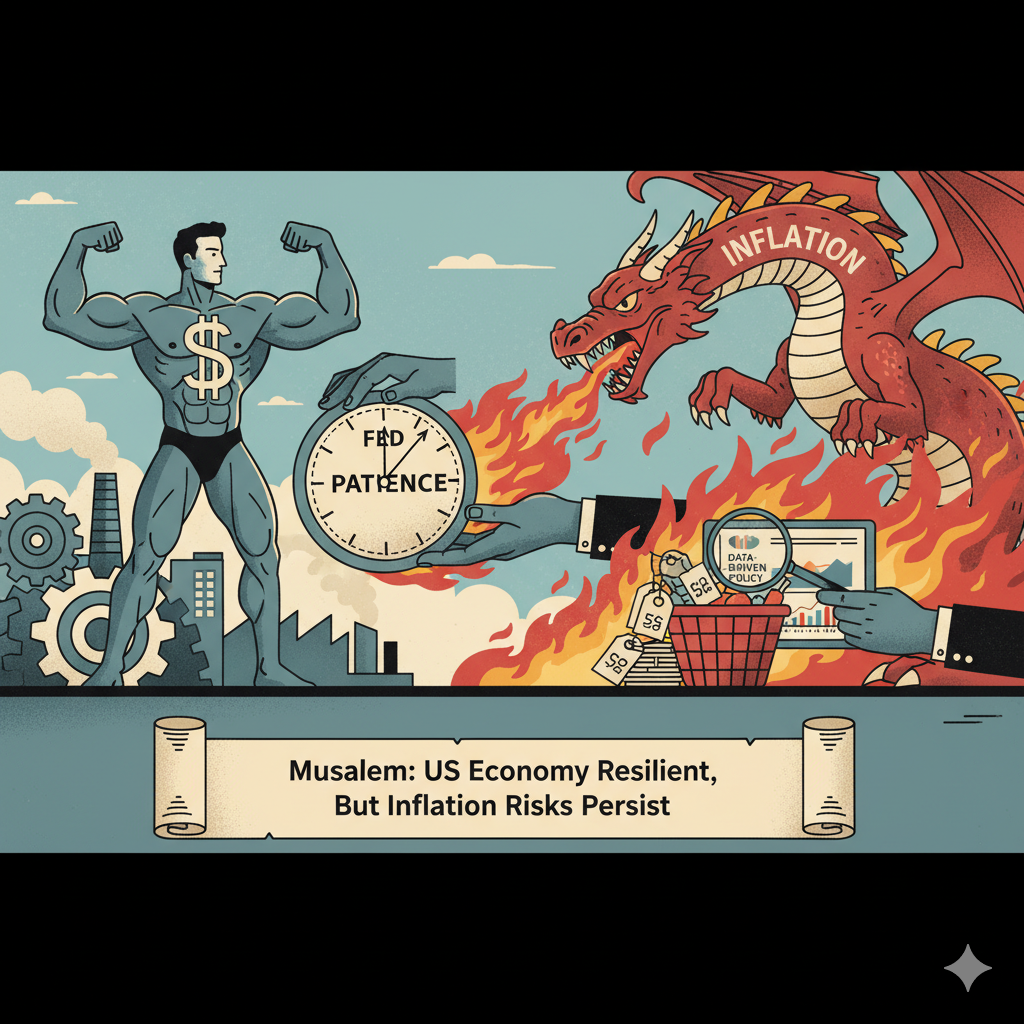
The U.S. economy, long known for its ability to recover from shocks, continues to demonstrate resilience even as inflation challenges linger. Recently shared a measured yet optimistic outlook on the nation’s economic landscape. Speaking about the Federal Reserve’s current policy stance, he highlighted that while growth has slowed, the economy remains fundamentally strong, underpinned by a robust labor market and solid financial foundations.
In his latest remarks, Musalem’s tone struck a balance between caution and confidence—acknowledging the progress made in cooling inflation while warning that the journey back to the 2% target remains incomplete. His comments come at a time when investors, economists, and businesses are trying to gauge whether the Federal Reserve is nearing the end of its tightening cycle or preparing to hold interest rates higher for longer.
Economic Strength Amid Slower Growth
Musalem began his assessment by acknowledging that the U.S. economy continues to perform relatively well despite facing multiple headwinds over the past few years—from the pandemic and supply chain disruptions to geopolitical tensions and shifting trade policies. He described the economy as “pretty resilient,” pointing to ongoing strength in the labor market as a major factor supporting consumption and overall stability.
However, he also noted that the pace of growth has started to moderate. Consumer spending, which has been the backbone of U.S. economic expansion, is showing early signs of cooling. Similarly, the housing market remains under pressure due to higher mortgage rates, which have significantly raised borrowing costs for buyers. These signs of softening suggest that the Federal Reserve’s restrictive policy stance is beginning to have its intended effect—slowing demand without triggering a full-scale recession.
Despite this moderation, Musalem’s view was that the underlying fundamentals of the economy remain sound. Businesses are still investing, job creation continues at a decent pace, and unemployment remains historically low. Such resilience, he argued, provides policymakers with room to carefully calibrate their next moves without rushing into premature easing.
Inflation Progress But Challenges Persist
Inflation remains one of the most persistent challenges for the Federal Reserve. Although price pressures have eased from their peaks in 2022, inflation still runs above the Fed’s 2% target. Musalem emphasized that the central bank must remain vigilant, as the “last mile” of disinflation is often the hardest to achieve.
He highlighted several factors contributing to ongoing inflationary pressures. Service sector prices—particularly in areas such as healthcare, housing, and travel—continue to rise faster than goods prices. Moreover, recent policy shifts, including higher tariffs and trade restrictions, could create new supply-side bottlenecks that make imported goods more expensive.
Musalem warned that if such cost-driven inflation persists, it could re-anchor inflation expectations higher. In simpler terms, if consumers and businesses begin to expect higher prices as the new normal, it becomes much harder for the Fed to bring inflation back down sustainably. This underscores the importance of maintaining credibility and ensuring that monetary policy signals remain consistent and data-dependent.
A “Modestly Restrictive” Policy Stance
When discussing the current monetary policy stance, Musalem described it as “modestly restrictive to neutral.” This means the Federal Reserve’s benchmark interest rates are high enough to help curb inflation but not so high as to severely damage the economy.
He explained that this balance allows the Fed to continue cooling price pressures while still supporting the job market. The approach is consistent with what many economists call a “soft landing” scenario—where inflation returns to target without pushing the economy into recession.
However, Musalem cautioned that the central bank must remain flexible. If inflation proves more stubborn than expected, the Fed may need to keep rates elevated for longer. Conversely, if growth slows too much or the labor market weakens sharply, policymakers could consider easing sooner. The key, he stressed, is to respond to incoming data rather than commit to a predetermined path.
Labor Market and Inflation Risks
One of the most notable aspects of Musalem’s remarks was his focus on the labor market. He observed that while job creation remains strong, there are early signs of cooling. Wage growth has moderated slightly, and job openings have come down from their record highs. This gradual rebalancing is seen as healthy, as it helps reduce inflationary pressures stemming from tight labor supply.
Still, Musalem acknowledged that the situation could shift quickly. If wage growth picks up again or productivity fails to improve, inflation could remain sticky. On the other hand, if the labor market slows more abruptly, consumer spending—the main driver of the U.S. economy—could weaken faster than expected.
He also discussed potential risks from global developments. Tariffs, energy price volatility, and geopolitical uncertainty could all influence both inflation and growth. For instance, higher oil prices could raise transportation and production costs, while new trade barriers might push up import prices. Such external shocks could complicate the Fed’s efforts to maintain price stability.
The Case for Patience and Data Dependence
Throughout his remarks, Musalem reiterated the importance of patience and data dependence in monetary policy. He stressed that the Federal Reserve should wait for clear evidence of inflation returning to its target before making major policy shifts. Premature rate cuts, he warned, could risk reigniting price pressures, undoing much of the progress achieved so far.
This cautious approach reflects the broader consensus among Federal Reserve officials that while inflation is moving in the right direction, the job is not yet done. Musalem’s comments align with those of other policymakers who have emphasized that decisions in the coming months will hinge on incoming data related to inflation, employment, and overall economic activity.
He also underscored the need for effective communication with the public and markets. In his view, transparent messaging about the Fed’s goals and reasoning is vital to maintaining trust and preventing misinterpretations that could lead to unnecessary market volatility.
One thought on “Fed’s Musalem Sees a Resilient U.S. Economy, But Warns of Inflation Risks Ahead”
Comments are closed.