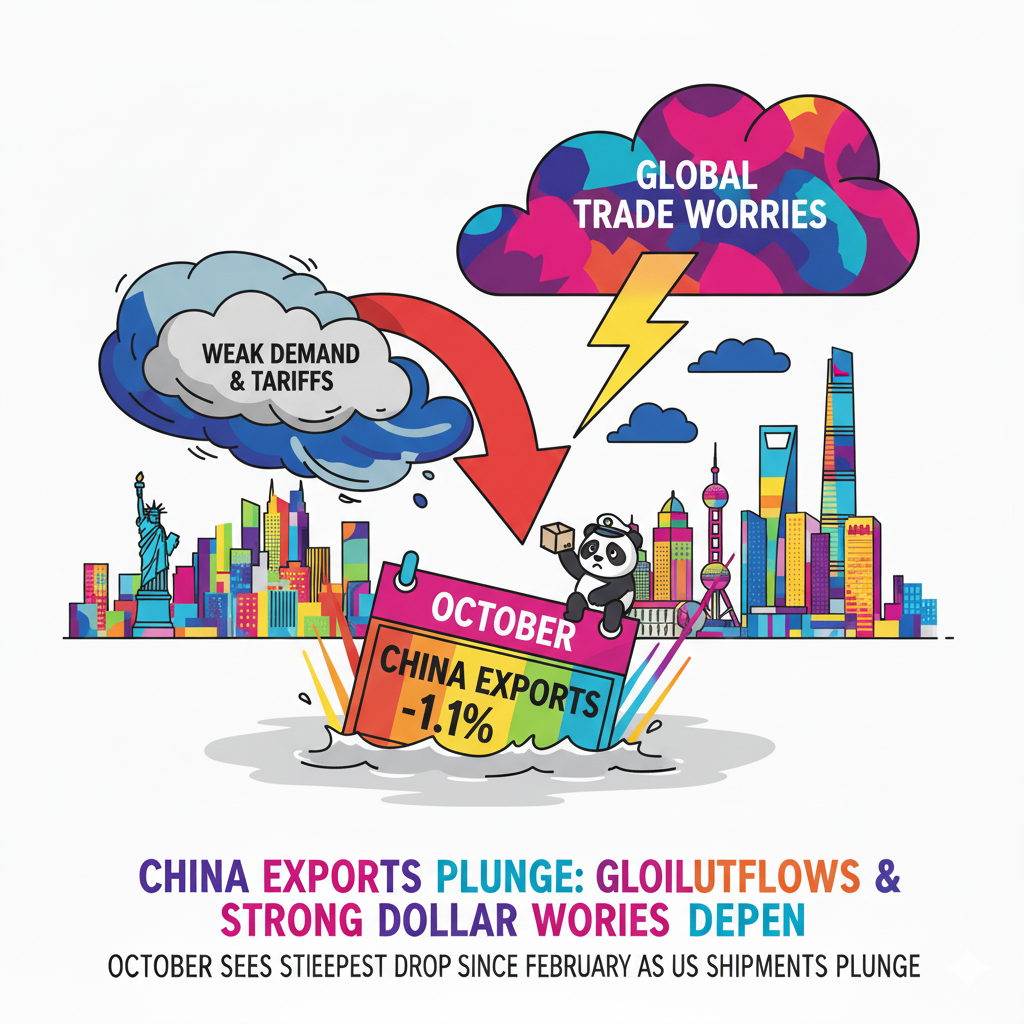
China, the world’s manufacturing powerhouse, has hit a troubling patch again. Recent trade data revealed that China’s exports plunged 1.1% year-on-year in October 2025, marking the sharpest downturn since February. The decline has sparked renewed concern among investors and global markets alike, suggesting that the world’s second-largest economy is still grappling with the aftershocks of trade disruptions, softening global demand, and growing protectionist policies — particularly from the United States.
As a stock market observer and analyst, it’s hard to ignore the signals this downturn sends — not only for China but also for global equities, commodities, and currencies tied to Asia’s economic engine. Let’s unpack what’s happening beneath the surface and what it could mean for your portfolio.
A Deeper Look into the Data
China’s 1.1% export decline in October may seem modest at first glance, but the composition tells a far deeper story. Exports to the United States nosedived by around 25%, representing the sharpest fall in several months. This single data point reflects the growing toll of renewed tariffs and the cooling of US consumer demand as inflation and interest rate uncertainty persist.
Meanwhile, exports to the European Union rose by 0.9% and to Southeast Asia by nearly 8.9%, showing that Chinese exporters are trying to diversify their markets. Yet, those gains couldn’t offset the sheer scale of lost business from the US — still China’s largest export destination.
Adding to the concern, imports grew by only 1%, the slowest in five months. Weak import data signals that domestic demand within China remains subdued, despite government efforts to stimulate consumption and stabilize property markets.
Tariffs, Trade Tensions, and the Shadow of the Trump Doctrine
One of the major catalysts behind the export downturn is the reintroduction and expansion of US tariffs on Chinese goods, a move that reignited trade friction between the world’s two largest economies. With the Trump administration’s policies back in focus, several categories of Chinese products — from electronics to steel and automotive components — have faced higher tariffs.
This escalation has forced many US companies to shift sourcing to alternative markets like Vietnam, India, and Mexico. The ripple effect has been a significant loss of competitiveness for Chinese manufacturers, particularly in electronics, textiles, and machinery.
Investors should note that trade tensions are not just political headlines — they directly influence supply chains, profit margins, and stock valuations. For instance, multinational corporations relying heavily on Chinese factories may see rising input costs, delayed shipments, and disrupted logistics — all of which weigh on quarterly earnings and investor sentiment.
The Weak Domestic Demand Story
Beyond external pressures, China’s internal economic structure is showing signs of fatigue. Imports rising only 1% underlines a broader issue: Chinese consumers are not spending at expected levels.
Despite various stimulus measures — such as rate cuts by the People’s Bank of China and local government bond issuances for infrastructure projects — household confidence remains low. The lingering property crisis, combined with stagnant wage growth, has restrained spending across urban households.
For investors, this is crucial. Weak domestic demand translates into lower consumption-driven growth, meaning that sectors like retail, consumer goods, and tourism may underperform relative to manufacturing and exports. However, even exports are no longer the reliable growth pillar they once were.
Global Ripple Effects: Stocks, Commodities, and Currencies
The Chinese export slump has far-reaching implications for global markets.
- Asian Stock Markets:
Regional equity markets such as Hong Kong’s Hang Seng and South Korea’s KOSPI tend to react sharply to Chinese trade data. Weak exports often trigger risk aversion, as investors anticipate lower demand for semiconductors, electronics, and industrial materials — key sectors tied to China’s factory activity. - Commodities:
China is the world’s largest consumer of raw materials, from copper to crude oil. A slowdown in exports and industrial output typically means reduced commodity imports, which can weigh on prices. Copper and iron ore — often considered barometers of Chinese manufacturing health — could see softening demand in the near term. - Currencies:
The Chinese yuan (CNY) has remained relatively stable, thanks to active intervention by the People’s Bank of China. However, continued trade weakness could renew depreciation pressures. The Australian dollar (AUD) and other commodity-linked currencies may also face selling pressure due to their close trade ties with China. - Global Growth Outlook:
China’s export sector is a critical driver of global supply chains. Prolonged weakness could feed into lower global trade volumes, hurting logistics companies, port operators, and shipping firms. The slowdown may also reduce inflationary pressures in developed economies by lowering import costs.
Analysts’ Reactions: More Caution Ahead
Economists warn that the October numbers are not an isolated blip but part of a longer-term structural adjustment. China is transitioning from an export-led growth model toward one based on domestic consumption and high-tech industries. However, that shift will take time — and comes with growing pains.
Several analysts have estimated that the sharp fall in US-bound exports shaved nearly 2 percentage points off total export growth, equivalent to around 0.3% of GDP. This decline may not derail China’s annual growth targets, but it does point to a slower recovery than expected.
In response, policymakers are likely to maintain a pro-stimulus stance — possibly with targeted measures for exporters, new incentives for technology manufacturers, and continued liquidity injections into the banking system.
What This Means for Investors
For global investors, China’s trade weakness offers both risks and opportunities.
- Short-term Caution:
Export-oriented sectors — particularly those linked to low-cost manufacturing — could face earnings pressure. Companies heavily reliant on US orders, such as consumer electronics assemblers, may see squeezed margins. - Long-term Opportunity:
China’s pivot toward domestic innovation and technology upgrading could eventually yield growth in sectors such as AI hardware, renewable energy, and electric vehicles. These industries are expected to benefit from state-backed subsidies and R&D support. - Portfolio Implications:
Investors may want to diversify exposure across Asia, favoring economies like India, Vietnam, and Indonesia, which are increasingly capturing manufacturing relocations from China. Meanwhile, maintaining exposure to Chinese tech and green sectors could offer upside potential when policy support intensifies.
A Reality Check: China Still Matters
Despite the headlines, it’s essential to remember that China remains the backbone of global manufacturing. A single month’s data doesn’t erase decades of infrastructure, logistics capability, and skilled labor that keep China central to the global supply chain.
However, the warning signs are clear: the combination of trade barriers, weak consumption, and external competition has slowed the Chinese growth engine. For global investors, that means being selective, data-driven, and forward-looking in how they engage with China-related assets.
Final Thoughts
China’s worst export downturn since February underscores the fragile balance in the global economy. With US tariffs biting, consumer demand slowing, and trade alliances shifting, China’s export machine is under serious strain.
Yet, history has shown that China is resilient — capable of recalibrating policy and markets when needed. As the world watches closely, investors should prepare for a year of volatility but also strategic opportunity — particularly in the sectors and regions best positioned to adapt to this new trade reality.
In short: The Chinese export decline is not just a data point — it’s a signal of the global economy’s ongoing transformation. For investors, the challenge lies in reading that signal correctly and positioning portfolios to benefit from the shifts ahead.