🌏 How Arjun Retired Early at 35 with SIP Investments – A Story for Young Investors

Most people believe retirement is something that happens after sixty. But what if you could design your life in a way that lets you retire by your mid-thirties, travel the world, and live without the stress of a 9-to-5 job? This isn’t a fantasy. With the right financial habits, especially starting a SIP (Systematic Investment Plan) early, it’s possible to build wealth that gives you freedom decades before others.

This is the story of Arjun, a young professional who, guided by his mentor Krishna, achieved financial independence and retired early. His journey is not just inspiring — it’s a blueprint for every young reader who wants to use mutual funds, SIPs, and SWPs to escape corporate life and live life on their own terms.


The Dream of Freedom

As a teenager, Arjun was curious and restless. He often wondered if life was meant to be spent in traffic, offices, and endless deadlines. He wanted to travel, explore, and live without restrictions. But like most young people, he didn’t know how to make that dream financially possible.

That’s when he met Krishna, his father’s friend and a seasoned mutual fund advisor. Krishna wasn’t tied to a corporate job. Instead, he lived freely, traveling and pursuing his passions. Arjun asked him the question every Gen Z investor has on their mind: “How can I achieve this kind of freedom?”


The Power of SIPs

Krishna explained that financial freedom wasn’t about luck or sudden wealth. It was about systematic, disciplined investing.

He introduced Arjun to Systematic Investment Plans (SIPs) — a simple method of investing a fixed amount in mutual funds every month. Even if Arjun started small, say ₹10,000 per month, compounding would turn it into crores over time.

The message was clear: start early, stay consistent, let compounding do the magic.


From First Salary to First Crore

At 22, Arjun got his first job in Bengaluru, earning ₹30,000 per month. Most of his peers spent their salaries on rent, gadgets, parties, and trips. Saving seemed impossible. But Krishna reminded him:

👉 “Treat your SIP like a Netflix subscription. It’s non-negotiable.”

So, Arjun began his journey with ₹10,000 SIP every month.

  • By 27, his portfolio had grown to over ₹20 lakhs.
  • By 32, he had accumulated nearly ₹80 lakhs.
  • At 35, his investments had compounded to ₹1.8 crores.

While his friends upgraded cars and houses with loans, Arjun upgraded his SIPs. Instead of chasing lifestyle inflation, he chased freedom.


Transitioning from SIP to SWP

When Arjun hit his financial milestone of nearly ₹2 crores, Krishna taught him about the next step — the Systematic Withdrawal Plan (SWP).

With SWP, Arjun could withdraw ₹80,000 per month for his expenses, while his portfolio continued to grow. This meant he didn’t need a corporate job anymore. His money was working harder than he ever could.

This is the power of combining SIPs for wealth creation and SWPs for financial independence.


Life Beyond the Office

At 35, Arjun quit his job, not out of frustration, but with peace. He had achieved what most people dream of — financial independence through investing.

He spent his days traveling, exploring cultures, and pursuing hobbies. His Instagram wasn’t filled with office selfies but with sunsets in Bali, treks in the Himalayas, and coffee shops in Europe.

When his old colleagues asked how he managed it, his answer was simple:

👉 “I invested early. While you bought things, I bought freedom.”


Lessons for Young Investors

Arjun’s story isn’t just motivational — it’s a practical roadmap for Gen Z who want to retire early in India:

  1. Start SIPs with your first salary – Even ₹5,000 to ₹10,000 makes a difference.
  2. Increase your SIP as your salary grows – Don’t fall into the lifestyle inflation trap.
  3. Stay invested for at least 12–15 years – Compounding needs time.
  4. Build a corpus of ₹1.5–2 crores – Enough to create a monthly SWP for expenses.
  5. Use SWP for cash flow – It lets you live off your investments while money keeps growing.

Why This Matters for Gen Z

Unlike previous generations, today’s youth don’t want to wait until their 60s to live life. They want early retirement, financial freedom, and the ability to explore the world.

By combining SIPs and SWPs, this dream is achievable. All it takes is discipline, patience, and a willingness to prioritize long-term goals over short-term pleasures.


Final Thought

Arjun’s journey proves that early retirement in your 30s is not a myth. It’s a strategy. If you are in your early 20s and just starting your career, the best gift you can give yourself is a SIP investment plan. In 10–15 years, you won’t just have money — you’ll have freedom.

So, the question isn’t whether financial independence is possible. The real question is: Will you start today, or will you wait until it’s too late?



PGIM India Global Equity Opportunities Fund of Fund – Complete Review 2025

Investors today are increasingly looking beyond Indian markets to diversify their portfolios. International mutual funds allow exposure to global economies, sectors, and companies that are not available in India. One such option is the PGIM India Global Equity Opportunities Fund of Fund (FoF).

This article provides a detailed review of the fund—including its objective, performance, risk profile, expense ratio, tax treatment, and whether it is a good fit for your investment strategy.

PGIM India Global Equity Opportunities Fund of Fund – Complete Review 2025


🔹 Fund Objective and Strategy

  • The primary aim of the fund is to generate long-term capital appreciation.
  • It achieves this by investing predominantly in units of overseas mutual funds.
  • Investment exposure spans across the U.S., Europe, Japan, and Canada.
  • Sectors covered include agriculture, allied industries, technology, healthcare, and global consumer businesses.
  • Since it is a Fund-of-Funds (FoF), it does not directly buy stocks but invests in international mutual funds.

👉 Best for investors seeking global diversification with long-term wealth creation.


🔹 Fund Launch & Benchmark

  • Launch Date: 14 May 2010
  • Benchmark Index: MSCI All Country World Index (TRI)
  • Fund Category: International FoF – Equity

This benchmark covers developed and emerging markets globally, making it a suitable comparison for the scheme’s performance.


🔹 Asset Allocation & Fund Size

  • The fund invests almost 98–99% in equity-oriented overseas mutual funds.
  • A very small proportion is parked in debt or cash instruments.

Assets Under Management (AUM) as of Aug 2025:

  • ₹1,474 crore – ₹1,496 crore

This places it in the mid-size category among international funds in India.


🔹 Expense Ratio & Exit Load

  • Regular Plan: ~2.39% (higher than category average of ~0.93%)
  • Direct Plan: ~0.63% (much cheaper, recommended for long-term investors)
  • Exit Load: 0.5% if redeemed within 90 days; no load afterward.

👉 Choosing the Direct Plan helps investors save significantly on costs.


🔹 Net Asset Value (NAV)

As of 28 August 2025:

  • Regular Plan – Growth NAV: ₹45.74
  • Direct Plan – Growth NAV: ₹51.82

The direct option has outperformed due to lower costs.


🔹 Risk Profile

  • Riskometer: Very High Risk
  • This is expected because it invests in global equities that are sensitive to international market cycles, currency fluctuations, and geopolitical risks.

👉 Suitable only for investors with high risk appetite and long-term investment horizon (5+ years).


🔹 Historical Performance

📊 Trailing Returns (as of Aug 2025 – Regular Growth Plan)

Time PeriodAbsolute ReturnsAnnualised CAGR
1 Year~6.6%~6.6%
3 Years~67.6%~18.8%
5 Years~48.8%~8.3%
Since Inception~351%~10.35%

📊 SIP Returns

SIP DurationTotal InvestmentValue as of Aug 2025Absolute GainAnnualised Return
3 Years₹36,000₹47,378+31.6%~18.7% CAGR
10 Years₹1,20,000₹2,50,000+108.8%~14.1% CAGR

👉 The fund has delivered strong SIP performance, proving the benefit of systematic investing.


🔹 Fund Ranking in Category (as per ET / Groww)

PeriodRank
1 Year53rd out of peers
3 Years19th
5 Years22nd

While 1-year ranking is low, long-term rankings are much better.


🔹 Taxation Rules

  • Short-Term Capital Gains (STCG):
    • If held ≤ 2 years → taxed as per individual slab rates.
  • Long-Term Capital Gains (LTCG):
    • If held > 2 years → taxed at 12.5% or 20% with indexation (depending on tax law interpretation).
  • Dividends: Added to taxable income and taxed as per slab. TDS applicable if dividend exceeds ₹5,000–₹10,000 (depending on rule).

👉 Always confirm with a tax advisor for the latest rules, as taxation on international FoFs is subject to periodic changes.


✅ Key Takeaways

  • Pros:
    • Global diversification across developed markets.
    • Strong long-term performance, especially via SIPs.
    • Direct plan offers low expense ratio.
    • Good for investors with long-term wealth creation goals.
  • Cons:
    • Very High Risk – not suitable for conservative investors.
    • High expense ratio in Regular plan.
    • Short-term performance can be volatile due to global market fluctuations.

🏆 Final Verdict

The PGIM India Global Equity Opportunities Fund of Fund is a strong option for investors looking to diversify internationally and capture growth opportunities in global markets.

  • Ideal Investment Horizon: 5+ years
  • Best Mode: Direct Growth Plan + SIP
  • Suitable for: High-risk, long-term investors who want exposure outside India.

If you are already heavily invested in Indian equities, this fund can act as a hedge and diversification tool to balance your portfolio.

Vikram Solar IPO 2025: Complete Details, Analysis & Expert Insights

The renewable energy sector is at the heart of India’s growth story, and Vikram Solar Limited, one of the country’s leading solar module manufacturers, is set to make a big move with its Initial Public Offering (IPO) in August 2025. Investors and analysts are closely tracking this public issue, considering the company’s strong presence in the solar industry and ambitious expansion plans.

This detailed guide covers everything about the Vikram Solar IPO — from issue size, price band, subscription details, company financials, and order book strength to expert recommendations.


Vikram Solar IPO Overview

Vikram Solar is launching an IPO that includes both a fresh issue of shares and an offer-for-sale (OFS) by existing shareholders. The company aims to raise capital for expansion while allowing current investors to partially exit.

  • Total Issue Size: ₹2,079 crore
  • Fresh Issue: ₹1,500 crore (new shares issued by the company)
  • Offer for Sale (OFS): ₹579 crore (shares sold by promoters and existing investors)

This combination ensures that the company raises funds for growth while also providing liquidity to early shareholders.


IPO Price Band and Lot Size

  • Price Band: ₹315 to ₹332 per share
  • Lot Size: 45 shares per lot
  • Minimum Investment: ₹14,940 (at the upper price band)
  • Maximum Investment (Retail): Retail investors can apply for up to 13 lots, i.e., 585 shares, amounting to ₹1,94,220.

The pricing has been structured to attract a wide base of retail, institutional, and high-net-worth investors.


IPO Timeline

EventDate
Issue Opening Date19 August 2025
Issue Closing Date21 August 2025
Basis of Allotment22 August 2025
Refunds Initiated25 August 2025
Shares Credited to Demat25 August 2025
Listing Date26 August 2025

The IPO is being managed by a strong group of lead managers and is expected to list on both BSE and NSE.


Investor Allocation

The allocation of shares in Vikram Solar IPO is structured as per SEBI guidelines:

  • Qualified Institutional Buyers (QIBs): Up to 50% of the net issue
  • Retail Investors: Minimum 35% of the net issue
  • Non-Institutional Investors (NIIs): Minimum 15% of the net issue
  • Employee Reservation: A small portion is reserved for employees at a discounted price

This ensures balanced participation across retail and institutional categories.


Grey Market Premium (GMP) Trends

The grey market premium (GMP) is an important indicator of investor sentiment. Ahead of the IPO launch, Vikram Solar’s GMP ranged between ₹54 to ₹70, which signals a premium of 16% to 21% over the upper price band.

This suggests a potential listing price around ₹389–₹400 per share, indicating the possibility of healthy listing gains.


Use of IPO Proceeds

The funds raised from the fresh issue will be used strategically to strengthen Vikram Solar’s business model and manufacturing capacity:

  1. Capital Expenditure: ₹793 crore will be invested into VSL Green Power Pvt Ltd, a subsidiary, for setting up advanced facilities.
  2. Project Expansion: ₹603 crore is earmarked for the company’s Phase-II expansion projects.
  3. General Corporate Purposes: Around ₹104 crore will go toward overall business requirements, including working capital and debt repayment.

A significant portion of the funds is directed towards establishing a 3 GW solar cell and module manufacturing facility in Tamil Nadu, which will enhance the company’s capacity and backward integration.


Company Background

  • Founded: 2005
  • Headquarters: Kolkata, West Bengal
  • Current Capacity: 4.5 GW solar module production as of March 2024
  • Client Base: Includes NTPC, Adani Green, JSW Energy, Azure Power, ACME, and other large energy players
  • Global Reach: Operates in over 39 countries

Vikram Solar started with a modest capacity of 12 MW in 2009 and has now become one of India’s largest solar PV manufacturers, playing a vital role in the nation’s renewable energy mission.


Growth Plans

The company has ambitious plans to expand aggressively:

  • Increase manufacturing capacity from 4.5 GW to 15.5 GW by FY26
  • Further scale to 20.5 GW by FY27
  • Enter the solar cell manufacturing segment for vertical integration
  • Explore battery energy storage solutions, which are critical for the future of renewable energy

These plans align perfectly with India’s target of achieving 500 GW of renewable energy capacity by 2030.


Financial Performance

Vikram Solar has delivered strong financial growth over the last three years:

  • Revenue FY25: ₹3,423 crore
  • EBITDA FY25: ₹492 crore
  • Profit After Tax (PAT) FY25: ₹140 crore
  • Revenue CAGR (FY23–FY25): ~29%
  • EBITDA CAGR (FY23–FY25): ~63%
  • PAT CAGR (FY23–FY25): ~211%

The company’s strong profitability and rapid growth in margins highlight operational efficiency and scalability.


Order Book Strength

As of March 2025, Vikram Solar reported an order pipeline of 10,340 MW, which is 2.3 times its current production capacity.

  • Orders Under Execution: 6,425 MW
  • Pending Orders: 3,916 MW

This strong order book provides visibility into revenue growth for the coming years.


Anchor Investors

Before the IPO opened for public subscription, Vikram Solar raised ₹621 crore from anchor investors. These included some of the world’s leading financial institutions and domestic mutual funds:

  • Goldman Sachs
  • Morgan Stanley India
  • BNP Paribas
  • HSBC
  • Citigroup
  • ICICI Prudential Life Insurance
  • SBI General Insurance
  • UTI Mutual Fund
  • Kotak Mahindra AMC
  • Nippon India Mutual Fund

The participation of such reputed investors reflects high confidence in Vikram Solar’s business model and growth potential.


Strengths of Vikram Solar

  1. Strong Brand & Market Presence: One of India’s leading solar module manufacturers with global presence.
  2. Robust Clientele: Long-term partnerships with major Indian and international companies.
  3. Large Order Book: Ensures revenue visibility for the next 2–3 years.
  4. Capacity Expansion: Aggressive growth plans to meet rising demand.
  5. Policy Support: Benefits from government incentives like PLI schemes and renewable energy targets.

Risks and Challenges

Despite strong fundamentals, there are certain risks investors should keep in mind:

  1. Capital Intensive Expansion: Huge investments needed for growth may strain cash flows.
  2. Customer Concentration: A large portion of revenue comes from a few big clients.
  3. Supply Chain Dependence: Import reliance for raw materials like solar cells could affect margins.
  4. Execution Risks: Large-scale expansion plans may face delays or cost overruns.
  5. Global Competition: International solar manufacturers pose strong competition.

Expert Recommendations

Different brokerage houses and analysts have shared mixed opinions about the IPO:

  • Positive Views: Many experts recommend subscribing due to the company’s strong order book, growing financials, and renewable energy sector tailwinds.
  • Cautious Views: Some analysts highlight high capital intensity and competitive risks, suggesting the IPO is best suited for investors with higher risk appetite.

Overall, the majority sentiment leans towards “Subscribe for long-term gains.”


Final Verdict

The Vikram Solar IPO is one of the most awaited issues in 2025, representing India’s renewable energy push. With a strong financial track record, aggressive expansion strategy, and reputed anchor investors, the company is well-positioned for growth.

Key Takeaways for Investors:

  • IPO Size: ₹2,079 crore (₹1,500 crore fresh + ₹579 crore OFS)
  • Price Band: ₹315 – ₹332
  • GMP Indication: Premium of ~16–21% over issue price
  • Strengths: Strong brand, high order book, financial growth
  • Risks: High capex, customer concentration, execution challenges

Conclusion: The Vikram Solar IPO offers a promising opportunity to participate in India’s renewable energy revolution. For investors with a medium to long-term horizon, it could be a strong addition to their portfolio

Vikram Solar IPO 2025: Complete Details, Analysis & Expert Insights

The renewable energy sector is at the heart of India’s growth story, and Vikram Solar Limited, one of the country’s leading solar module manufacturers, is set to make a big move with its Initial Public Offering (IPO) in August 2025. Investors and analysts are closely tracking this public issue, considering the company’s strong presence in the solar industry and ambitious expansion plans.

This detailed guide covers everything about the Vikram Solar IPO — from issue size, price band, subscription details, company financials, and order book strength to expert recommendations.


Vikram Solar IPO Overview

Vikram Solar is launching an IPO that includes both a fresh issue of shares and an offer-for-sale (OFS) by existing shareholders. The company aims to raise capital for expansion while allowing current investors to partially exit.

  • Total Issue Size: ₹2,079 crore
  • Fresh Issue: ₹1,500 crore (new shares issued by the company)
  • Offer for Sale (OFS): ₹579 crore (shares sold by promoters and existing investors)

This combination ensures that the company raises funds for growth while also providing liquidity to early shareholders.


IPO Price Band and Lot Size

  • Price Band: ₹315 to ₹332 per share
  • Lot Size: 45 shares per lot
  • Minimum Investment: ₹14,940 (at the upper price band)
  • Maximum Investment (Retail): Retail investors can apply for up to 13 lots, i.e., 585 shares, amounting to ₹1,94,220.

The pricing has been structured to attract a wide base of retail, institutional, and high-net-worth investors.


IPO Timeline

EventDate
Issue Opening Date19 August 2025
Issue Closing Date21 August 2025
Basis of Allotment22 August 2025
Refunds Initiated25 August 2025
Shares Credited to Demat25 August 2025
Listing Date26 August 2025

The IPO is being managed by a strong group of lead managers and is expected to list on both BSE and NSE.


Investor Allocation

The allocation of shares in Vikram Solar IPO is structured as per SEBI guidelines:

  • Qualified Institutional Buyers (QIBs): Up to 50% of the net issue
  • Retail Investors: Minimum 35% of the net issue
  • Non-Institutional Investors (NIIs): Minimum 15% of the net issue
  • Employee Reservation: A small portion is reserved for employees at a discounted price

This ensures balanced participation across retail and institutional categories.


Grey Market Premium (GMP) Trends

The grey market premium (GMP) is an important indicator of investor sentiment. Ahead of the IPO launch, Vikram Solar’s GMP ranged between ₹54 to ₹70, which signals a premium of 16% to 21% over the upper price band.

This suggests a potential listing price around ₹389–₹400 per share, indicating the possibility of healthy listing gains.


Use of IPO Proceeds

The funds raised from the fresh issue will be used strategically to strengthen Vikram Solar’s business model and manufacturing capacity:

  1. Capital Expenditure: ₹793 crore will be invested into VSL Green Power Pvt Ltd, a subsidiary, for setting up advanced facilities.
  2. Project Expansion: ₹603 crore is earmarked for the company’s Phase-II expansion projects.
  3. General Corporate Purposes: Around ₹104 crore will go toward overall business requirements, including working capital and debt repayment.

A significant portion of the funds is directed towards establishing a 3 GW solar cell and module manufacturing facility in Tamil Nadu, which will enhance the company’s capacity and backward integration.


Company Background

  • Founded: 2005
  • Headquarters: Kolkata, West Bengal
  • Current Capacity: 4.5 GW solar module production as of March 2024
  • Client Base: Includes NTPC, Adani Green, JSW Energy, Azure Power, ACME, and other large energy players
  • Global Reach: Operates in over 39 countries

Vikram Solar started with a modest capacity of 12 MW in 2009 and has now become one of India’s largest solar PV manufacturers, playing a vital role in the nation’s renewable energy mission.


Growth Plans

The company has ambitious plans to expand aggressively:

  • Increase manufacturing capacity from 4.5 GW to 15.5 GW by FY26
  • Further scale to 20.5 GW by FY27
  • Enter the solar cell manufacturing segment for vertical integration
  • Explore battery energy storage solutions, which are critical for the future of renewable energy

These plans align perfectly with India’s target of achieving 500 GW of renewable energy capacity by 2030.


Financial Performance

Vikram Solar has delivered strong financial growth over the last three years:

  • Revenue FY25: ₹3,423 crore
  • EBITDA FY25: ₹492 crore
  • Profit After Tax (PAT) FY25: ₹140 crore
  • Revenue CAGR (FY23–FY25): ~29%
  • EBITDA CAGR (FY23–FY25): ~63%
  • PAT CAGR (FY23–FY25): ~211%

The company’s strong profitability and rapid growth in margins highlight operational efficiency and scalability.


Order Book Strength

As of March 2025, Vikram Solar reported an order pipeline of 10,340 MW, which is 2.3 times its current production capacity.

  • Orders Under Execution: 6,425 MW
  • Pending Orders: 3,916 MW

This strong order book provides visibility into revenue growth for the coming years.


Anchor Investors

Before the IPO opened for public subscription, Vikram Solar raised ₹621 crore from anchor investors. These included some of the world’s leading financial institutions and domestic mutual funds:

  • Goldman Sachs
  • Morgan Stanley India
  • BNP Paribas
  • HSBC
  • Citigroup
  • ICICI Prudential Life Insurance
  • SBI General Insurance
  • UTI Mutual Fund
  • Kotak Mahindra AMC
  • Nippon India Mutual Fund

The participation of such reputed investors reflects high confidence in Vikram Solar’s business model and growth potential.


Strengths of Vikram Solar

  1. Strong Brand & Market Presence: One of India’s leading solar module manufacturers with global presence.
  2. Robust Clientele: Long-term partnerships with major Indian and international companies.
  3. Large Order Book: Ensures revenue visibility for the next 2–3 years.
  4. Capacity Expansion: Aggressive growth plans to meet rising demand.
  5. Policy Support: Benefits from government incentives like PLI schemes and renewable energy targets.

Risks and Challenges

Despite strong fundamentals, there are certain risks investors should keep in mind:

  1. Capital Intensive Expansion: Huge investments needed for growth may strain cash flows.
  2. Customer Concentration: A large portion of revenue comes from a few big clients.
  3. Supply Chain Dependence: Import reliance for raw materials like solar cells could affect margins.
  4. Execution Risks: Large-scale expansion plans may face delays or cost overruns.
  5. Global Competition: International solar manufacturers pose strong competition.

Expert Recommendations

Different brokerage houses and analysts have shared mixed opinions about the IPO:

  • Positive Views: Many experts recommend subscribing due to the company’s strong order book, growing financials, and renewable energy sector tailwinds.
  • Cautious Views: Some analysts highlight high capital intensity and competitive risks, suggesting the IPO is best suited for investors with higher risk appetite.

Overall, the majority sentiment leans towards “Subscribe for long-term gains.”


Final Verdict

The Vikram Solar IPO is one of the most awaited issues in 2025, representing India’s renewable energy push. With a strong financial track record, aggressive expansion strategy, and reputed anchor investors, the company is well-positioned for growth.

Key Takeaways for Investors:

  • IPO Size: ₹2,079 crore (₹1,500 crore fresh + ₹579 crore OFS)
  • Price Band: ₹315 – ₹332
  • GMP Indication: Premium of ~16–21% over issue price
  • Strengths: Strong brand, high order book, financial growth
  • Risks: High capex, customer concentration, execution challenges

Conclusion: The Vikram Solar IPO offers a promising opportunity to participate in India’s renewable energy revolution. For investors with a medium to long-term horizon, it could be a strong addition to their portfolio.


Direct Mutual Fund vs MFD: Which is Better for You? A Complete Guide with Example


Direct Mutual Fund vs MFD

When it comes to investing in mutual funds, you often face two options: Direct Plan or Regular Plan through a Mutual Fund Distributor (MFD).
Both have their advantages — but the right choice depends on your knowledge, time, and comfort level with financial decisions.

In this guide, we’ll explore the key differences, provide real-world examples, and share an imaginary success story to inspire you to make the right choice.


1. Understanding the Basics

Before diving into the comparison, let’s define the two types:

  • Direct Mutual Fund Plan
    You invest directly with the Asset Management Company (AMC) without intermediaries. This means no distributor commission, resulting in a slightly lower expense ratio.
  • MFD / Regular Mutual Fund Plan
    You invest through a Mutual Fund Distributor who provides guidance, research, and after-investment services. The expense ratio is slightly higher as it includes distributor commission.

2. Key Differences Between Direct and MFD Plans

AspectDirect PlanMFD / Regular Plan
How You InvestDirectly through AMC websites or apps.Through an MFD, advisor, or broker.
Expense RatioLower (no commission).Slightly higher (includes commission).
ReturnsHigher by 0.5%–1% annually in the long term.Slightly lower returns due to commission costs.
GuidanceNo personal guidance — you decide yourself.Expert advice, portfolio review, and rebalancing support.
ConvenienceYou handle all paperwork, KYC, and tracking.MFD manages all documentation, reminders, and monitoring.
Best ForExperienced investors who can track markets.Beginners or busy professionals needing assistance.

3. Why Many Investors Choose MFD Over Direct Plans

While Direct Plans seem attractive due to low costs, they require constant market tracking, research skills, and disciplined decision-making.
On the other hand, MFDs offer peace of mind — they guide you, help you avoid mistakes, and ensure you stay on track to meet your goals.


4. Motivational Example – The Story of Rohan and Meera

Let’s imagine two friends: Rohan and Meera.

Rohan – The Direct Plan Investor

Rohan decided to invest ₹10,000 per month directly in mutual funds.
In the first year, everything went well. He checked NAVs, read financial blogs, and felt confident.
But in the third year, the market went down. Panicked, he stopped investing for six months. Later, he restarted but missed the compounding benefits during that period.

Meera – The MFD Guided Investor

Meera also invested ₹10,000 per month — but through an MFD.
When the market fell, her distributor explained that market downturns are temporary and that continuing SIPs during a fall actually benefits investors.
She stayed invested, and after 10 years, her portfolio grew faster than Rohan’s — not just because of fund selection, but because she stayed disciplined.


5. How an MFD Adds Value Beyond Returns

  • Personalized Advice – Tailored investment strategies based on your age, goals, and risk profile.
  • Portfolio Review – Periodic reviews to ensure you are on track.
  • Behavioral Coaching – Prevents panic selling and helps you stay invested in tough times.
  • Convenience – Handles paperwork, transactions, and tax statements.

6. Final Verdict – Which Should You Choose?

  • If you are experienced, disciplined, and have time to research, Direct Plans might work for you.
  • If you are new to investing, busy with work, or want expert guidance, MFDs are the better choice — because small mistakes in mutual fund investing can cost you more than the commission you save.

7. Take Action Now

If you want to grow your wealth without the stress of constant monitoring, find a trusted Mutual Fund Distributor today.
Remember, in investing, discipline matters more than just cost savings — and having an expert by your side can make all the difference.


SEO Keywords Used: Direct mutual fund plan, MFD mutual fund, regular mutual fund plan, direct vs regular mutual fund, benefits of mutual fund distributor, how to invest in mutual funds.


If you want, I can also make a short WhatsApp/Email version of this article so you can share it with potential clients as part of your investment pitch.
Do you want me to prepare that next?

🏦 What is a Mutual Fund? A Complete Guide for First-Time Investors

Introduction

Are you thinking of investing but confused by complex terms like stocks, bonds, or NAV? You’re not alone. Many first-time investors feel overwhelmed when they hear about financial markets. That’s where mutual funds step in — offering a simple, flexible, and expert-managed path to grow your money.

In this complete guide, we’ll break down the basics of mutual funds, explain how they work, answer common questions, and even share a story to inspire your investment journey.


What is a Mutual Fund?

A mutual fund is a pool of money collected from many investors, which is then invested in a diversified portfolio of assets like stocks, bonds, or other securities. This pool is managed by professional fund managers with the goal of generating returns for all investors.

🧠 Simple Analogy:

Think of a mutual fund like a tiffin service. Everyone pays a little money and gets a complete, nutritious meal — cooked by expert chefs. You don’t need to know how to cook (or invest), but you still enjoy the benefits.


🔍 How Does a Mutual Fund Work?

Here’s a simple breakdown of how mutual funds function:

StepWhat Happens
1. Investors ContributeYou and others invest money in a mutual fund scheme
2. Fund is CreatedThe pooled money is managed by a professional fund house (AMC)
3. Fund Manager InvestsThe fund manager invests in assets (stocks, bonds, etc.) based on strategy
4. Returns are EarnedGains or losses from those investments are shared proportionally among investors
5. NAV is UpdatedNAV (Net Asset Value) changes daily based on the market value of investments

📦 Types of Mutual Funds (Based on Asset Class)

TypeDescriptionBest For
Equity FundInvests mainly in stocks; high returns, high riskLong-term growth
Debt FundInvests in bonds, govt. securities; safer but lower returnsRegular income, low risk
Hybrid FundMix of equity & debt; balances risk and returnBalanced investors
ELSSTax-saving equity fund under Section 80CTax-saving with growth
Index FundPassively tracks a market index (like Nifty 50)Low-cost, steady growth

📈 What is NAV in Mutual Funds?

NAV (Net Asset Value) is the price of one unit of a mutual fund.
It is calculated as:

NAV = (Total Assets – Liabilities) / Total Units Outstanding

Example:

If a fund’s assets are ₹100 crore and it has 10 crore units,
NAV = ₹10 per unit

Your investment value = NAV × number of units you hold


🧮 How Do You Earn Returns?

You can earn returns in 3 main ways:

  1. Capital Appreciation – Increase in NAV over time.
  2. Dividends – Some funds pay out profits regularly.
  3. Interest Income – From debt instruments in debt/hybrid funds.

✅ Benefits of Investing in Mutual Funds

BenefitWhy It Matters
DiversificationYour risk is spread across multiple assets
Expert ManagementProfessional fund managers make informed investment decisions
LiquidityEasy to buy/sell mutual fund units (except for lock-in funds like ELSS)
Low Entry BarrierStart SIPs with as little as ₹100–500 per month
Tax EfficiencyELSS funds offer tax deduction under Section 80C

📖 Real-Life Story: How Neha Made Her First Lakh

Neha, a 25-year-old software engineer in Pune, wanted to start investing but didn’t have time to learn about stock markets. Her colleague suggested mutual funds. Neha started a SIP of ₹2000/month in a balanced mutual fund.
She stayed invested for 5 years, never skipping a month.

Here’s what happened:

YearTotal SIP InvestmentApprox. Value (Assuming 12% CAGR)
1₹24,000₹25,510
2₹48,000₹53,990
3₹72,000₹87,470
4₹96,000₹1,26,320
5₹1,20,000₹1,71,830

Neha’s ₹1.2 lakh investment grew to nearly ₹1.7 lakh — without checking the market daily.

✅ Lesson: Start early. Stay consistent. Let compounding do the magic.


❓ Common Questions Answered

1. Is mutual fund safe?

While mutual funds carry some risk (especially equity funds), they’re considered safer than directly investing in individual stocks due to diversification.

2. Can I lose money in mutual funds?

Yes, short-term market volatility can cause losses. However, staying invested long-term reduces this risk significantly.

3. How much should I invest in mutual funds?

Start with any amount you’re comfortable with — even ₹500/month via SIP. Increase it as your income grows.

4. What documents are needed?

You need PAN, Aadhaar, and KYC-compliant bank details. Many platforms now offer paperless online onboarding.

5. When should I withdraw?

Ideally after 5+ years or once your financial goal is met. Avoid panic-selling during market dips.


💡 Expert Tips for First-Time Mutual Fund Investors

  1. Start Early, Even Small – Time is more powerful than money.
  2. Use SIPs – Automate investing to build discipline.
  3. Set Clear Goals – Invest with purpose: retirement, education, emergency.
  4. Don’t Time the Market – Stay invested during ups and downs.
  5. Review Annually – Check if your fund still meets your goals.

📊 Mutual Fund vs Fixed Deposit (FD)

FeatureMutual FundFixed Deposit (FD)
Return Potential8–15% (equity), 5–7% (debt)5–7%
RiskModerate to High (depending on fund type)Low
LiquidityHigh (except ELSS)Medium (penalty on early withdrawal)
Tax BenefitsELSS under Sec 80C5-year tax-saving FD only
Inflation-Beating✅ Yes (Equity Funds)❌ No

✨ The Power of Compounding: Why You Shouldn’t Wait

“Compound interest is the 8th wonder of the world.” – Albert Einstein

Let’s say you invest ₹3000/month for 20 years in a mutual fund that gives 12% annual return.

YearsTotal InvestmentMaturity Value
10₹3.6 lakh₹6.9 lakh
15₹5.4 lakh₹13.5 lakh
20₹7.2 lakh₹23.3 lakh

You invest ₹7.2 lakh over 20 years but earn ₹16 lakh extra. That’s the power of patience + mutual funds.


🚀 How to Get Started With Mutual Funds?

  1. Choose a trusted platform – Zerodha Coin, Groww, Paytm Money, Kuvera
  2. Complete KYC – Aadhaar, PAN, and selfie verification online
  3. Start SIP or Lumpsum – Begin with ₹100–500/month
  4. Track & Review – Use apps to monitor your portfolio easily

🛡️ Words of Caution

  • Read scheme documents carefully.
  • Don’t chase last year’s top-performing fund.
  • Avoid excessive portfolio churning.
  • Stick with your goals, not market noise.

🏁 Conclusion

Mutual funds are the simplest gateway to wealth-building for first-time investors. With low investment requirements, expert management, and powerful long-term growth potential, they offer a smart alternative to FDs, RDs, or sitting on idle cash.

💬 Start where you are. Use what you have. Begin now.

Still unsure where to begin? Choose a good balanced fund, start a SIP, and let compounding take care of the rest. Your future self will thank you.

Bajaj Finserv Small Cap Fund NFO 2025: Key Details & Investment Guide

Bajaj Finserv Small Cap Fund NFO 2025 – Complete Guide

Bajaj Finserv Small Cap Fund NFO – A Smart Investment Opportunity in 2025

The Bajaj Finserv Small Cap Fund is an exciting new offering in the Indian mutual fund space. Launched under Bajaj Finserv Asset Management Ltd., this New Fund Offer (NFO) aims to capitalize on the potential of small-cap companies with strong fundamentals, good governance, and long-term growth prospects.

NFO Timeline

Start Date: 27th June 2025
End Date: 11th July 2025

Fund Type & Objective

This is an open-ended equity scheme primarily investing in small-cap companies. The objective is to generate long-term capital appreciation by investing in fundamentally sound businesses that fall within the small-cap universe.

Investment Strategy

The Bajaj Small Cap Fund follows a ‘3-in-1’ investment philosophy: Quality, Growth, and Value.
  • Quality: Focuses on good governance and sustainability.
  • Growth: Targets companies with consistent and scalable earnings.
  • Value: Looks for businesses trading below their intrinsic value.

Asset Allocation

Asset Type Allocation (%)
Small-cap equities 65% – 100%
Other equities (large/mid cap, foreign) 0% – 35%
Debt & Money Market Instruments 0% – 35%
REITs / InvITs 0% – 10%

Offer Details

Issue Price: ₹10 per unit
Minimum Investment (Lumpsum): ₹500
SIP Option: ₹500 (minimum 6 instalments)

Load Structure

  • Entry Load: Nil
  • Exit Load: 1% if redeemed within 6 months, Nil thereafter

Plan Options

The fund is available under:

  • Direct Plan (low-cost, for DIY investors)
  • Regular Plan (via distributor)
  • Growth & IDCW options (Reinvestment / Payout / Transfer)

Fund Managers

  • Nimesh Chandan – CIO (Equity)
  • Sorbh Gupta – Senior Fund Manager (Equity)
  • Siddharth Chaudhary – Senior Fund Manager (Debt)

Risk Profile & Benchmark

Risk Level: Very High
Benchmark: BSE 250 SmallCap TRI

Why Invest in Bajaj Finserv Small Cap Fund?

  • Strong research-driven approach with forensic analysis
  • Opportunity to invest in high-growth early-stage companies
  • Backed by trusted Bajaj brand and experienced fund managers

Call to Action

If you’re a long-term investor seeking growth and can handle high risk, this NFO may be worth considering. Don’t miss out on this opportunity to get in at the ground floor price of ₹10 per unit.

Invest Now

Trust Mutual Fund – Fixed Income Options for Conservative Investors

Trust Mutual Fund Overview

Trust Mutual Fund – Fixed Income Options for Conservative Investors

Presented by: SEBI-Registered Mutual Fund Distributor

AMC Overview

ParticularDetails
AMC NameTrust Asset Management Pvt. Ltd.
Launch Date7 October 2019
Incorporation Date12 December 2017
SponsorTrust Investment Advisors Pvt. Ltd.
Trustee CompanyTrust AMC Trustee Pvt. Ltd.
MD & CEOMr. Sandeep Bagla
Compliance OfficerMs. Puja Trivedi
Investor Service OfficerMr. Nilesh Bhurke

Investment Philosophy

Trust Mutual Fund uses a Limited Active Strategy, aiming to balance passive discipline with targeted active research.

  • Focus on credit quality, liquidity, low volatility
  • Backed by data-driven, rule-based methodology
  • Cost-effective and process-oriented
Note: Mutual Fund investments are subject to market risks. Read scheme-related documents carefully before investing.

Available Schemes (As of June 2025)

Fund Name Risk Level Type AUM (₹ Cr) 1-Year Return* Min Investment
Banking & PSU Debt Fund Low to Moderate Debt 110 ~9.2% ₹1,000
Short Duration Fund Moderate Debt 112 ~9.5% ₹1,000
Liquid Fund Low to Moderate Debt 764 ~7.2% ₹1,000
Overnight Fund Low Debt 78 ~6.4% ₹1,000
*Past performance is not indicative of future returns.

Fund Management

ParticularDetails
Lead Fund ManagerMr. Anand Nevatia
ExperienceOver 19 years in capital markets
SpecialisationFixed Income Portfolio Management

How to Invest

ModeProcess
OfflineSubmit application form, KYC, cheque, and photograph
OnlineUse AMC website or platforms like Groww, Paytm, complete eKYC

Final Note

Trust MF is ideal for conservative investors seeking low-risk debt exposure. Let’s schedule a consultation to explore options tailored to your goals.

Book Your Free Consultation

Should You Invest in ArisInfra Solutions Limited IPO ? Full Breakdown Inside

ArisInfra Solutions IPO 2025: Full Analysis, Dates, Price Band, Lot Size & Financials

ArisInfra Solutions Limited , a fast-growing, tech-enabled B2B construction materials platform, is set to debut on the Indian stock exchanges with an IPO worth ₹499.60 crore. With strong fundamentals, a scalable business model, and an established footprint in the infrastructure procurement space, ArisInfra Solutions Limited IPO has caught the attention of both retail and institutional investors. This comprehensive guide provides all the critical details about the IPO, including dates, price band, company background, competitive strengths, and investment strategy.

Arisinfra Solutions Limited  IPO

📊 IPO Highlights at a Glance

ParticularsDetails
IPO NameArisInfra Solutions Limited IPO
IPO Size₹499.60 crore
Issue TypeBook Built Issue IPO
Fresh Issue2.25 crore shares
Price Band₹210 to ₹222 per share
Lot Size (Retail)67 shares
Minimum Retail Investment₹14,070
Suggested Cutoff Investment₹14,874
IPO Open DateJune 18, 2025
IPO Close DateJune 20, 2025
Allotment DateJune 23, 2025
Listing Date (Tentative)June 25, 2025
ExchangesBSE, NSE

💼 Investment Categories

Investor CategoryMinimum ApplicationInvestment Amount (₹)
Retail Investors1 Lot (67 shares)14,070 – 14,874
Small NII (sNII)14 Lots (938 shares)2,08,236
Big NII (bNII)68 Lots (4,556 shares)10,11,432

🏠 About ArisInfra Solutions Limited

Incorporated in 2021, ArisInfra Solutions Limited is a next-generation platform tailored for the construction and infrastructure sector. The company digitizes the entire procurement chain, offering an end-to-end technology-driven solution to acquire construction materials efficiently.

Operating as a B2B platform, ArisInfra simplifies material sourcing and financial management for clients such as infrastructure developers, builders, and contractors. The firm leverages AI-based tools and a strong vendor ecosystem to deliver speed, accuracy, and savings.


⚖️ Product Portfolio

The company’s offerings include a wide range of essential construction materials such as:

  • GI Pipes (Steel)
  • MS Wires (Steel)
  • MS TMT Bars
  • OPC Bulk Cement
  • Aggregates
  • Ready-Mix Concrete (RMC)
  • Construction Chemicals
  • Walling Solutions

👥 Clientele & Market Reach

Between April 1, 2021, and March 31, 2024, ArisInfra:

  • Delivered 10.35 million metric tonnes of construction materials
  • Partnered with 1,458 vendors
  • Served 2,133 customers
  • Covered 963 pin codes across cities like Mumbai, Bengaluru, and Chennai

Key Clients Include:

  • Capacit’e Infraprojects Limited
  • J Kumar Infraprojects Limited
  • Afcons Infrastructure Limited
  • EMS Limited
  • S P Singla Constructions Pvt. Ltd.

Its subsidiary, ArisUnitern Re Solutions Pvt. Ltd., extends advisory, marketing, consultancy, and sales support services to real estate developers, providing a complete ecosystem.


📊 Financial Performance Snapshot

ArisInfra has shown promising financial trends:

Fiscal YearRevenue (₹ Cr)Net Profit/Loss (₹ Cr)
FY 2023702.00-17.00
FY 2024557.80+6.50

The company has reversed its losses in FY2024, achieving profitability with prudent operational strategies and cost efficiencies.


🌟 Competitive Strengths

  1. Technology-Driven Platform:
    • AI-enabled credit risk tools and operational automation streamline procurement.
  2. Wide Product Basket:
    • From steel to cement, ArisInfra offers a one-stop-shop for construction needs.
  3. Vendor & Client Ecosystem:
    • Strong relationships with both suppliers and buyers ensure reliable demand and supply.
  4. Pan-India Presence:
    • Service coverage across 900+ pin codes ensures scalability.
  5. Experienced Management:
    • Backed by professionals with deep industry expertise and startup experience.

🔄 Use of IPO Proceeds

The IPO funds will be allocated as follows:

  • Repayment and/or prepayment of existing borrowings
  • Working capital augmentation
  • Strategic investment into subsidiaries
  • General corporate purposes

📊 Grey Market Premium (GMP) & Market Sentiment

As of June 18, the GMP stands around ₹24-25 per share, indicating a potential listing gain of 10-12%. While the first day saw retail category fully subscribed, QIBs and NIIs are expected to boost demand by Day 3.


✅ Should You Subscribe?

Pros:

  • Positive financial turnaround
  • Strong market demand in construction sector
  • Digital-first approach in a traditional supply chain
  • Impressive clientele and vendor base

Cons:

  • Early-stage business with high scalability expectations
  • Thin profit margins and dependency on working capital

Expert Verdict:
For long-term investors, ArisInfra offers a compelling growth opportunity in India’s infrastructure revolution. Retail investors may consider subscribing at the cutoff price to maximize allocation chances.


📆 Key Dates Recap

EventDate
IPO Opening DateJune 18, 2025
IPO Closing DateJune 20, 2025
Allotment FinalizationJune 23, 2025
Refund InitiationJune 24, 2025
Shares Credited in DematJune 24, 2025
Listing Date (Tentative)June 25, 2025

Final Words:

ArisInfra Solutions Limited is bringing a tech edge to a traditionally offline, unorganized market. With a diversified product line, experienced leadership, and a digitally integrated supply chain, the IPO stands out among mid-cap offerings. While risks remain due to its recent profitability and reliance on large working capital, the long-term vision and market potential offer promising rewards.

Patil IPO information you can check

Axis Bank’s fundamentals

Here’s a concise summary of Axis Bank’s fundamentals as of the most recent available data (FY 2023-24). Please note that values might have slightly changed depending on the latest quarterly results.


🏦 Axis Bank – Company Overview

  • Founded: 1993
  • Headquarters: Mumbai, Maharashtra
  • Type: Private Sector Bank
  • CEO & MD: Amitabh Chaudhry
  • Market Cap: Approx. ₹3.5–4 lakh crore (varies with market)
  • NSE/BSE Code: AXISBANK

💰 Key Financials (FY 2023–24)

MetricValue
Net Interest Income (NII)₹51,569 crore
Net Profit₹23,344 crore
Total Assets₹14.86 lakh crore
Net Interest Margin (NIM)~4.05%
Gross NPA1.43%
Net NPA0.36%
Provision Coverage Ratio81%
Return on Equity (ROE)17.51%
Return on Assets (ROA)1.84%
Capital Adequacy Ratio17.63% (well above regulatory norms)
CASA Ratio~44%

📈 Stock Performance (1-Year)

  • 52 Week High/Low: ₹1,180 / ₹905
  • Current Price (as of June 2025): ₹1,120 approx
  • P/E Ratio: ~14.5
  • Price to Book (P/B): ~2.2

🧾 Recent Developments

  • Strong Q4 FY24 results with significant profit jump YoY.
  • Continuous reduction in NPAs – healthy asset quality.
  • Focus on digital banking and expanding retail loan book.
  • Acquired Citibank India’s consumer banking business (completed in 2023), boosting its credit card and wealth management operations.

📊 Strengths

  • Strong brand and wide retail presence
  • Good digital infrastructure and tech adoption
  • Healthy growth in retail and SME loans
  • Robust risk management and improving asset quality

⚠️ Risks & Weaknesses

  • Sensitive to RBI’s rate changes (impacts NIM)
  • Exposure to corporate loans (can add volatility)
  • Competitive private banking space (HDFC Bank, ICICI Bank, Kotak, etc.)

Would you like:

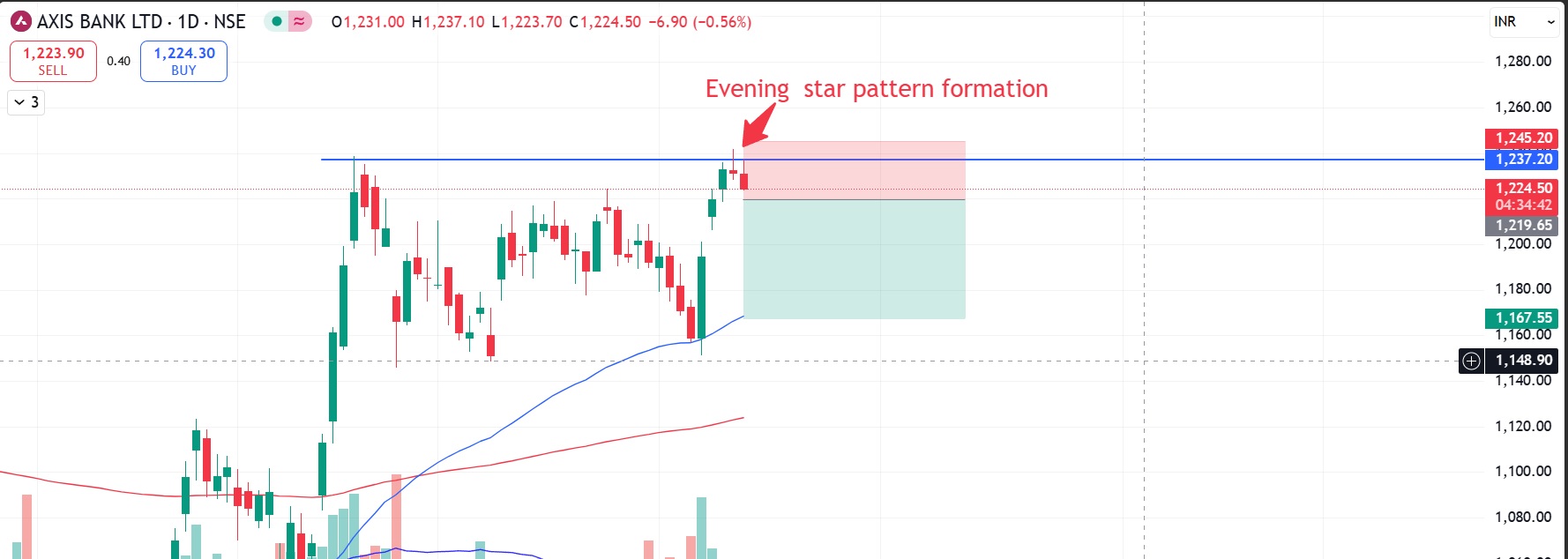
evening star