Managing your finances often feels like trying to solve a complex puzzle without having the picture on the box. Between the rising cost of living, the temptation of instant gratification through online shopping, and the looming pressure of future goals like buying a home or retiring comfortably, it is easy to feel overwhelmed. Many people avoid budgeting altogether because they assume it requires hours of tedious spreadsheet data entry or a degree in accounting. However, financial stability doesn’t have to be complicated.
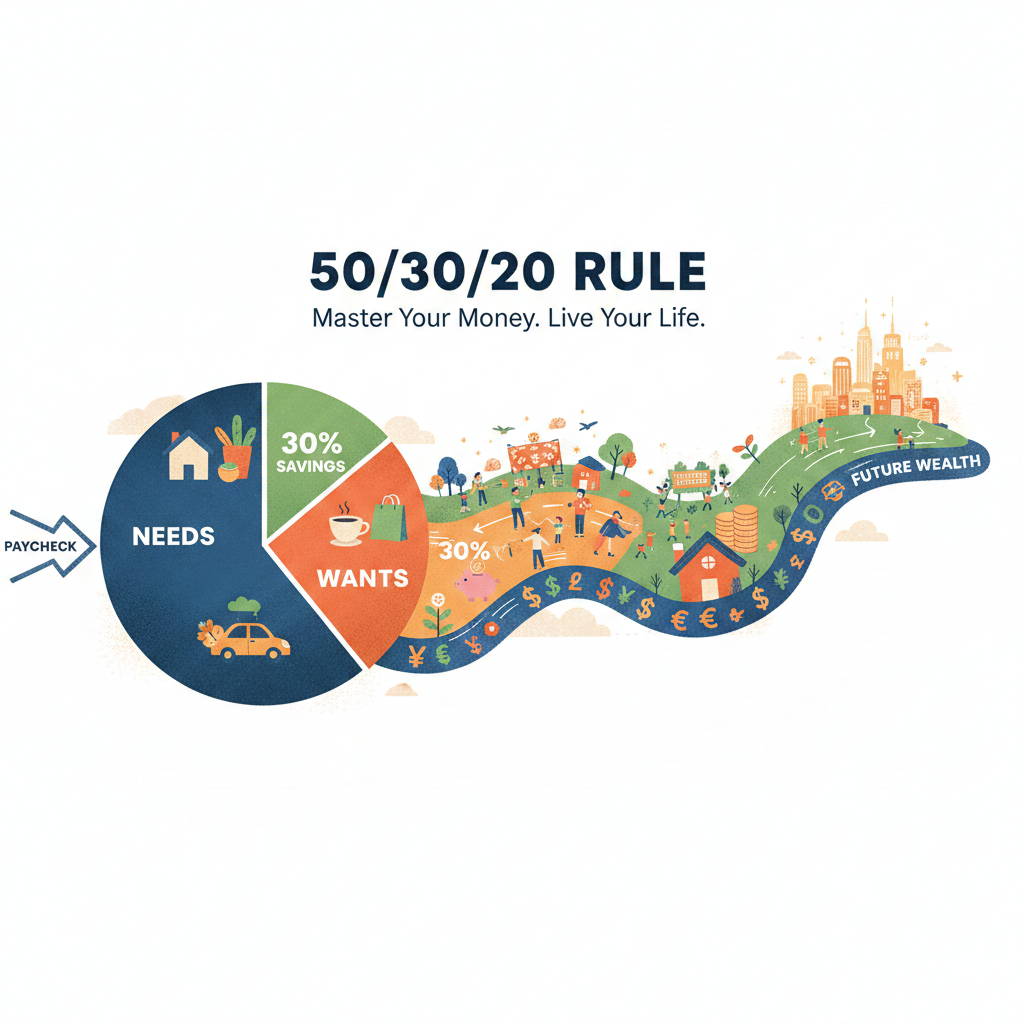
One of the most effective, time-tested strategies for regaining control of your money is the 50/30/20 Rule. Popularized by Senator Elizabeth Warren in her book All Your Worth, this framework has become a cornerstone of modern personal finance. It is designed to be a “rule of thumb” rather than a rigid set of laws, offering a balanced approach that allows you to live for today while still preparing for tomorrow.
In this guide, we will break down the mechanics of the 50/30/20 rule, explore why it works, and provide a roadmap for how you can implement it in your own life.
The Foundation: Understanding Your “Take-Home Pay”
Before you can divide your money into categories, you must first determine exactly how much you have to work with. The 50/30/20 rule is based on your after-tax income—also known as your “take-home pay.”
If you are a salaried employee, this is the amount that actually hits your bank account every month after taxes, insurance, and retirement contributions have been deducted. If you are a freelancer or business owner, your take-home pay is your gross income minus your business expenses and the amount you set aside for taxes. Once you have this single, clear number, you can begin the process of allocation.
1. The 50%: Managing Your “Needs”
The largest portion of your budget—half of your income—is dedicated to your Needs. These are the non-negotiables. If you stopped paying for these things, your life would experience a significant disruption or legal consequence.
What counts as a Need?
- Housing: Your rent or mortgage payments, property taxes, and home insurance.
- Utilities: Electricity, water, heating, and basic internet/phone service (which are essential in the modern world).
- Groceries: The basic food items required to keep you healthy.
- Transportation: Car payments, fuel, insurance, or public transit passes required for work and daily life.
- Healthcare: Insurance premiums and essential medications.
- Minimum Debt Payments: The absolute minimum required to keep your loans (like student loans or car loans) in good standing.
The goal of the 50% category is to ensure that your basic survival is covered. If your needs currently exceed 50% of your income, it is a signal that you might be “house poor” or “car poor.” In such cases, the rule encourages you to look for ways to downsize or reduce fixed costs so that you aren’t living on the edge of a financial crisis.
2. The 30%: Embracing Your “Wants”
The most common mistake in budgeting is being too restrictive. If you try to cut out every bit of fun from your life, you will eventually experience “budget burnout” and give up entirely—much like a crash diet that is impossible to maintain. This is where the 30% for Wants comes in.
This category is about lifestyle. These are the things you spend money on by choice, not by necessity.
What counts as a Want?
- Dining Out: Brunches, coffee shop runs, and Friday night takeout.
- Entertainment: Movie tickets, concerts, and sporting events.
- Subscriptions: Netflix, Spotify, gym memberships, and gaming passes.
- Shopping: New clothes that aren’t strictly for work, latest gadgets, and home decor.
- Travel: Weekend getaways or saving for a major vacation.
Assigning a full 30% to wants allows you to enjoy the fruits of your labor without guilt. It transforms budgeting from a “restrictive chore” into a “spending plan.” As long as you stay within that 30% threshold, you can spend your money on whatever brings you joy, knowing that your essentials and your future are already taken care of.
3. The 20%: Securing Your “Financial Future“
The final 20% is the most critical for long-term peace of mind. While the first 50% covers your present and the next 30% covers your enjoyment, this 20% is dedicated to Savings and Debt Repayment.
This isn’t just about putting money under a mattress; it’s about strategic financial movement.
Where does the 20% go?
- Emergency Fund: Your first priority should be saving 3 to 6 months of living expenses. This acts as a buffer against job loss or medical emergencies.
- Retirement: Contributions to 401(k)s, IRAs, or pension schemes. The earlier you start, the more “compounding interest” works in your favor.
- Aggressive Debt Paydown: This goes beyond the “minimum payments” mentioned in the needs category. This is for paying off high-interest credit card debt or extra principal on your mortgage.
- Investing: Once an emergency fund is established, this money can go into stocks, bonds, or mutual funds to grow your wealth.
By consistently hitting this 20% mark, you ensure that you aren’t just surviving month-to-month, but actually building a net worth that will provide freedom later in life.
Why the 50/30/20 Rule Actually Works
The reason this method has remained popular for decades is its psychological accessibility.
First, it removes the “all-or-nothing” mentality. Many people think that to save money, they must live like a monk. By explicitly carving out 30% for “wants,” the rule gives you permission to spend, which makes the overall plan much more sustainable.
Second, it provides instant clarity. If you find yourself struggling at the end of the month, you can look at these three buckets and identify the leak. Are your “wants” creeping into the 40% range? Is your rent taking up 60% of your income? The rule provides a diagnostic tool to fix your finances.
Third, it automates decision-making. When you get a raise, you don’t have to wonder what to do with the extra money. You simply apply the ratio: half to bettering your current lifestyle/needs, a bit more for fun, and a significant chunk for your future.
How to Get Started: A Step-by-Step Guide
- Calculate your income: Look at your last three paystubs to find your average monthly take-home pay.
- Categorize your spending: Go through your bank statements from the last month. Mark every expense as a Need, a Want, or Savings/Debt.
- Compare your current percentages: See how close you are to 50/30/20. Don’t be discouraged if your numbers are off; the goal is progress, not perfection.
- Adjust the “Wants” first: If you are over budget, the easiest place to cut is the 30% category. Small tweaks to subscriptions and dining habits can yield big results.
- Automate your savings: Set up a recurring transfer so that 20% of your paycheck goes directly into a savings or investment account the moment it hits your bank. If you don’t see it, you won’t spend it.
Final Thoughts: Flexibility is Key
It is important to remember that the 50/30/20 rule is a compass, not a map. Life is unpredictable. If you live in a high-cost-of-living city like New York or London, your “Needs” might naturally take up 60% of your income. In that case, you might need to adjust your “Wants” to 20% to keep your “Savings” at 20%.
The ultimate goal of the 50/30/20 rule is to foster a healthy relationship with money. It teaches us that financial health isn’t about how much we earn, but about how we manage what we have. By balancing our obligations, our desires, and our future goals, we can reduce financial stress and build a life of true security and enjoyment.
2 thoughts on “Budgeting by the Numbers: 50/30/20”
Comments are closed.