Lenskart IPO Receives 2X plus Subscription; Retail Bidders Shine Bright

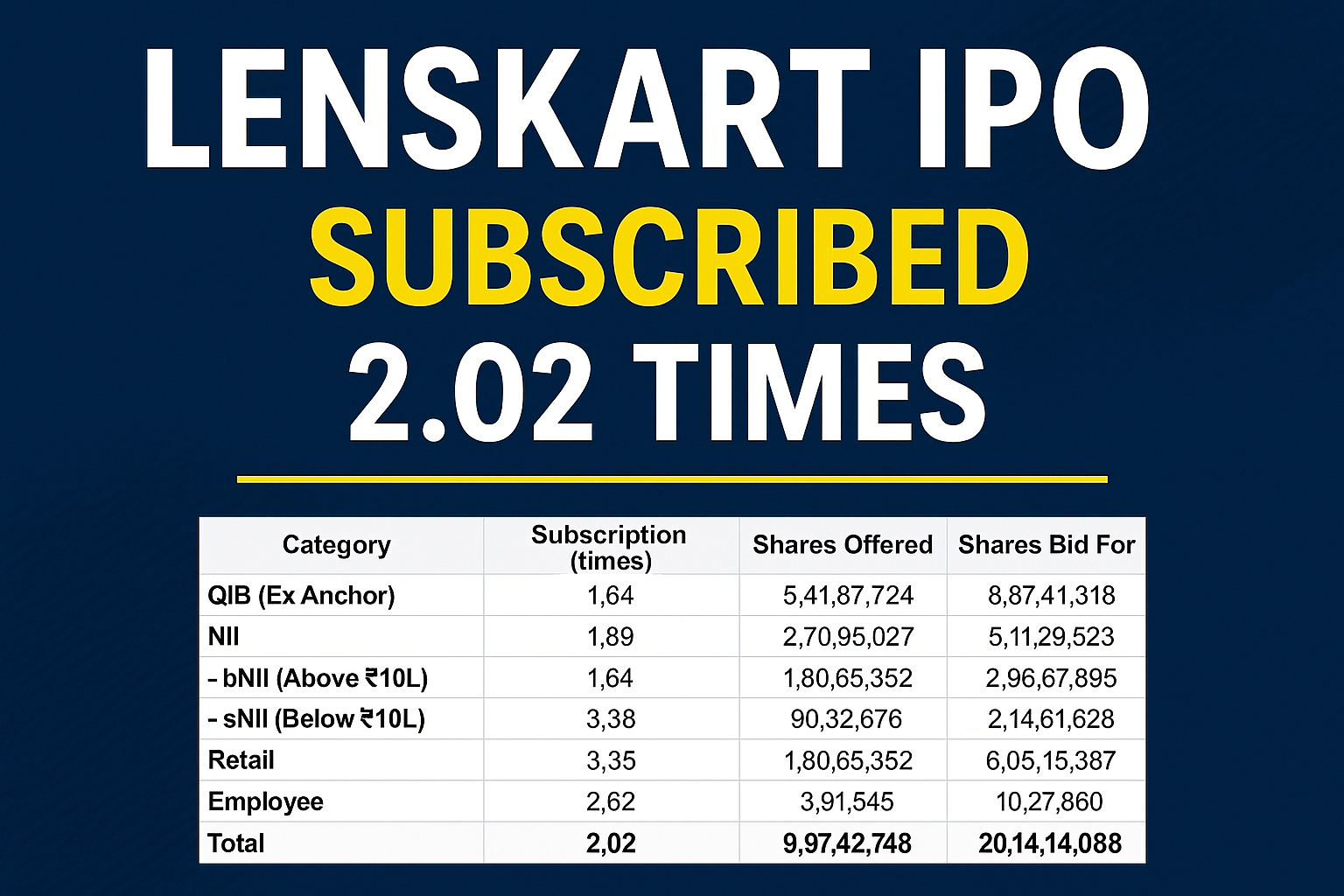
The Lenskart IPO received an impressive response from investors, with an overall subscription of 2.02 times on the final bidding day. The issue saw strong demand from all categories, especially retail investors, who subscribed 3.35 times, applying for over 6.05 crore shares against 1.80 crore offered.

Qualified Institutional Buyers (QIBs) subscribed 1.64 times, while Non-Institutional Investors (NIIs) subscribed 1.89 times, showing solid interest from both large and small HNIs. The employee quota also saw healthy participation at 2.62 times, reflecting confidence from within the company.

Overall, Lenskart’s strong brand, omnichannel presence, and growing market share helped attract wide investor attention. Market experts expect a positive listing on the NSE and BSE, given the robust subscription figures and investor sentiment.

CategorySubscription (times)Shares OfferedShares Bid For
QIB (Ex Anchor)1.645,41,87,7248,87,41,318
NII1.892,70,98,0275,11,29,523
– bNII (Above ₹10L)1.641,80,65,3522,96,67,895
– sNII (Below ₹10L)2.3890,32,6762,14,61,628
Retail3.351,80,65,3526,05,15,387
Employee2.623,91,64510,27,860
Total2.029,97,42,74820,14,14,088

Sensex Slips 300 Points, Nifty Below 25,800: FII Selling Among Key Factors Behind Market Decline

The Indian equity market witnessed a sharp downturn on Friday, with the Sensex slipping nearly 300 points and the Nifty falling below the crucial 25,800 mark. Persistent foreign institutional investor (FII) selling, cautious sentiment ahead of key global events, and profit-booking across major sectors contributed to the market weakness.


📉 Market Overview

At the close, the BSE Sensex ended down 298 points at 84,215, while the NSE Nifty 50 settled at 25,775, losing nearly 0.6%. The decline comes after a week of volatile sessions, as traders grapple with mixed global cues, rising US bond yields, and concerns over foreign fund outflows.

Broader markets also mirrored the trend — the BSE Midcap and Smallcap indices shed between 0.4% and 0.7%, indicating selling pressure beyond blue-chip stocks.


💸 FII Selling Remains a Key Drag

One of the central reasons behind the market’s decline is sustained FII selling. According to exchange data, foreign investors sold equities worth over ₹2,500 crore in the last two sessions alone. This marks the continuation of a trend observed over the past month, where global funds have been gradually trimming exposure to Indian equities.

Analysts attribute this to multiple factors — a strengthening US dollar, rising US Treasury yields, and geopolitical uncertainties pushing investors toward safer assets. Additionally, valuations in Indian equities remain elevated compared to other emerging markets, prompting foreign investors to book profits.

In contrast, domestic institutional investors (DIIs) have been net buyers, absorbing part of the FII outflow. However, their support was insufficient to offset the broad-based selling seen today.


🏦 Sectoral Pressure: Banks and IT Lead Decline

Selling was visible across sectors, with Banking, IT, and Metal stocks taking the biggest hit. The Nifty Bank index dropped nearly 0.8%, weighed down by private lenders such as HDFC Bank, ICICI Bank, and Axis Bank.

The IT index also fell sharply amid global risk-off sentiment, with Infosys, TCS, and Wipro witnessing moderate losses. Analysts noted that weak global demand, a firm rupee, and cautious outlooks from US clients could weigh on IT sector performance in the near term.

Meanwhile, metal stocks were impacted by China’s sluggish industrial data, dampening hopes of a quick recovery in global commodity demand.


💹 Defensive Plays Offer Some Cushion

Amid the decline, FMCG and Pharma stocks provided some support, as investors turned defensive. Shares of Hindustan Unilever, ITC, Sun Pharma, and Cipla saw marginal gains, reflecting a typical shift toward low-volatility counters during uncertain market phases.


🌍 Global Cues: US Fed Outlook and Oil Prices Weigh

Globally, markets were subdued as investors awaited fresh signals from the US Federal Reserve regarding interest rates. Hawkish comments from some Fed officials earlier this week have reignited fears that rates could stay higher for longer.

Adding to the pressure, crude oil prices have inched up again, with Brent crude hovering near $91 per barrel, raising concerns over inflation and current account deficits for energy-importing nations like India.

Asian peers also traded mixed, with Japan’s Nikkei slipping 0.7%, while China’s Shanghai Composite ended nearly flat.


🧾 Expert Views: “Healthy Correction, Not Panic”

Market experts believe that the current correction is a healthy pullback after recent record highs rather than a sign of deeper weakness.

“The Sensex and Nifty had rallied strongly in the past few weeks, touching fresh lifetime highs. Some profit-taking at these levels was expected. FIIs turning sellers adds to short-term pressure, but the long-term fundamentals of the Indian economy remain intact,” said Vinod Nair, Head of Research at Geojit Financial Services.

Similarly, Siddhartha Khemka, Head of Retail Research at Motilal Oswal Financial Services, noted that investors should not panic over this decline.

“We expect volatility to continue in the near term due to global macroeconomic factors, but dips like these offer buying opportunities in quality large-cap names,” he said.


📊 Technical View: Nifty Faces Resistance at 25,900

From a technical standpoint, analysts see immediate support for the Nifty around 25,700–25,650 levels, while resistance remains near 25,900–26,000. A breach below current support could trigger further downside toward 25,500.

The Sensex, meanwhile, has a key support zone around 84,000. A sustained break below this could open the door to 83,500 in the short term.


🏁 What Should Investors Do Now?

Experts suggest that traders should remain cautious in the short term but long-term investors can use dips to accumulate fundamentally strong stocks, especially in sectors like banking, capital goods, and consumption.

“Corrections like these are opportunities for disciplined investors. With India’s GDP growth remaining robust and earnings outlook positive, equities continue to be an attractive long-term asset,” said Ajit Mishra, SVP – Research, Religare Broking.

For risk-averse investors, a systematic investment plan (SIP) approach can help average out costs during volatile periods.


📅 The Road Ahead

Going forward, market direction will likely hinge on:

  • Global bond yield movement and Fed commentary
  • Crude oil price trend
  • FII flow momentum
  • Domestic Q2 earnings and macro data such as GDP growth and inflation

Traders will also keep an eye on upcoming US non-farm payroll data and India’s manufacturing PMI, which could provide cues about near-term market direction.


🧭 Conclusion

The Sensex slipping 300 points and Nifty falling below 25,800 highlights the sensitivity of Indian markets to global capital flows and macroeconomic cues. While FII selling has emerged as a key pressure point, domestic investors remain optimistic about India’s long-term story.

Volatility may persist, but the underlying fundamentals — steady GDP growth, corporate earnings momentum, and fiscal stability — continue to support India’s bullish narrative in the global equity landscape.

General Atlantic Backs PhonePe with $600 Million Ahead of Its Mega IPO

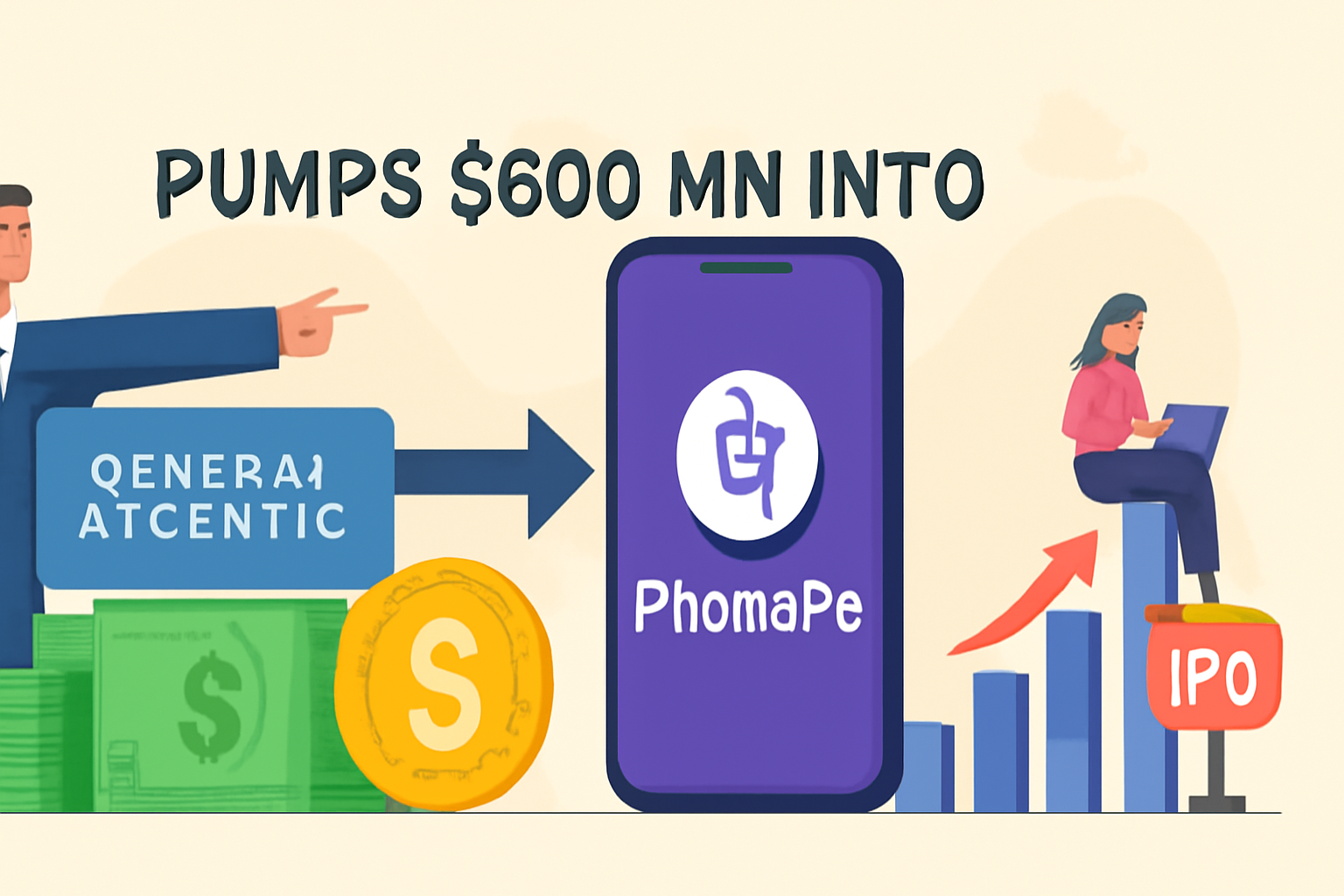
As part of its strategic pre-IPO positioning, General Atlantic (GA) has infused a substantial US$600 million into PhonePe, marking a significant milestone ahead of the fintech giant’s highly anticipated public listing in India.

With this transaction, GA’s ownership stake in PhonePe has nearly doubled, rising from around 4.4% to approximately 9%, according to Moneycontrol. This clearly signals the firm’s growing conviction in PhonePe’s long-term growth potential and leadership in India’s digital payments ecosystem.

It’s worth noting that the funding is primarily secondary in nature, meaning General Atlantic acquired shares from existing shareholders rather than injecting fresh capital into the company. This structure indicates strong investor appetite and confidence in PhonePe’s valuation ahead of its IPO.

PhonePe, one of India’s leading fintech innovators, is eyeing a US$1.35 billion (₹12,000 crore) IPO, primarily through an Offer for Sale (OFS) of existing shares. Such a move reflects maturity in the company’s financial structure and readiness for public markets, allowing early investors to partially exit while strengthening institutional participation.

For investors tracking the Indian fintech landscape, this transaction underscores robust foreign institutional interest in high-quality digital platforms. PhonePe’s upcoming IPO could be one of the most closely watched listings in India’s tech sector, signaling a pivotal moment for both the company and the broader digital payments industry.

🎯 Why this matters

A significant vote of confidence: GA increasing its stake shows it believes in PhonePe’s growth potential and the digital payments/fintech opportunity in India.

Employee incentive management: The infusion is also to help PhonePe employees meet tax obligations arising from exercising employee stock options (ESOPs) ahead of the listing.

Stronger valuation positioning: The move comes as PhonePe strengthens its financials — for example, reported ~40 % year-on-year revenue growth (to ~₹7,115 crore) in FY25 and free-cash-flow positive (~₹1,202 crore) in that year.

For investors and the market: It adds momentum to PhonePe’s IPO story, which may impact pricing, market sentiment, and competitive dynamics in the Indian fintech space.

🧮 Implications & things to watch

  • Dilution vs. shareholding: Since this is largely a secondary transaction, it may not materially dilute existing shareholders — but when the IPO happens, any new primary issue could.
  • IPO timing & valuation: With this backing, PhonePe may push for strong valuation. But market conditions, regulatory environment (in India and globally), and fintech competition will play a role.
  • Post-IPO expectations: Being free cash flow positive and having growth in adjacent verticals (beyond payments, into lending/wealth/insurance) boosts the case. PhonePe’s ability to deliver on these will matter.
  • ESOP tax burden: The fact that this funding partly addresses ESOP tax means employee retention/motivation is being managed — a good sign for internal operations.
  • Competition: Other fintech players in India will watch closely; PhonePe’s strengthened finances may intensify competition.

💡 Lenskart Solutions IPO: A Clear Vision for Investors in 2025


Lenskart Solutions IPO

India’s eyewear retail market is about to witness one of its biggest public issues yet — the Lenskart Solutions IPO. Known for revolutionizing how Indians buy glasses online and offline, Lenskart has now stepped into the capital market with an ambitious ₹7,278 crore IPO. For investors looking at the next consumer growth story, this public issue deserves a closer look.


📅 IPO Overview

ParticularsDetails
IPO Opening Date31 October 2025
IPO Closing Date4 November 2025
Price Band₹382 – ₹402 per share
Face Value₹2 per share
Issue Size₹7,278.02 crore
Fresh Issue₹2,150 crore
Offer for Sale (OFS)₹5,128 crore
Lot Size37 shares
Minimum Investment (Retail)₹14,874 (at upper band)
Listing Date (Tentative)10 November 2025
ExchangesNSE and BSE

🏢 About Lenskart Solutions Ltd

Founded by Peyush Bansal (popularly known from Shark Tank India), Lenskart Solutions Ltd has become India’s largest omnichannel eyewear retailer. From humble beginnings as an online eyewear platform, the company now operates over 2,800 stores worldwide, including more than 2,100 stores across India.

Lenskart has successfully merged online convenience with offline reach. Its mobile app, virtual try-on technology, and affordable frame pricing have made it a go-to brand for millions of Indians seeking stylish eyewear without breaking the bank.

The brand’s consistent focus on quality, affordability, and technology-driven personalization has helped it maintain strong brand recall in a highly competitive market.


📈 Financial Performance: From Vision to Profit

In recent years, Lenskart has transitioned from an aggressive growth stage to a more balanced, profitable business model. Here’s a snapshot of its recent performance:

Financial YearRevenue (₹ Crore)Net Profit (₹ Crore)
FY235,428-63 (Loss)
FY246,652297 (Profit)

Revenue growth: The company recorded a solid 22% increase in revenue in FY25 compared to FY24, demonstrating strong sales momentum.
Profit turnaround: After years of expansion-related losses, Lenskart turned profitable with a PAT of ₹297 crore, driven by improved operational efficiency and higher in-store productivity.


🎯 Objectives of the IPO

Lenskart is raising fresh capital to strengthen its retail network and digital capabilities. The breakdown of fund utilization is as follows:

  1. Store Expansion:
    Around ₹272.62 crore will be used for setting up new Company-Owned Company-Operated (CoCo) stores across India.
  2. Store Leasing & Infrastructure:
    ₹591.44 crore will be allocated for rental and license costs for upcoming stores.
  3. Technology & Cloud Infrastructure:
    ₹213.38 crore is set aside for upgrading technology platforms, logistics, and backend systems to improve user experience and scalability.
  4. Marketing & Brand Building:
    ₹320.06 crore will go toward brand awareness, advertising, and global promotion.
  5. Strategic Acquisitions & General Purposes:
    Remaining proceeds will be reserved for acquisitions and working capital requirements.

These objectives underline Lenskart’s intent to expand aggressively while fortifying its technological backbone — a key differentiator in the retail eyewear sector.


🌍 Market Potential: India’s Eyewear Boom

The Indian eyewear market is valued at over ₹80,000 crore and growing at an annual rate of 8–10%, fueled by rising digital screen exposure and increasing awareness about eye health.

Lenskart enjoys a market share of nearly 35% in the organized retail eyewear space, giving it a significant competitive edge. Its vertically integrated business model — controlling everything from design and manufacturing to retail and after-sales service — allows it to maintain strong margins.

Moreover, its global expansion across Southeast Asia and the Middle East opens doors to new revenue streams, diversifying its growth base beyond India.


⚖️ Strengths of Lenskart Solutions

Omnichannel Presence:
A seamless blend of online and offline channels ensures maximum customer reach.

Strong Brand Recognition:
Consistent advertising, celebrity endorsements, and a strong social media presence have made Lenskart a household name.

In-House Manufacturing:
Lenskart owns its own lens manufacturing and assembly units, giving it better control over cost and quality.

Technological Leadership:
From AI-driven recommendations to virtual try-ons, Lenskart leads the digital eyewear revolution.

Backed by Global Investors:
Strong institutional backing from SoftBank, KKR, and Temasek signals high investor confidence.


⚠️ Key Risks to Consider

Despite its strong growth story, investors should be aware of the following risks:

  1. High Valuation:
    The IPO is priced at a premium compared to traditional retail peers. Post-listing valuation may appear stretched.
  2. Rising Costs:
    Rental and marketing expenses may remain elevated as the company continues expanding into new markets.
  3. Dependence on Consumer Sentiment:
    Eyewear, though essential, still has a discretionary spending component — a slowdown in consumption could affect sales.
  4. Competition:
    Rivals like Titan Eye+, Coolwinks, and Specsavers (internationally) could impact market share if price wars intensify.
  5. Global Exposure Risks:
    Expansion in foreign markets brings exposure to currency fluctuations and regulatory complexities.

💬 Expert Verdict: Should You Apply?

The Lenskart Solutions IPO represents an opportunity to invest in a well-known consumer brand operating in a fast-growing market with a proven omnichannel business model. Its profitable turnaround, robust market share, and brand loyalty make it an attractive long-term growth story.

However, the valuation premium suggests it’s more suitable for investors with a medium to long-term horizon (2–3 years) rather than short-term listing gains.

Analyst View:

  • Ideal for investors seeking exposure to India’s retail consumption story.
  • Recommended as a “Subscribe for Long-Term” opportunity.

🧭 Final Takeaway

The Lenskart Solutions IPO is more than just a listing event — it’s a landmark for India’s consumer tech retail ecosystem. With strong fundamentals, a visionary leadership team, and a scalable business model, Lenskart appears ready to take its next big leap from private dominance to public market success.

If you believe in the future of organized eyewear retail and the power of digital transformation in consumer goods, Lenskart’s IPO could indeed offer a crystal-clear opportunity.


🌏 How Arjun Retired Early at 35 with SIP Investments – A Story for Young Investors

Most people believe retirement is something that happens after sixty. But what if you could design your life in a way that lets you retire by your mid-thirties, travel the world, and live without the stress of a 9-to-5 job? This isn’t a fantasy. With the right financial habits, especially starting a SIP (Systematic Investment Plan) early, it’s possible to build wealth that gives you freedom decades before others.

This is the story of Arjun, a young professional who, guided by his mentor Krishna, achieved financial independence and retired early. His journey is not just inspiring — it’s a blueprint for every young reader who wants to use mutual funds, SIPs, and SWPs to escape corporate life and live life on their own terms.


The Dream of Freedom

As a teenager, Arjun was curious and restless. He often wondered if life was meant to be spent in traffic, offices, and endless deadlines. He wanted to travel, explore, and live without restrictions. But like most young people, he didn’t know how to make that dream financially possible.

That’s when he met Krishna, his father’s friend and a seasoned mutual fund advisor. Krishna wasn’t tied to a corporate job. Instead, he lived freely, traveling and pursuing his passions. Arjun asked him the question every Gen Z investor has on their mind: “How can I achieve this kind of freedom?”


The Power of SIPs

Krishna explained that financial freedom wasn’t about luck or sudden wealth. It was about systematic, disciplined investing.

He introduced Arjun to Systematic Investment Plans (SIPs) — a simple method of investing a fixed amount in mutual funds every month. Even if Arjun started small, say ₹10,000 per month, compounding would turn it into crores over time.

The message was clear: start early, stay consistent, let compounding do the magic.


From First Salary to First Crore

At 22, Arjun got his first job in Bengaluru, earning ₹30,000 per month. Most of his peers spent their salaries on rent, gadgets, parties, and trips. Saving seemed impossible. But Krishna reminded him:

👉 “Treat your SIP like a Netflix subscription. It’s non-negotiable.”

So, Arjun began his journey with ₹10,000 SIP every month.

  • By 27, his portfolio had grown to over ₹20 lakhs.
  • By 32, he had accumulated nearly ₹80 lakhs.
  • At 35, his investments had compounded to ₹1.8 crores.

While his friends upgraded cars and houses with loans, Arjun upgraded his SIPs. Instead of chasing lifestyle inflation, he chased freedom.


Transitioning from SIP to SWP

When Arjun hit his financial milestone of nearly ₹2 crores, Krishna taught him about the next step — the Systematic Withdrawal Plan (SWP).

With SWP, Arjun could withdraw ₹80,000 per month for his expenses, while his portfolio continued to grow. This meant he didn’t need a corporate job anymore. His money was working harder than he ever could.

This is the power of combining SIPs for wealth creation and SWPs for financial independence.


Life Beyond the Office

At 35, Arjun quit his job, not out of frustration, but with peace. He had achieved what most people dream of — financial independence through investing.

He spent his days traveling, exploring cultures, and pursuing hobbies. His Instagram wasn’t filled with office selfies but with sunsets in Bali, treks in the Himalayas, and coffee shops in Europe.

When his old colleagues asked how he managed it, his answer was simple:

👉 “I invested early. While you bought things, I bought freedom.”


Lessons for Young Investors

Arjun’s story isn’t just motivational — it’s a practical roadmap for Gen Z who want to retire early in India:

  1. Start SIPs with your first salary – Even ₹5,000 to ₹10,000 makes a difference.
  2. Increase your SIP as your salary grows – Don’t fall into the lifestyle inflation trap.
  3. Stay invested for at least 12–15 years – Compounding needs time.
  4. Build a corpus of ₹1.5–2 crores – Enough to create a monthly SWP for expenses.
  5. Use SWP for cash flow – It lets you live off your investments while money keeps growing.

Why This Matters for Gen Z

Unlike previous generations, today’s youth don’t want to wait until their 60s to live life. They want early retirement, financial freedom, and the ability to explore the world.

By combining SIPs and SWPs, this dream is achievable. All it takes is discipline, patience, and a willingness to prioritize long-term goals over short-term pleasures.


Final Thought

Arjun’s journey proves that early retirement in your 30s is not a myth. It’s a strategy. If you are in your early 20s and just starting your career, the best gift you can give yourself is a SIP investment plan. In 10–15 years, you won’t just have money — you’ll have freedom.

So, the question isn’t whether financial independence is possible. The real question is: Will you start today, or will you wait until it’s too late?


Nazara Technologies Ltd : Complete Stock Analysis, Financials, and Future Outlook (2025-26)

Nazara Technologies Ltd. is one of India’s most popular gaming and media companies, often in the headlines for its financial growth, acquisitions, and stock market performance. With operations spanning gaming, esports, and ad-tech, the company has established itself as a unique small-cap stock in India’s technology and entertainment sector.

In this detailed article, we cover Nazara Technologies’ company overview, financial performance, stock updates, shareholding patterns, valuation metrics, and the impact of new regulations on its business and stock price.


📌 Company Overview

  • Incorporated: 1999
  • Industry: Gaming, Media & Entertainment (Services Sector)
  • Market Cap (Aug 2025): ₹10,753.67 crore (Small Cap)
  • Headquarters: Mumbai, Maharashtra
  • Business Verticals: Gaming IPs, Esports, Ad-Tech

Key Brands under Nazara

  • Gaming & IP Ventures: Kiddopia, Animal Jam, WCC, Fusebox
  • Esports & Media: Nodwin Gaming, Sportskeeda, Pro Football Network
  • Ad-Tech: Datawrkz

Nazara has positioned itself as a diversified gaming ecosystem, catering to both Indian and global audiences.


📊 Financial Performance (Q1 FY26 & FY25)

Nazara Technologies has shown consistent growth in revenue and profit, backed by strong performance in the gaming and ad-tech segments.

Q1 FY26 Results (Quarter ended June 2025)

MetricValueGrowth (YoY)
Total Income₹575.87 crore+108.91%
Net Profit (PAT)₹75.59 crore+118%
EPS (Earnings/Share)₹11.55Significant
  • Gaming Revenue: ₹240 crore (+170% YoY; 2.7× growth)
  • Ad-Tech Revenue: ₹106 crore (+300% YoY; 4× growth)
  • Expenses: ₹521 crore (Advertising and marketing tripled to ₹124.75 crore)

Q4 FY25 Performance

MetricValueGrowth (YoY)
Revenue₹520 crore+95%
Net Profit (PAT)₹16 crore+100%

➡️ Nazara has nearly doubled its revenue within one year, indicating strong execution in both domestic and global gaming markets.


📈 Capital Actions & Corporate Moves

  • Stock Split: Face value reduced from ₹4 to ₹2 (August 2025).
  • Bonus Issue: 1:1 ratio, rewarding shareholders.
  • Share Capital Increase: Board proposed raising authorized capital from ₹50 crore to ₹80 crore (Q1 FY26).

These actions indicate management’s confidence and an effort to improve stock liquidity.


👥 Shareholding Pattern (June 2025)

CategoryShareholding %Trend
Promoters8.31%Stable, no pledged shares
FIIs12.98%Slight decline (from 13.04%)
DIIs9.80%Decline (from 11.6%)
Mutual Funds8.95%Stable
Public & Others68.91%Highest stake

🔎 The majority stake is held by retail investors (Public & Others), making the stock volatile during market sentiment shifts.


📉 Valuation Metrics (as of August 2025)

MetricValue
P/E Ratio100.49
Price/Sales5.11
Price/Book3.32
ROE (5-Year)1.4%

➡️ The high P/E ratio reflects strong growth expectations, but also signals overvaluation risk.


📰 Regulatory Challenges: Online Gaming Bill 2025

One of the biggest challenges faced by Nazara in 2025 was the introduction of the Online Gaming Bill, which regulates or bans real-money gaming (RMG).

Impact on Nazara

  • Direct Exposure: NIL – Nazara does not earn directly from RMG.
  • Indirect Stake: Holds 46.07% in Moonshine Technologies (PokerBaazi operator).
  • Contribution to Profit: Negative PAT from Moonshine in Q1 FY26.
  • Investments: ₹805 crore + ₹255 crore in convertible shares.

Despite low direct exposure, the stock faced a sentiment-driven sell-off.


📉 Stock Market Performance

  • 15% drop after Lok Sabha passed the Online Gaming Bill.
  • 18% decline in three sessions (down to ₹1,145.55).
  • 28% fall in 4 days, breaking brokerage targets.

Brokerage & Investor Reaction

  • ICICI Securities downgraded the stock to ‘Reduce’, target cut from ₹1,500 to ₹1,100.
  • Nikhil Kamath lost ~₹58.3 crore.
  • Madhusudan Kela lost ~₹42.38 crore.
  • Rekha Jhunjhunwala exited in June 2025 with 111% returns in 3 years, avoiding the crash.

➡️ Clearly, the regulatory risk impacted investor wealth significantly.


🔮 Future Outlook for Nazara Technologies

Despite the temporary stock fall, Nazara’s core fundamentals remain strong.

Growth Drivers

  1. Gaming Expansion: Rise in mobile gaming penetration in India and global markets.
  2. Ad-Tech Growth: 4× YoY revenue indicates strong momentum.
  3. Esports Popularity: Nodwin Gaming & Sportskeeda are leaders in esports content.
  4. Diversified Portfolio: Revenue not heavily dependent on RMG, reducing risk.

Risks

  • Regulatory changes in gaming and ad-tech policies.
  • High valuation compared to earnings (P/E >100).
  • Dependence on aggressive marketing spend for growth.

📌 Key Takeaways for Investors

  • Strong revenue growth (108% YoY in Q1 FY26).
  • Minimal RMG exposure, making it safer amid regulatory uncertainty.
  • Attractive brands & global presence in gaming/esports.
  • Stock volatility due to high retail holding and news-driven sentiment.
  • Long-term potential but short-term caution advised due to high P/E.

📊 Summary Table: Nazara Technologies at a Glance

ParameterValue (Aug 2025)
Market Cap₹10,753.67 crore
Q1 FY26 Income₹575.87 crore (+108.91%)
Q1 FY26 Net Profit₹75.59 crore (+118%)
EPS₹11.55
P/E Ratio100.49
Shareholding (Public)68.91%
Dividend Yield0%
Bonus / Split1:1 bonus, FV ₹4→₹2
Major BrandsNodwin, Kiddopia, Sportskeeda, Datawrkz
Risk FactorOnline Gaming Bill, Valuation

🏁 Conclusion

Nazara Technologies Ltd. is a unique small-cap stock offering exposure to India’s rapidly growing gaming and esports industry. With strong financial growth, global partnerships, and minimal direct exposure to real-money gaming, the company is well-positioned for the future.

However, stock valuation remains stretched, and recent regulatory changes highlight the risks of investing in this sector. For long-term investors, Nazara can be a high-growth but high-volatility bet. For short-term traders, caution is advisable until market sentiment stabilizes.


  • Nazara Technologies share price
  • Nazara Technologies stock analysis
  • Nazara Technologies financial results
  • Nazara Technologies Q1 FY26 performance
  • Nazara Technologies future outlook
  • Nazara Technologies news 2025
  • Nazara Technologies investors

PGIM India Global Equity Opportunities Fund of Fund – Complete Review 2025

Investors today are increasingly looking beyond Indian markets to diversify their portfolios. International mutual funds allow exposure to global economies, sectors, and companies that are not available in India. One such option is the PGIM India Global Equity Opportunities Fund of Fund (FoF).

This article provides a detailed review of the fund—including its objective, performance, risk profile, expense ratio, tax treatment, and whether it is a good fit for your investment strategy.

PGIM India Global Equity Opportunities Fund of Fund – Complete Review 2025


🔹 Fund Objective and Strategy

  • The primary aim of the fund is to generate long-term capital appreciation.
  • It achieves this by investing predominantly in units of overseas mutual funds.
  • Investment exposure spans across the U.S., Europe, Japan, and Canada.
  • Sectors covered include agriculture, allied industries, technology, healthcare, and global consumer businesses.
  • Since it is a Fund-of-Funds (FoF), it does not directly buy stocks but invests in international mutual funds.

👉 Best for investors seeking global diversification with long-term wealth creation.


🔹 Fund Launch & Benchmark

  • Launch Date: 14 May 2010
  • Benchmark Index: MSCI All Country World Index (TRI)
  • Fund Category: International FoF – Equity

This benchmark covers developed and emerging markets globally, making it a suitable comparison for the scheme’s performance.


🔹 Asset Allocation & Fund Size

  • The fund invests almost 98–99% in equity-oriented overseas mutual funds.
  • A very small proportion is parked in debt or cash instruments.

Assets Under Management (AUM) as of Aug 2025:

  • ₹1,474 crore – ₹1,496 crore

This places it in the mid-size category among international funds in India.


🔹 Expense Ratio & Exit Load

  • Regular Plan: ~2.39% (higher than category average of ~0.93%)
  • Direct Plan: ~0.63% (much cheaper, recommended for long-term investors)
  • Exit Load: 0.5% if redeemed within 90 days; no load afterward.

👉 Choosing the Direct Plan helps investors save significantly on costs.


🔹 Net Asset Value (NAV)

As of 28 August 2025:

  • Regular Plan – Growth NAV: ₹45.74
  • Direct Plan – Growth NAV: ₹51.82

The direct option has outperformed due to lower costs.


🔹 Risk Profile

  • Riskometer: Very High Risk
  • This is expected because it invests in global equities that are sensitive to international market cycles, currency fluctuations, and geopolitical risks.

👉 Suitable only for investors with high risk appetite and long-term investment horizon (5+ years).


🔹 Historical Performance

📊 Trailing Returns (as of Aug 2025 – Regular Growth Plan)

Time PeriodAbsolute ReturnsAnnualised CAGR
1 Year~6.6%~6.6%
3 Years~67.6%~18.8%
5 Years~48.8%~8.3%
Since Inception~351%~10.35%

📊 SIP Returns

SIP DurationTotal InvestmentValue as of Aug 2025Absolute GainAnnualised Return
3 Years₹36,000₹47,378+31.6%~18.7% CAGR
10 Years₹1,20,000₹2,50,000+108.8%~14.1% CAGR

👉 The fund has delivered strong SIP performance, proving the benefit of systematic investing.


🔹 Fund Ranking in Category (as per ET / Groww)

PeriodRank
1 Year53rd out of peers
3 Years19th
5 Years22nd

While 1-year ranking is low, long-term rankings are much better.


🔹 Taxation Rules

  • Short-Term Capital Gains (STCG):
    • If held ≤ 2 years → taxed as per individual slab rates.
  • Long-Term Capital Gains (LTCG):
    • If held > 2 years → taxed at 12.5% or 20% with indexation (depending on tax law interpretation).
  • Dividends: Added to taxable income and taxed as per slab. TDS applicable if dividend exceeds ₹5,000–₹10,000 (depending on rule).

👉 Always confirm with a tax advisor for the latest rules, as taxation on international FoFs is subject to periodic changes.


✅ Key Takeaways

  • Pros:
    • Global diversification across developed markets.
    • Strong long-term performance, especially via SIPs.
    • Direct plan offers low expense ratio.
    • Good for investors with long-term wealth creation goals.
  • Cons:
    • Very High Risk – not suitable for conservative investors.
    • High expense ratio in Regular plan.
    • Short-term performance can be volatile due to global market fluctuations.

🏆 Final Verdict

The PGIM India Global Equity Opportunities Fund of Fund is a strong option for investors looking to diversify internationally and capture growth opportunities in global markets.

  • Ideal Investment Horizon: 5+ years
  • Best Mode: Direct Growth Plan + SIP
  • Suitable for: High-risk, long-term investors who want exposure outside India.

If you are already heavily invested in Indian equities, this fund can act as a hedge and diversification tool to balance your portfolio.

Vikram Solar IPO 2025: Complete Details, Analysis & Expert Insights

The renewable energy sector is at the heart of India’s growth story, and Vikram Solar Limited, one of the country’s leading solar module manufacturers, is set to make a big move with its Initial Public Offering (IPO) in August 2025. Investors and analysts are closely tracking this public issue, considering the company’s strong presence in the solar industry and ambitious expansion plans.

This detailed guide covers everything about the Vikram Solar IPO — from issue size, price band, subscription details, company financials, and order book strength to expert recommendations.


Vikram Solar IPO Overview

Vikram Solar is launching an IPO that includes both a fresh issue of shares and an offer-for-sale (OFS) by existing shareholders. The company aims to raise capital for expansion while allowing current investors to partially exit.

  • Total Issue Size: ₹2,079 crore
  • Fresh Issue: ₹1,500 crore (new shares issued by the company)
  • Offer for Sale (OFS): ₹579 crore (shares sold by promoters and existing investors)

This combination ensures that the company raises funds for growth while also providing liquidity to early shareholders.


IPO Price Band and Lot Size

  • Price Band: ₹315 to ₹332 per share
  • Lot Size: 45 shares per lot
  • Minimum Investment: ₹14,940 (at the upper price band)
  • Maximum Investment (Retail): Retail investors can apply for up to 13 lots, i.e., 585 shares, amounting to ₹1,94,220.

The pricing has been structured to attract a wide base of retail, institutional, and high-net-worth investors.


IPO Timeline

EventDate
Issue Opening Date19 August 2025
Issue Closing Date21 August 2025
Basis of Allotment22 August 2025
Refunds Initiated25 August 2025
Shares Credited to Demat25 August 2025
Listing Date26 August 2025

The IPO is being managed by a strong group of lead managers and is expected to list on both BSE and NSE.


Investor Allocation

The allocation of shares in Vikram Solar IPO is structured as per SEBI guidelines:

  • Qualified Institutional Buyers (QIBs): Up to 50% of the net issue
  • Retail Investors: Minimum 35% of the net issue
  • Non-Institutional Investors (NIIs): Minimum 15% of the net issue
  • Employee Reservation: A small portion is reserved for employees at a discounted price

This ensures balanced participation across retail and institutional categories.


Grey Market Premium (GMP) Trends

The grey market premium (GMP) is an important indicator of investor sentiment. Ahead of the IPO launch, Vikram Solar’s GMP ranged between ₹54 to ₹70, which signals a premium of 16% to 21% over the upper price band.

This suggests a potential listing price around ₹389–₹400 per share, indicating the possibility of healthy listing gains.


Use of IPO Proceeds

The funds raised from the fresh issue will be used strategically to strengthen Vikram Solar’s business model and manufacturing capacity:

  1. Capital Expenditure: ₹793 crore will be invested into VSL Green Power Pvt Ltd, a subsidiary, for setting up advanced facilities.
  2. Project Expansion: ₹603 crore is earmarked for the company’s Phase-II expansion projects.
  3. General Corporate Purposes: Around ₹104 crore will go toward overall business requirements, including working capital and debt repayment.

A significant portion of the funds is directed towards establishing a 3 GW solar cell and module manufacturing facility in Tamil Nadu, which will enhance the company’s capacity and backward integration.


Company Background

  • Founded: 2005
  • Headquarters: Kolkata, West Bengal
  • Current Capacity: 4.5 GW solar module production as of March 2024
  • Client Base: Includes NTPC, Adani Green, JSW Energy, Azure Power, ACME, and other large energy players
  • Global Reach: Operates in over 39 countries

Vikram Solar started with a modest capacity of 12 MW in 2009 and has now become one of India’s largest solar PV manufacturers, playing a vital role in the nation’s renewable energy mission.


Growth Plans

The company has ambitious plans to expand aggressively:

  • Increase manufacturing capacity from 4.5 GW to 15.5 GW by FY26
  • Further scale to 20.5 GW by FY27
  • Enter the solar cell manufacturing segment for vertical integration
  • Explore battery energy storage solutions, which are critical for the future of renewable energy

These plans align perfectly with India’s target of achieving 500 GW of renewable energy capacity by 2030.


Financial Performance

Vikram Solar has delivered strong financial growth over the last three years:

  • Revenue FY25: ₹3,423 crore
  • EBITDA FY25: ₹492 crore
  • Profit After Tax (PAT) FY25: ₹140 crore
  • Revenue CAGR (FY23–FY25): ~29%
  • EBITDA CAGR (FY23–FY25): ~63%
  • PAT CAGR (FY23–FY25): ~211%

The company’s strong profitability and rapid growth in margins highlight operational efficiency and scalability.


Order Book Strength

As of March 2025, Vikram Solar reported an order pipeline of 10,340 MW, which is 2.3 times its current production capacity.

  • Orders Under Execution: 6,425 MW
  • Pending Orders: 3,916 MW

This strong order book provides visibility into revenue growth for the coming years.


Anchor Investors

Before the IPO opened for public subscription, Vikram Solar raised ₹621 crore from anchor investors. These included some of the world’s leading financial institutions and domestic mutual funds:

  • Goldman Sachs
  • Morgan Stanley India
  • BNP Paribas
  • HSBC
  • Citigroup
  • ICICI Prudential Life Insurance
  • SBI General Insurance
  • UTI Mutual Fund
  • Kotak Mahindra AMC
  • Nippon India Mutual Fund

The participation of such reputed investors reflects high confidence in Vikram Solar’s business model and growth potential.


Strengths of Vikram Solar

  1. Strong Brand & Market Presence: One of India’s leading solar module manufacturers with global presence.
  2. Robust Clientele: Long-term partnerships with major Indian and international companies.
  3. Large Order Book: Ensures revenue visibility for the next 2–3 years.
  4. Capacity Expansion: Aggressive growth plans to meet rising demand.
  5. Policy Support: Benefits from government incentives like PLI schemes and renewable energy targets.

Risks and Challenges

Despite strong fundamentals, there are certain risks investors should keep in mind:

  1. Capital Intensive Expansion: Huge investments needed for growth may strain cash flows.
  2. Customer Concentration: A large portion of revenue comes from a few big clients.
  3. Supply Chain Dependence: Import reliance for raw materials like solar cells could affect margins.
  4. Execution Risks: Large-scale expansion plans may face delays or cost overruns.
  5. Global Competition: International solar manufacturers pose strong competition.

Expert Recommendations

Different brokerage houses and analysts have shared mixed opinions about the IPO:

  • Positive Views: Many experts recommend subscribing due to the company’s strong order book, growing financials, and renewable energy sector tailwinds.
  • Cautious Views: Some analysts highlight high capital intensity and competitive risks, suggesting the IPO is best suited for investors with higher risk appetite.

Overall, the majority sentiment leans towards “Subscribe for long-term gains.”


Final Verdict

The Vikram Solar IPO is one of the most awaited issues in 2025, representing India’s renewable energy push. With a strong financial track record, aggressive expansion strategy, and reputed anchor investors, the company is well-positioned for growth.

Key Takeaways for Investors:

  • IPO Size: ₹2,079 crore (₹1,500 crore fresh + ₹579 crore OFS)
  • Price Band: ₹315 – ₹332
  • GMP Indication: Premium of ~16–21% over issue price
  • Strengths: Strong brand, high order book, financial growth
  • Risks: High capex, customer concentration, execution challenges

Conclusion: The Vikram Solar IPO offers a promising opportunity to participate in India’s renewable energy revolution. For investors with a medium to long-term horizon, it could be a strong addition to their portfolio

Vikram Solar IPO 2025: Complete Details, Analysis & Expert Insights

The renewable energy sector is at the heart of India’s growth story, and Vikram Solar Limited, one of the country’s leading solar module manufacturers, is set to make a big move with its Initial Public Offering (IPO) in August 2025. Investors and analysts are closely tracking this public issue, considering the company’s strong presence in the solar industry and ambitious expansion plans.

This detailed guide covers everything about the Vikram Solar IPO — from issue size, price band, subscription details, company financials, and order book strength to expert recommendations.


Vikram Solar IPO Overview

Vikram Solar is launching an IPO that includes both a fresh issue of shares and an offer-for-sale (OFS) by existing shareholders. The company aims to raise capital for expansion while allowing current investors to partially exit.

  • Total Issue Size: ₹2,079 crore
  • Fresh Issue: ₹1,500 crore (new shares issued by the company)
  • Offer for Sale (OFS): ₹579 crore (shares sold by promoters and existing investors)

This combination ensures that the company raises funds for growth while also providing liquidity to early shareholders.


IPO Price Band and Lot Size

  • Price Band: ₹315 to ₹332 per share
  • Lot Size: 45 shares per lot
  • Minimum Investment: ₹14,940 (at the upper price band)
  • Maximum Investment (Retail): Retail investors can apply for up to 13 lots, i.e., 585 shares, amounting to ₹1,94,220.

The pricing has been structured to attract a wide base of retail, institutional, and high-net-worth investors.


IPO Timeline

EventDate
Issue Opening Date19 August 2025
Issue Closing Date21 August 2025
Basis of Allotment22 August 2025
Refunds Initiated25 August 2025
Shares Credited to Demat25 August 2025
Listing Date26 August 2025

The IPO is being managed by a strong group of lead managers and is expected to list on both BSE and NSE.


Investor Allocation

The allocation of shares in Vikram Solar IPO is structured as per SEBI guidelines:

  • Qualified Institutional Buyers (QIBs): Up to 50% of the net issue
  • Retail Investors: Minimum 35% of the net issue
  • Non-Institutional Investors (NIIs): Minimum 15% of the net issue
  • Employee Reservation: A small portion is reserved for employees at a discounted price

This ensures balanced participation across retail and institutional categories.


Grey Market Premium (GMP) Trends

The grey market premium (GMP) is an important indicator of investor sentiment. Ahead of the IPO launch, Vikram Solar’s GMP ranged between ₹54 to ₹70, which signals a premium of 16% to 21% over the upper price band.

This suggests a potential listing price around ₹389–₹400 per share, indicating the possibility of healthy listing gains.


Use of IPO Proceeds

The funds raised from the fresh issue will be used strategically to strengthen Vikram Solar’s business model and manufacturing capacity:

  1. Capital Expenditure: ₹793 crore will be invested into VSL Green Power Pvt Ltd, a subsidiary, for setting up advanced facilities.
  2. Project Expansion: ₹603 crore is earmarked for the company’s Phase-II expansion projects.
  3. General Corporate Purposes: Around ₹104 crore will go toward overall business requirements, including working capital and debt repayment.

A significant portion of the funds is directed towards establishing a 3 GW solar cell and module manufacturing facility in Tamil Nadu, which will enhance the company’s capacity and backward integration.


Company Background

  • Founded: 2005
  • Headquarters: Kolkata, West Bengal
  • Current Capacity: 4.5 GW solar module production as of March 2024
  • Client Base: Includes NTPC, Adani Green, JSW Energy, Azure Power, ACME, and other large energy players
  • Global Reach: Operates in over 39 countries

Vikram Solar started with a modest capacity of 12 MW in 2009 and has now become one of India’s largest solar PV manufacturers, playing a vital role in the nation’s renewable energy mission.


Growth Plans

The company has ambitious plans to expand aggressively:

  • Increase manufacturing capacity from 4.5 GW to 15.5 GW by FY26
  • Further scale to 20.5 GW by FY27
  • Enter the solar cell manufacturing segment for vertical integration
  • Explore battery energy storage solutions, which are critical for the future of renewable energy

These plans align perfectly with India’s target of achieving 500 GW of renewable energy capacity by 2030.


Financial Performance

Vikram Solar has delivered strong financial growth over the last three years:

  • Revenue FY25: ₹3,423 crore
  • EBITDA FY25: ₹492 crore
  • Profit After Tax (PAT) FY25: ₹140 crore
  • Revenue CAGR (FY23–FY25): ~29%
  • EBITDA CAGR (FY23–FY25): ~63%
  • PAT CAGR (FY23–FY25): ~211%

The company’s strong profitability and rapid growth in margins highlight operational efficiency and scalability.


Order Book Strength

As of March 2025, Vikram Solar reported an order pipeline of 10,340 MW, which is 2.3 times its current production capacity.

  • Orders Under Execution: 6,425 MW
  • Pending Orders: 3,916 MW

This strong order book provides visibility into revenue growth for the coming years.


Anchor Investors

Before the IPO opened for public subscription, Vikram Solar raised ₹621 crore from anchor investors. These included some of the world’s leading financial institutions and domestic mutual funds:

  • Goldman Sachs
  • Morgan Stanley India
  • BNP Paribas
  • HSBC
  • Citigroup
  • ICICI Prudential Life Insurance
  • SBI General Insurance
  • UTI Mutual Fund
  • Kotak Mahindra AMC
  • Nippon India Mutual Fund

The participation of such reputed investors reflects high confidence in Vikram Solar’s business model and growth potential.


Strengths of Vikram Solar

  1. Strong Brand & Market Presence: One of India’s leading solar module manufacturers with global presence.
  2. Robust Clientele: Long-term partnerships with major Indian and international companies.
  3. Large Order Book: Ensures revenue visibility for the next 2–3 years.
  4. Capacity Expansion: Aggressive growth plans to meet rising demand.
  5. Policy Support: Benefits from government incentives like PLI schemes and renewable energy targets.

Risks and Challenges

Despite strong fundamentals, there are certain risks investors should keep in mind:

  1. Capital Intensive Expansion: Huge investments needed for growth may strain cash flows.
  2. Customer Concentration: A large portion of revenue comes from a few big clients.
  3. Supply Chain Dependence: Import reliance for raw materials like solar cells could affect margins.
  4. Execution Risks: Large-scale expansion plans may face delays or cost overruns.
  5. Global Competition: International solar manufacturers pose strong competition.

Expert Recommendations

Different brokerage houses and analysts have shared mixed opinions about the IPO:

  • Positive Views: Many experts recommend subscribing due to the company’s strong order book, growing financials, and renewable energy sector tailwinds.
  • Cautious Views: Some analysts highlight high capital intensity and competitive risks, suggesting the IPO is best suited for investors with higher risk appetite.

Overall, the majority sentiment leans towards “Subscribe for long-term gains.”


Final Verdict

The Vikram Solar IPO is one of the most awaited issues in 2025, representing India’s renewable energy push. With a strong financial track record, aggressive expansion strategy, and reputed anchor investors, the company is well-positioned for growth.

Key Takeaways for Investors:

  • IPO Size: ₹2,079 crore (₹1,500 crore fresh + ₹579 crore OFS)
  • Price Band: ₹315 – ₹332
  • GMP Indication: Premium of ~16–21% over issue price
  • Strengths: Strong brand, high order book, financial growth
  • Risks: High capex, customer concentration, execution challenges

Conclusion: The Vikram Solar IPO offers a promising opportunity to participate in India’s renewable energy revolution. For investors with a medium to long-term horizon, it could be a strong addition to their portfolio.


Patel Retail IPO 2025: Complete Guide for Investors

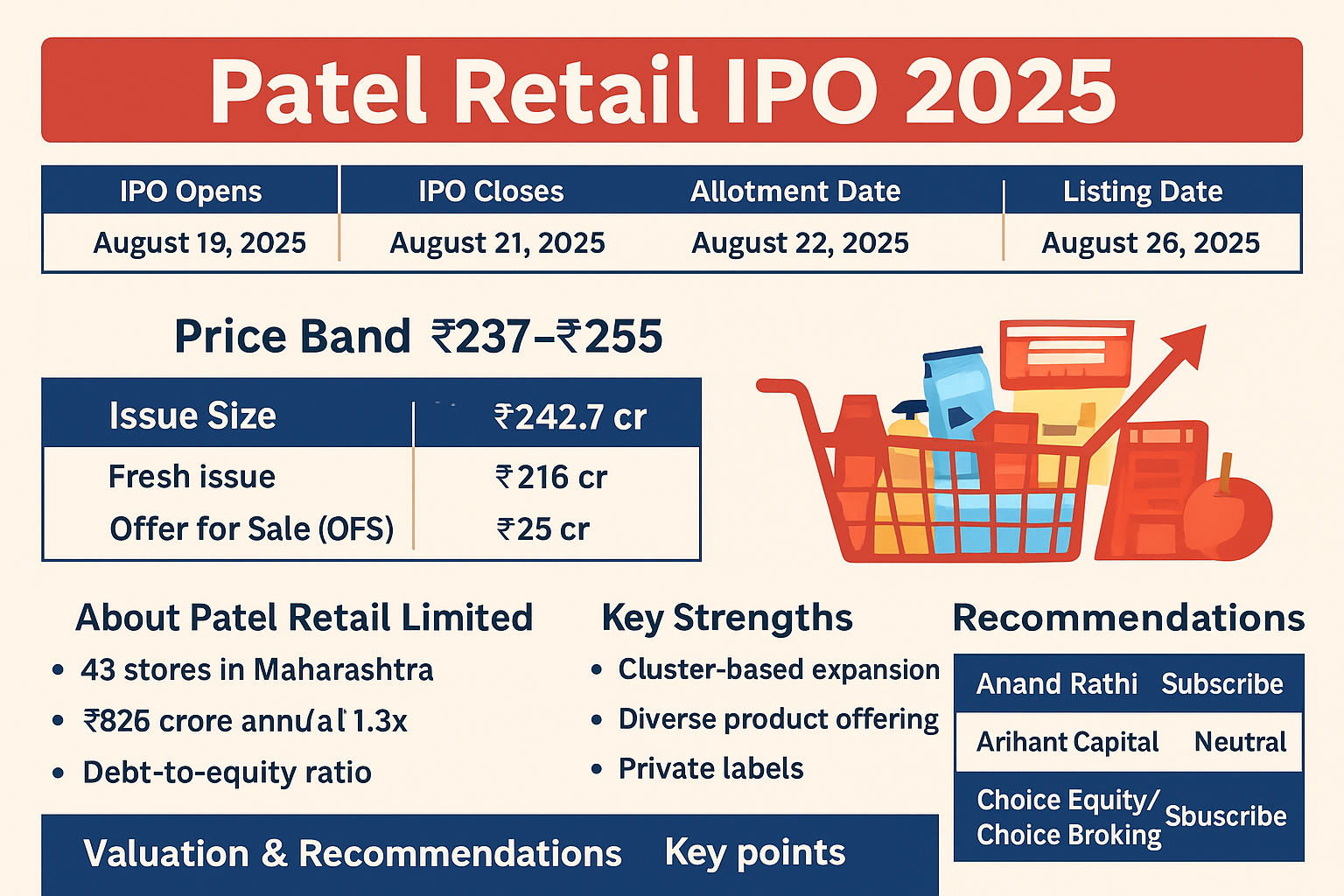
The Indian stock market is witnessing another promising entry in 2025 — Patel Retail Limited, a fast-growing supermarket chain, has launched its Initial Public Offering (IPO).

This detailed guide covers every aspect of the Patel Retail IPO, including price band, issue size, company background, financials, strengths, risks, and expert opinions.


IPO Snapshot

ParticularsDetails
IPO Open DateAugust 19, 2025
IPO Close DateAugust 21, 2025
Allotment DateAugust 22, 2025
Listing DateAugust 26, 2025
ExchangeBSE & NSE
Issue TypeBook Built Issue
Face Value₹10 per share
Price Band₹237 – ₹255 per share
Lot Size58 shares
Minimum Investment₹14,790
Maximum Investment₹1,92,270 (13 lots)
Total Issue Size₹242.76 crore
Fresh Issue₹216 crore (85.18 lakh shares)
Offer for Sale (OFS)₹25 crore (10.02 lakh shares by promoters)

Anchor Investor Participation

On August 18, 2025, Patel Retail raised ₹43 crore from anchor investors by allocating 17,04,388 shares at ₹255 each.
This strong institutional backing reflects investor confidence ahead of the IPO launch.


About Patel Retail Limited

  • Founded in 2008, Patel Retail started with its first supermarket under the brand “Patel’s R Mart” in Ambernath, Maharashtra.
  • As of May 2025, the company operates 43 stores across Thane and Raigad districts.
  • Retail space: 1.79 lakh sq. ft.
  • Business model: Food, FMCG, apparel, general merchandise, and in-house private labels.
  • Private-label brands: Patel Fresh, Indian Chaska, Blue Nation, Patel Essentials.
  • Exports: Products sold in 35+ countries.

Financial Performance

Here’s a snapshot of Patel Retail’s recent financials:

Financial MetricFY2024FY2025
Revenue₹817 crore₹826 crore
Profit After Tax (PAT)₹22.5 crore₹25.3 crore
EBITDA₹53.4 crore₹57.1 crore
EBITDA Margin6.6%~7%
Debt-to-Equity Ratio2.0x1.3x
Revenue per Sq. Ft.₹20,500 approx

Highlights:
✔ Consistent revenue growth above ₹800 crore
✔ Improved profitability and margins
✔ Strong debt reduction compared to the previous year


Strengths of Patel Retail

  • Cluster-Based Expansion: Focused growth in Maharashtra’s suburban clusters ensures brand loyalty.
  • Diverse Portfolio: From groceries to apparel, the company provides a one-stop shopping experience.
  • Private Labels: Higher margins due to in-house brands.
  • Operational Efficiency: Strong IT systems for inventory and procurement management.
  • Steady Growth: Scaled revenues above ₹800 crore despite being regionally focused.

Risks and Challenges

Risk FactorExplanation
Geographic ConcentrationAll 43 stores are located in Maharashtra’s Thane and Raigad districts, exposing business to regional risks.
High Debt LevelsAlthough improving, leverage remains significant.
Store SaturationMany stores are 5–10 years old with limited new growth potential.
Intense CompetitionFaces tough competition from organized players like DMart and unorganized kirana shops.

Valuation and Analysts’ Views

Brokerage FirmRecommendationKey Points
Anand RathiSubscribe (Long-Term)Strong regional presence, valuation at ~33.6x P/E, market cap ~₹850 crore.
Arihant CapitalNeutralP/E ~25.9x, EV/EBITDA ~14.5x, concerns over regional concentration.
Choice EquitySubscribe (Long-Term)Attractive P/B (2.4x), EV/Sales (1.0x), positive for debt reduction.
SBI SecuritiesNeutralFairly valued vs peers; working capital intensity is a concern.

Grey Market Premium (GMP) Outlook

  • Current GMP is around ₹38–45 per share.
  • Indicates a 15–18% premium over the upper price band.
  • Suggests potential for short-term listing gains, though GMP is speculative.

Utilization of IPO Proceeds

The company plans to use fresh issue funds as follows:

PurposeAllocation
Debt RepaymentReduce borrowings and strengthen balance sheet
Working CapitalFund store expansion and operations
General Corporate UseTechnology upgrades, marketing, and other expenses

IPO Timeline

EventDate
IPO OpensAugust 19, 2025
IPO ClosesAugust 21, 2025
Allotment FinalizedAugust 22, 2025
Listing DateAugust 26, 2025

Final Verdict: Should You Invest?

The Patel Retail IPO offers a balanced mix of growth and caution:

Positives:
✔ Strong brand in Maharashtra suburbs
✔ Growing revenues and profits
✔ Private-label brands ensure higher margins
✔ Debt reduction strategy in place

Concerns:
⚠️ Overdependence on a single region
⚠️ Competitive retail landscape
⚠️ Debt levels still on the higher side

👉 For short-term investors, the positive GMP suggests possible listing gains.
👉 For long-term investors, Patel Retail’s expansion and debt-reduction plans could deliver value, provided it expands beyond its regional concentration.


Conclusion

Patel Retail’s IPO stands out as a growth story rooted in regional dominance, private-label profitability, and operational efficiency. While the risks of concentration and competition cannot be ignored, the company’s financial improvements and expansion roadmap make it an IPO worth considering.

For investors, Patel Retail may well be one of the most interesting IPOs of 2025 — especially if the company successfully scales beyond Maharashtra.