Is Your Personality Affecting Your Trading?

When most people start trading, they focus heavily on strategy. They search for the right indicators, study chart patterns, and look for the perfect entry and exit rules. But very few traders pause to examine something far more important — their own personality. The truth is, your personality plays a huge role in how you behave in the market. It shapes your decisions, influences your risk appetite, and determines how well you handle pressure, losses, and sudden opportunities.

Understanding your personality is one of the most underrated steps toward becoming a better trader. You could have a solid strategy, a well-designed plan, and good market knowledge, but if your personality pushes you into emotional decisions, all of that can go to waste. The more you understand who you are, the better you can adjust your trading style to fit your natural tendencies.

Your Personality Influences Your Trading More Than You Realize

Trading is essentially decision-making under uncertainty. Every buy or sell order reflects not just your analysis but also your personal traits — your patience, your discipline, your confidence, your emotional stability, and even your tolerance for risk. If someone is naturally impulsive, they may enter trades too quickly. A cautious person might hesitate and miss opportunities. Someone who hates being wrong may hold losing trades longer than necessary because closing them feels like admitting defeat.

These natural tendencies do not disappear just because you’re trading. They show up in your habits, your mistakes, and your reactions. The best traders are not those who try to change their entire personality, but those who learn how to manage it.

Discipline: The Backbone of Successful Trading

Discipline is a trait every trader hears about, yet very few fully master. In trading, discipline means more than just staying calm — it’s the ability to stick to your strategy even when emotions try to pull you in another direction.

A disciplined trader:

  • follows their trading plan without improvising
  • exits losing trades when the stop loss is hit
  • avoids chasing the market
  • resists the urge to overtrade
  • takes profits according to plan instead of greed

Without discipline, even the best strategy becomes ineffective. Imagine a trader who has a well-tested system but cannot resist closing trades early whenever the market moves slightly against them. Or someone who increases position size after a win because they feel unstoppable. Lack of discipline leads to inconsistent behavior, and inconsistent behavior leads to inconsistent results.

The good news is discipline can be trained. It’s built through practice, self-control, and regular reflection. But first, you must understand whether discipline comes naturally to you or whether it’s something you struggle with.

Confidence: Helpful in Moderation, Dangerous in Excess

Confidence is a powerful trait in trading — without it, you wouldn’t have the courage to take a position or stay in a trade long enough to let it grow. A confident trader trusts their strategy, executes without fear, and recovers from losses more easily.

But like many personality traits, confidence has a dark side. Overconfidence makes traders believe they know more than the market. It causes them to take oversized positions, ignore warning signs, or trade impulsively because they believe they’re “on a streak.” Overconfidence is one of the fastest paths to big losses.

On the other hand, lack of confidence has its own problems. Traders who doubt themselves hesitate too long, exit too early, or avoid taking good opportunities. They rely too heavily on others’ opinions and struggle to trust their analysis.

The key is finding the balance. Confidence should support your trading — not blind you or paralyze you.

Rational Thinking vs Emotional Trading

One of the biggest challenges in trading is staying rational when money is involved. Humans naturally react emotionally to gains and losses. Fear, excitement, frustration, and hope can easily hijack your decision-making.

Rational thinking means:

  • making decisions based on facts and analysis
  • planning for the possibility of losses
  • avoiding emotional impulses
  • sticking to your strategy during volatility
  • focusing on probability rather than outcome

For example, a rational trader might close a losing position as planned, while an emotional trader might move the stop loss further away hoping the market will reverse. Rational thinking protects you from unnecessary risk, while emotional decisions often magnify losses.

The ability to remain logical varies from person to person. Some people naturally stay calm under pressure, while others react strongly to uncertainty or money-related stress. Knowing your tendencies helps you adjust your trading style accordingly.

Why Practicing on Demo or Through Backtesting Helps

One of the most effective ways to manage your personality in trading is to practice in an environment where emotions are minimized. This is where demo trading and backtesting become extremely valuable.

A demo account lets you experience market conditions without the pressure of real money. You can:

  • test how well you follow a strategy
  • understand your emotional reactions
  • practice discipline
  • refine your entries and exits
  • build confidence in your system

Backtesting also helps by showing how a strategy performs in different conditions. Reviewing historical results builds trust in the system, making it easier to follow during real trading.

Practicing without financial stress helps reveal which personality traits are helping and which are hurting. It provides a safe space to correct mistakes before they become costly.

Personality Traits Can Be Managed and Improved

The most encouraging part of the article is that your personality does not have to limit your success in trading. Once you understand your natural tendencies, you can take steps to manage them.

Here are some ways traders can work on their personality-driven habits:

  • Write a detailed trading plan so you don’t rely on emotion.
  • Use strict risk management to prevent fear or overconfidence.
  • Journal trades to identify recurring emotional mistakes.
  • Set realistic goals to avoid frustration or unreasonable expectations.
  • Take breaks during stressful periods instead of forcing trades.
  • Reflect regularly on what went right and what went wrong.

Each of these practices helps build emotional resilience and self-awareness.

Final Thoughts

Your personality is not separate from your trading — it is at the center of it. The way you think, react, decide, and handle pressure directly influences every trade you make. Instead of fighting your personality or ignoring it, the smarter approach is to understand it and build your trading habits around who you are.

The more aware you are of your strengths and weaknesses, the better you’ll become at managing emotions, controlling impulses, and staying consistent. Success in trading is not just about strategies or charts — it’s about the trader behind them. By learning to work with your personality instead of against it, you give yourself one of the most powerful advantages in the market.


Building a Trading System That Truly Matches Your Personality (1100-word Human Rewrite)

One of the biggest misconceptions in trading is the belief that success depends on finding the perfect indicator or stumbling upon a secret strategy that consistently beats the markets. Many new traders jump from system to system, feeling certain that the next one will finally deliver reliable profits. But the reality is very different: the best trading system is the one you can actually follow, and the only way to follow a system consistently is if it’s built to match your personality, your mindset, and your way of thinking.

This idea forms the heart of the discussion on building a trading system that fits who you are. It’s not just about charts or signals — it’s about psychology, discipline, self-awareness, and designing a trading approach that aligns with your strengths rather than works against them.

Discipline Matters More Than Indicators

It doesn’t take long for traders to realize that indicators alone do not create success. What truly matters is discipline — the discipline to follow rules, maintain a trading plan, manage risk properly, journal trades, and keep emotions under control.

Without discipline, even the most profitable system will fail you. You may exit too early, hold trades too long, or skip valid signals out of fear. But when discipline is strong, even an average system can perform well because it’s executed consistently. The author emphasizes that discipline should apply to everything: how you learn, how you test strategies, how you choose markets, how you manage risk, and how you review performance.

Your Personality Is Central to Your System

A major theme in the discussion is that trading is not one-size-fits-all. What works brilliantly for one trader may be disastrous for another. Each person brings different strengths, weaknesses, fears, and comfort levels.

For example, some traders are extremely patient and can hold long-term positions without stress. Others prefer fast-paced environments and enjoy trading intraday volatility. Similarly, some traders are comfortable with ambiguity and can make discretionary decisions based on chart patterns, while others feel safest with a rigid, mechanical approach that removes guesswork.

If your system goes against your natural tendencies, you will consistently struggle with following it. That’s why self-awareness becomes one of the most valuable trading tools. Knowing who you are allows you to design a system that you can actually execute during real-world trading conditions, especially when the market becomes stressful or unpredictable.

The Importance of a Detailed Trading Plan

A trading system cannot exist without a well-structured trading plan. A plan is more than a list of rules — it acts as a map that guides every decision you make. It defines not only how you enter trades but also why you trade in the first place.

A solid trading plan should include:

  • Your long-term and short-term goals
  • The markets you will trade (forex, commodities, stocks, etc.)
  • The timeframes that fit your schedule and personality
  • The risk management rules you will follow
  • The type of system you prefer (trend-following, breakout, mean reversion, etc.)
  • How often you expect signals
  • Your acceptable level of drawdown
  • How you will evaluate performance

Writing all this down gives clarity. It eliminates impulsive decisions and provides structure during moments of pressure.

Understanding System Properties and Performance Metrics

Once a trader starts developing or selecting a system, it becomes important to evaluate its statistical characteristics. These performance parameters show whether the system is realistic and reliable.

Some of the key factors include:

1. Profit Factor
The ratio of total profits to total losses. A higher profit factor typically means a stronger system, but it must be evaluated alongside risk.

2. Recovery Factor
This shows how well the system recovers from drawdowns. A system with a high recovery factor usually handles losses more gracefully.

3. Payoff Ratio
The average size of winners compared to losers. Some systems rely on high win rates with small wins, while others prefer larger wins with fewer signals.

4. Win Rate
The percentage of trades that are profitable. This must be understood in the context of reward-to-risk; a system with a low win rate can still be profitable if the payoff ratio is strong.

5. Drawdown Level
This indicates how much equity is typically lost during losing streaks. Traders struggle emotionally with drawdowns, so it’s essential to choose a system whose drawdowns you can psychologically tolerate.

Evaluating these properties helps traders understand whether the system’s expectations align with their emotional and financial tolerance.

Mechanical or Discretionary? Finding Your Style

Another key decision is choosing between:

  • A mechanical system, where rules are fixed and followed exactly
  • A discretionary system, where the trader interprets certain conditions

Neither is inherently better. What matters is which approach suits your personality.

A mechanical system may be ideal if you prefer structure, precision, and reduced emotional decision-making. Discretionary systems may fit traders who are comfortable analyzing charts, recognizing patterns, and making decisions based on context.

Some individuals enjoy blended systems — mechanical for entries, but discretionary for exits or trade management. The right choice reduces stress and increases consistency.

Self-Assessment: The Foundation of a Personalized System

Developing a trading system that fits your personality requires deep self-reflection. This includes analyzing:

  • Your emotional characteristics
  • Your ability to handle risk
  • Your beliefs about the market
  • Your strengths (patience, analytical ability, discipline)
  • Your weaknesses (impulsiveness, fear, perfectionism)
  • Your available time and lifestyle
  • Your tolerance for drawdowns, losses, or uncertainty

Honest self-assessment ensures that the system you build is realistic. It helps avoid the frustration of forcing yourself into a style that doesn’t feel natural.

For example, if you dislike holding trades overnight, a swing-trading system won’t suit you. If you become stressed by fast market movements, scalping might be the wrong fit. If you don’t enjoy watching charts all day, automated systems or higher timeframes may be better.

Building a System You Can Follow During Tough Times

Every trading system faces tough periods. Even a profitable one goes through drawdowns, losing streaks, and frustrating phases. If your system does not match your personality, you are more likely to abandon it during those difficult moments.

But when the system aligns with who you are, sticking to it becomes easier. You trust it. You understand its strengths and weaknesses. You trade it with confidence — not because it’s perfect, but because it feels right for you.

Final Thoughts

The ultimate message is simple: successful trading systems are personal. They are not copied, not blindly followed, and not found by chance. They are designed through self-awareness, discipline, and thoughtful planning. When you build a system that genuinely matches your personality, trading becomes more controlled, more confident, and far more consistent. Indicators and strategies matter — but the trader behind them matters even more.

Trading Psychology: Understanding the Emotions and Biases That Shape Your Trading Decisions (1100-Word Human Rewrite)

Trading in financial markets is often viewed as a numbers game. Charts, indicators, price patterns, and economic data dominate most discussions, giving the impression that trading success depends entirely on strategy and technical skill. But experienced traders know something extremely important: your mind can either be your greatest strength or your biggest weakness in the markets. No strategy can save you if your psychology is unstable, and no signal is reliable if the person using it is emotionally influenced. This is where the concept of trading psychology becomes essential.

Trading psychology refers to the emotional and mental framework that influences how traders behave. It includes everything from fear and greed to confidence, discipline, mindset, and emotional intelligence. Every decision — entering a trade, holding it, cutting it, or taking profit — is deeply affected by a trader’s emotional state. Understanding this hidden layer is one of the keys to long-term success in trading.

The Powerful Role of Emotions in Trading

The markets constantly trigger emotional reactions. Prices rise and fall rapidly. News events shake sentiment. Losses sting. Wins excite. Traders who cannot manage this emotional roller coaster often experience inconsistent results.

Fear and greed are the two emotions most commonly associated with trading, but they’re not the only ones. Stress, frustration, overconfidence, anger, and panic can also influence a trader’s ability to make sound decisions.

For example, fear often leads traders to close positions too early, even when the trade has room to grow. On the other hand, greed convinces them to hold on for too long, hoping for unrealistic gains. Overconfidence after a few wins may push someone to take oversized risks, just as frustration from losses might push them into revenge trading — taking impulsive trades in the hope of recovering quickly.

The biggest trap is believing you can completely avoid emotions. You can’t. What you can do is learn to understand and manage them so they don’t interfere with rational decision-making.

Behavioral Biases Every Trader Should Know

Trading psychology is not only about emotions; it’s also shaped by cognitive biases. These are mental shortcuts or patterns of thinking that influence how we interpret information. Most traders fall victim to these biases without even realizing it.

Here are some of the common ones:

1. Confirmation Bias
This happens when traders look only for information that supports their existing opinion. If someone believes a stock or currency pair will rise, they tend to ignore warnings or contradictory signals and focus only on positive news.

2. Loss Aversion
Humans feel the pain of loss more intensely than the pleasure of gains. Traders affected by loss aversion often hold losing trades far longer than they should, hoping the market will eventually turn in their favor. Cutting losses becomes psychologically difficult.

3. Anchoring Bias
Anchoring occurs when a trader becomes fixated on a particular price level or target. Even when conditions change, they keep holding on to that number, making decisions based on outdated or irrelevant information.

4. Recency Bias
Many traders get influenced by the most recent events instead of the bigger picture. A few winning trades might convince someone they are on a hot streak, while a sudden loss might make them overly fearful even when their strategy is working.

5. Overconfidence Bias
Dangerous but extremely common, overconfidence makes traders believe they are more skilled than they actually are. This often leads to excessive risk-taking and increased exposure.

Biases operate quietly in the background and distort perception. The problem is not that they exist — it’s that traders rarely realize when they’re controlling decisions.

How Biases and Emotions Impact Trading Results

When emotions and biases dominate decisions, trading becomes unpredictable. Even traders with strong strategies can fail because they struggle to follow their own rules.

Emotional and psychological challenges often lead to:

  • Closing winning trades too early because of fear
  • Holding losing trades too long due to hope or denial
  • Taking more trades than necessary
  • Trading larger positions after a winning streak
  • Exiting trades impulsively after a sudden move
  • Ignoring well-designed risk management rules

These behaviors destroy consistency. Markets reward discipline, not emotional reactions. The difference between a good trader and a struggling trader often comes down to psychological strength rather than superior strategies.

Strengthening Your Trading Psychology

Improving trading psychology is not about eliminating emotions; it’s about developing the mindset to recognize and manage them. Here are some of the most effective ways to build strong psychological discipline in trading:

1. Create and Follow a Trading Plan
A trading plan serves as a roadmap. It defines when to enter, exit, and manage risk. Following a plan removes much of the emotional uncertainty from trading and keeps impulsive decisions in check.

2. Use Strict Risk Management
Risk management is essentially emotional management. When you risk only a small percentage per trade, fear decreases dramatically. Knowing you cannot lose too much on a single trade gives you the confidence to follow your strategy without panic.

3. Trade Smaller to Reduce Pressure
Many psychological issues arise because traders risk more than they comfortably can. By reducing position size, decision-making becomes clearer and emotionally stable.

4. Keep a Trading Journal
A trading journal is one of the most powerful tools for improving mindset. It helps track not just entries and exits but also emotional states during trades. Over time, this helps identify patterns and weaknesses.

5. Develop Patience and Consistency
The best traders are patient. They wait for high-probability setups instead of forcing trades. Consistency creates confidence, and confidence reduces emotional volatility.

6. Review and Reflect Regularly
Regular reflection helps traders understand why things went wrong or right. It breaks the cycle of repeating psychological mistakes.

Trading Psychology and Behavioral Finance

Trading psychology aligns closely with the field of behavioral finance, which studies how people make financial decisions under pressure. This research confirms something traders have known for decades: humans are not always rational when money is involved. Market movements themselves often reflect collective emotions — fear-driven selloffs, euphoric rallies, and panic-driven volatility.

Understanding these psychological forces not only helps improve personal performance but also offers insights into broader market behavior.

Final Thoughts

Trading psychology is not a secondary skill — it is central to a trader’s success. Strategies, indicators, and tools matter, but they can only work when used with discipline, emotional control, and self-awareness. The market rewards traders who understand themselves as well as they understand price charts. Mastering your psychology takes time, but it is one of the most valuable investments you can make on your trading journey.

Ashish Kacholia’s Portfolio: A Detailed 1100-Word Human-Written Analysis

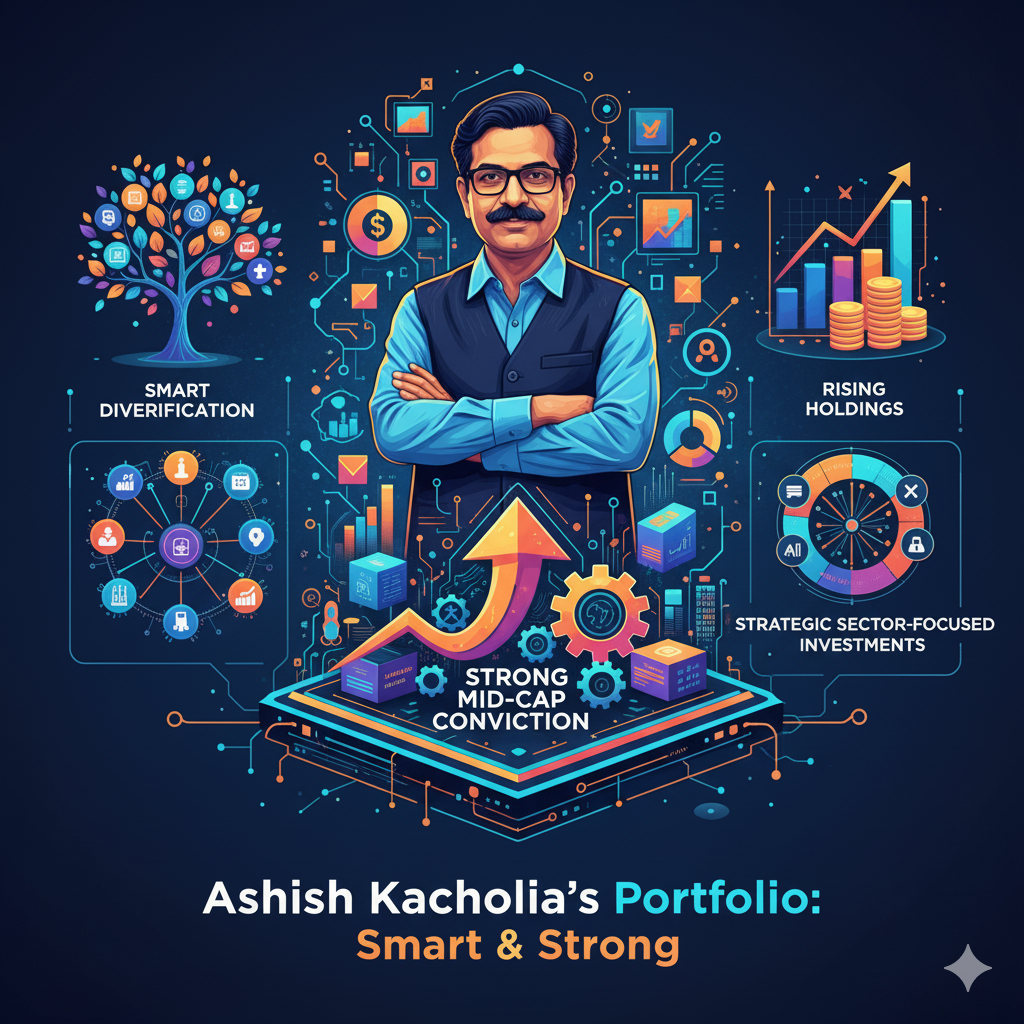
Ashish Kacholia, often referred to as the “Big Whale of Midcaps,” has long held a reputation for identifying high-potential companies before they catch mainstream attention. Known for finding multibaggers in niche sectors—ranging from manufacturing and chemicals to engineering and speciality businesses—Kacholia’s portfolio is followed closely by retail investors, analysts, and fund managers. His ability to consistently spot under-the-radar opportunities makes each quarterly portfolio change worth studying.

The latest disclosures from Trendlyne and financial research platforms highlight several important updates: new additions, stake increases, strategic reductions, and changes driven by market conditions. Together, these moves offer valuable insights into Kacholia’s current priorities and market outlook.

Portfolio Value Rises Despite Market Volatility

In the most recent update, Kacholia’s disclosed portfolio witnessed a 4.7% increase in value, bringing his net worth to nearly ₹2,854.64 crore. This rise comes during a period marked by uneven performance in mid-cap and small-cap stocks—segments Kacholia is heavily invested in.

A portfolio uptick in such conditions points to strong selection within his holdings. Many of his companies operate in sectors with improving fundamentals or in industries benefiting from long-term structural growth such as manufacturing, infrastructure, defence engineering, and speciality chemicals. This resilience reflects Kacholia’s trademark approach: backing fundamentally strong businesses capable of growing through market cycles.

Fresh Buy: Significant Increase in Man Industries

One of the key highlights this quarter is his fresh and sizeable increase in Man Industries, where he raised his stake by 1.01%. Man Industries operates in the steel pipe manufacturing space and supplies to sectors like oil & gas, water infrastructure, and utilities.

The company has seen steady order inflows and improving business visibility, especially with the government focusing on expanding pipeline networks and strengthening national infrastructure. By increasing his position, Kacholia appears to be betting on rising demand for steel pipes, long-term infrastructure spending, and the company’s improving margins.

Such a decisive purchase suggests he sees significant value ahead. Kacholia often makes large moves when he identifies strong earnings visibility or a sectoral tailwind—this addition mirrors that pattern.

Trimming Exposure in Dhabriya Polywood

On the sell side, Kacholia trimmed his holdings in Dhabriya Polywood Ltd., cutting his position by about 0.88%. Dhabriya Polywood, which manufactures PVC and WPC-based building materials, has witnessed volatility due to fluctuating raw material prices and demand pressures in the real estate supply chain.

The reduction appears strategic rather than a complete shift away from the company. Kacholia typically trims positions to rebalance weightages, control risk, or redirect capital toward higher-conviction opportunities. Given that he has not exited the company entirely, it suggests he still sees potential but prefers a reduced exposure given market conditions.

Aggressive Buying During the March Quarter Selloff

A standout aspect of his recent behaviour is his willingness to buy aggressively during market corrections. During the March-quarter selloff—a period when broader markets dipped and small caps faced pressure—Ashish Kacholia added nine new companies to his portfolio.

The new additions included:

  • DU Digital Global
  • Infinium Pharmachem
  • C2C Advanced Systems
  • BEW Engineering
  • and several others across manufacturing, technology, and industrial services.

This aggressive buying reflects a classic Kacholia trait: using periods of panic to accumulate fundamentally solid companies at favourable valuations. Unlike investors who wait for clearer trends, Kacholia often steps in early when prices are depressed but business fundamentals remain strong.

His selection during the selloff also shows his preference for smaller companies with scalable business models. Most of these names operate in industries benefiting from long-term structural growth such as digital services, pharmaceutical intermediates, and precision engineering.

Increasing Stakes in Existing High-Conviction Stocks

Along with nine fresh additions, Kacholia also increased his holdings in five of his existing companies during the same downturn. This signals two key aspects of his strategy:

  1. High conviction during volatility — He does not hesitate to add more to quality companies even when markets are falling.
  2. Long-term focus — Temporary declines do not deter him from strengthening positions in fundamentally strong businesses.

For Kacholia, market dips are not periods of fear but opportunities to deepen exposure to his best ideas. This is a hallmark of many successful investors.

Portfolio Reshuffle in the September 2025 Quarter

In another important update, Kacholia reshuffled his ₹2,675 crore portfolio during the September 2025 quarter. This reshuffle included both new entries and stake reductions.

He added four new companies, signalling new strategic bets:

  • V-Marc India
  • Pratham EPC Projects
  • Jain Resource Recycling
  • Vasa Denticity

These companies operate in diverse sectors such as electrical cables, EPC contracting, recycling solutions, and dental consumables. The combination shows Kacholia’s ability to diversify across industries while still maintaining a focus on niche, rapidly expanding business models.

At the same time, he trimmed his stakes in:

  • Xpro India
  • Brand Concepts
  • Dhabriya Polywood

The reductions suggest careful rebalancing and profit booking after significant past gains, especially in companies that saw rapid appreciation. Kacholia often fine-tunes his portfolio to maintain an optimal mix between growth potential and valuation comfort.

What the Latest Moves Reveal About His Strategy

When viewed together, Kacholia’s recent activities reveal several important aspects of his investment philosophy:

1. Continued preference for mid-caps and small caps
He remains focused on companies that have large addressable markets and room for multi-year compounding.

2. Aggressive buying during corrections
Market panic does not deter him; he uses downturns to accumulate promising stocks cheaply.

3. Strategic trimming but not abrupt exits
Reductions in holdings like Dhabriya Polywood are calculated and based on valuation or rotation needs rather than sudden loss of conviction.

4. Sectoral diversification
New additions span manufacturing, engineering, recycling, digital, financial services, and speciality chemicals.

5. Focus on long-term structural themes
Most additions are aligned with India’s broader growth story—manufacturing expansion, digital adoption, infrastructure spending, and supply-chain modernisation.

Conclusion

Ashish Kacholia’s latest portfolio activities reflect his dynamic and research-driven style. Whether it’s adding high-potential new companies, increasing stakes in existing winners, or trimming overvalued positions, each move is methodical and conviction-led. His portfolio’s rise to nearly ₹2,854 crore demonstrates not just market recovery but the strength of his carefully chosen holdings.

By adding companies across multiple sectors, boosting exposure during downturns, and resetting weights where required, Kacholia showcases a disciplined approach to long-term investing. His portfolio remains a masterclass in identifying niche opportunities poised for growth in the Indian economy.

Ashish Dhawan’s Latest Portfolio Update: A Detailed 1100-Word Human-Written Analysis

Ashish Dhawan, one of India’s most respected and intellectually driven investors, continues to be closely tracked by market watchers who look to his portfolio for signals about emerging opportunities in the Indian equity landscape. Known for his long-term thinking, deep research, and ability to identify scalable businesses early, Dhawan’s investment decisions often reflect a balance of conviction, caution, and strategic diversification.

The founder of ChrysCapital and a leading philanthropist, Dhawan has long been admired for his sharp understanding of business cycles and structural trends. His portfolio evolves steadily over time, shaped by a mix of high-conviction bets and tactical adjustments. The latest Trendlyne data shows several interesting movements—both in terms of new entries and stake changes—that provide insight into his current market outlook.

A Decline in Portfolio Value but Not in Confidence

One of the biggest highlights from the latest disclosure is a 16% decline in Dhawan’s portfolio value, which currently stands at approximately ₹2,799 crore. Markets over recent quarters have seen volatility across sectors like pharmaceuticals, financial services, and selected mid-cap segments, all of which form a meaningful part of Dhawan’s exposure.

However, seasoned investors like Dhawan often treat market dips as opportunities to consolidate their holdings or add new picks at attractive valuations. Therefore, while the headline figure may appear concerning, it is essential to understand that such temporary drawdowns are common in long-term portfolio strategies. More importantly, a later quarter shows his net worth rising again, proving the resilience of his holdings.

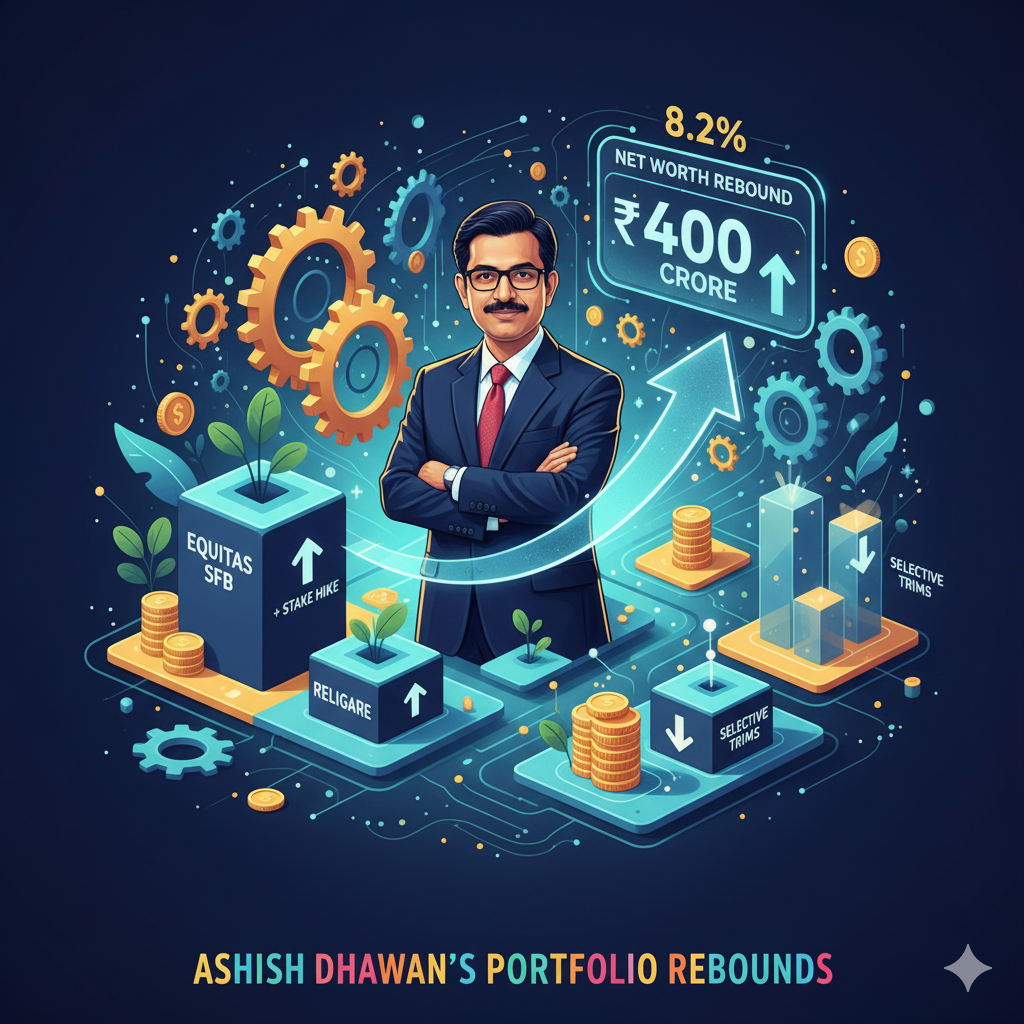
In fact, in Q2 2025, Dhawan’s portfolio rebounded by 8.2%, pushing his net worth back up to around ₹3,281.96 crore. This recovery reflects improved performance in some of his major stocks, better macroeconomic sentiment, and a bounce-back in mid-cap names.

Increasing Stake in Equitas Small Finance Bank

One of the notable moves in his latest activity is his decision to increase his stake in Equitas Small Finance Bank (SFB) by around 0.11%.

Equitas SFB has shown strong financial growth over the last few years, driven by expansion into microfinance, vehicle loans, and small businesses. The bank has improved its asset quality, widened its lending base, and increased deposit mobilisation. Dhawan’s increased investment indicates confidence in the bank’s future performance, especially at a time when India’s credit cycle is strengthening and small finance banks are widening their presence in underserved markets.

Investors like Dhawan typically increase stakes when valuations are attractive and the long-term growth trajectory appears promising. The incremental buy suggests that Equitas SFB remains a high-conviction financial sector pick for him.

Reducing Exposure to Glenmark Pharmaceuticals

While he added to Equitas SFB, Dhawan also trimmed his stake in Glenmark Pharmaceuticals, reducing his exposure by about 0.53%.

The pharmaceutical sector has faced challenges including pricing pressure in global markets, regulatory headwinds, and slower-than-expected recovery in the generics space. Glenmark, despite its strong research focus and product pipeline, has not been immune to these issues.

A reduction in stake does not necessarily imply that Dhawan has lost confidence in the company. Rather, it may reflect portfolio rebalancing, profit booking, or a shift of funds toward sectors with better near-term prospects. This approach aligns with Dhawan’s investing style—consistent monitoring and recalibration based on business conditions.

Four New Companies Added to His Portfolio

A major highlight of the June 2025 quarter was Dhawan’s addition of four new companies, signalling his interest in emerging opportunities across sectors. The new entries are:

  • RPSG Ventures
  • Northern ARC Capital
  • Digitide Solutions
  • Bluspring Enterprises

Together, these new holdings represent investments exceeding ₹400 crore—a sizeable addition and a clear indication of his strategic expansion.

RPSG Ventures reflects interest in diversified business models with exposure to fast-growing consumer and service segments.
Northern ARC Capital, focused on structured finance and lending to under-served segments, aligns with Dhawan’s keen understanding of financial inclusion and credit markets.
Digitide Solutions and Bluspring Enterprises are part of India’s rapidly evolving technology and digital transformation space.

By adding these companies, Dhawan is broadening his participation in both traditional and new-age business models. This move also highlights his willingness to explore high-potential early-stage listed opportunities—something he has successfully done throughout his career.

Increasing Stakes in Existing Favourites

Apart from new additions, Dhawan also increased his positions in some of his existing holdings, particularly in Religare Enterprises and Equitas SFB. The combined value of these increased stakes is estimated to be over ₹15 crore.

Religare Enterprises has been undergoing a multi-year turnaround, strengthening its financial services ecosystem and improving governance standards. With new management at the helm and improving performance in its health insurance and lending subsidiaries, the company appears to be on a revitalisation path. Dhawan’s increased investment signals continued belief in the company’s structural revival.

Meanwhile, adding more to Equitas SFB further consolidates his conviction in India’s financial inclusion story—one of the key long-term themes driving lending growth across rural and semi-urban regions.

Portfolio Outlook and Investment Philosophy

Despite quarterly fluctuations, Dhawan’s long-term investment philosophy remains clear and consistent. He typically follows a value-driven approach with a strong emphasis on management quality, scalability, and durability of growth. His interests span across sectors such as finance, pharmaceuticals, consumer services, technology, and industrials.

The latest updates show that Dhawan:

  • remains committed to his high-conviction stocks,
  • selectively trims positions where valuations may be stretched or near-term volatility is high,
  • and continues exploring new opportunities in emerging companies with strong long-term potential.

This multi-pronged strategy helps balance risk while ensuring participation in India’s economic growth story.

Conclusion

Ashish Dhawan’s latest portfolio changes offer valuable insight into the mind of a seasoned investor who blends deep research with disciplined execution. Despite a temporary 16% decline in portfolio value, his holdings recovered strongly in the next quarter, proving the long-term strength of his choices. His recent activities—adding new companies, increasing stakes in financial firms, and trimming exposure in select stocks—highlight a portfolio that is both dynamic and strategically grounded.

With new bets in RPSG Ventures, Northern ARC Capital, Digitide Solutions, and Bluspring Enterprises, along with increased exposure to Equitas SFB and Religare Enterprises, Dhawan continues to position himself for future growth opportunities. His approach remains a masterclass in thoughtful, patient, and research-backed investing.

Sunil Singhania’s Latest Portfolio: A Detailed 1100-Word Human-Written Analysis

Sunil Singhania, one of India’s most respected equity investors and the founder of Abakkus Asset Manager LLP, continues to attract attention with his strategic stock-picking approach and consistent performance in the small-cap and mid-cap space. His portfolio, updated in the latest shareholding disclosures, reveals not just the companies he believes in but also the evolving market themes he is aligning with. With decades of market experience and a reputation built from his long association with Reliance Mutual Fund, Singhania’s investment style blends strong fundamentals, valuation comfort, and long-term conviction.

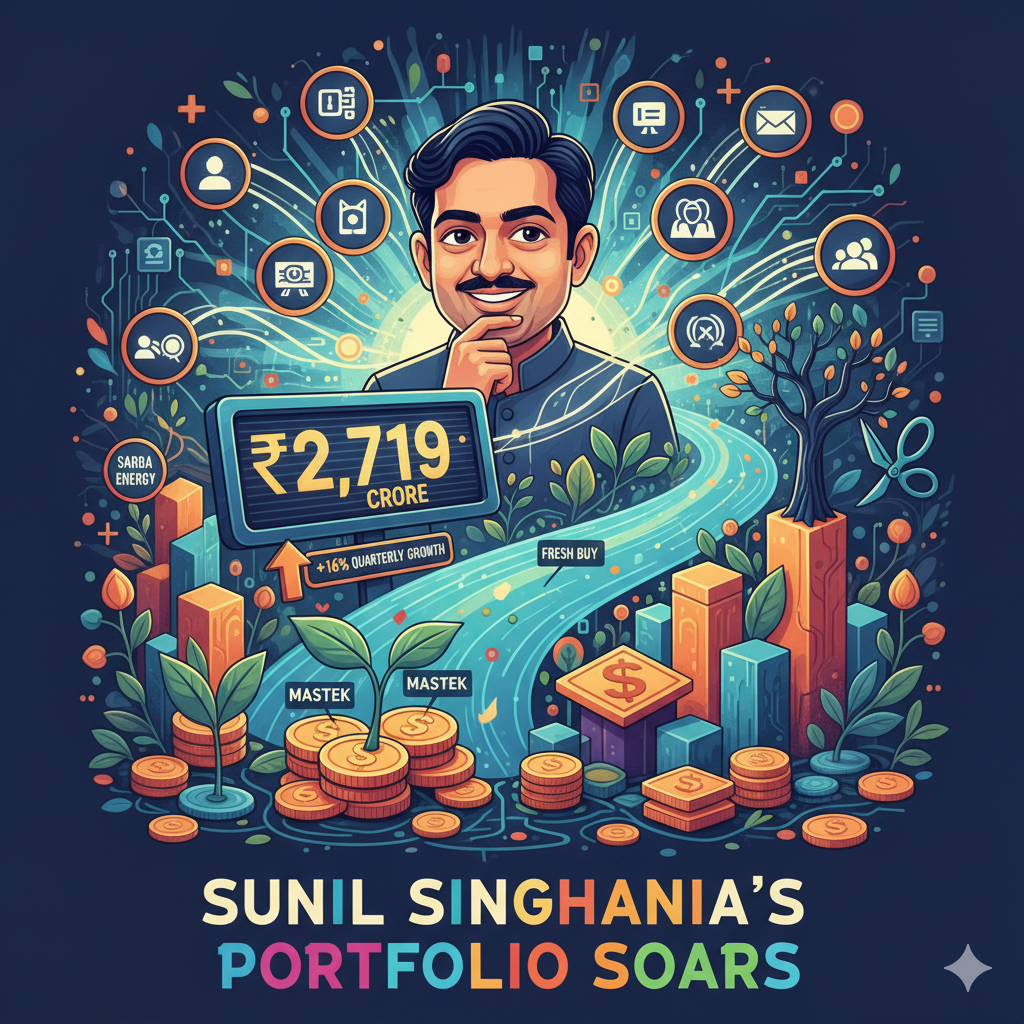
As per the latest available data, Singhania publicly holds 26 stocks, forming a diversified and high-value portfolio worth nearly ₹2,719 crore. This makes him one of the most closely tracked investors in the Indian markets. The most recent quarter has also been a positive one for him, with the portfolio recording approximately 16.4% growth. Such a sharp quarterly rise indicates that his mid-cap and small-cap bets have performed strongly, driven by sectoral tailwinds, improving business momentum, and the broader rally in high-growth companies.

Increasing Stake in Mastek Ltd.: A Vote of Confidence

One of the more interesting updates this quarter is his decision to increase his stake in Mastek Ltd., a well-known digital engineering and cloud transformation company. The increase, though modest at around 0.04%, reflects the continued conviction he has in the company. Mastek has been on an expansion journey, strengthening its global client base and focusing on high-value digital solutions. Investors like Singhania often increase their holdings gradually to average their cost or reinforce their long-term belief in a business.

Mastek has benefited from strong order flows, digital transformation mandates across industries, and increasing participation in government technology initiatives. Even a small incremental buy from a seasoned investor like Singhania sends a signal that he expects continued growth momentum in the company. For the market, this typically strengthens sentiment around the stock.

Reducing Exposure to Sarda Energy & Minerals Ltd.

In contrast, Singhania trimmed his stake in Sarda Energy & Minerals Ltd. by about 0.39%. This small reduction is not necessarily a bearish signal; such portfolio adjustments often stem from profit booking or rebalancing rather than a loss of conviction. Sarda Energy operates in the steel, ferro alloys, and hydropower businesses—sectors where price cycles can be volatile.

Given the global uncertainties surrounding metal prices and energy markets, Singhania may simply be redistributing his funds to sectors with higher risk-adjusted potential. Successful investors frequently rotate capital into newer opportunities while continuing to hold quality businesses even after trimming stakes. Thus, this move should be seen as tactical rather than a fundamental shift in view.

Top Holdings That Define His Core Strategy

A look at his major holdings offers insights into his investment philosophy. Some of the standout names in his portfolio include Dynamatic Technologies, Jubilant Pharmova, Technocraft Industries, Himatsingka Seide, Rupa & Company, and Suven Life Sciences. Each of these companies represents a different sector, but together they highlight Singhania’s preference for strong management, operational turnaround potential, and companies with deep niche strengths.

Dynamatic Technologies, one of his top bets, operates in the aerospace, automotive, and hydraulic components segments. The company’s specialised engineering capabilities and long-term defence manufacturing prospects have made it a favorite among high-conviction investors. The defence sector in India has been gaining momentum due to increasing government orders and the push toward self-reliance, creating a favourable backdrop for companies like Dynamatic.

Jubilant Pharmova, another key holding, has navigated a challenging period in the pharmaceutical industry but remains a strong player with diversified segments in pharma, drug discovery, and contract manufacturing. Singhania’s confidence in such a company suggests he believes in its long-term growth revival supported by global pharmaceutical demand and India’s rising position in the drug supply chain.

Technocraft Industries and Rupa & Company reflect his interest in manufacturing-led businesses with solid export potential. Indian textile, apparel, and industrial product companies have seen improved demand and better valuation comfort in recent years, making them attractive picks for value-oriented investors.

Meanwhile, Suven Life Sciences, which is deeply focused on research-driven pharmaceutical innovation, aligns well with his belief in specialised niche segments. The company’s strong pipeline and position in contract research manufacturing give it long-term upside, making it a compelling component of his portfolio.

A Diversified, Balanced, and Sector-Agnostic Approach

One of the strengths of Singhania’s portfolio is the diversified nature of his holdings. While many high-profile investors concentrate heavily on a few stocks, Singhania spreads his bets across multiple sectors including engineering, chemicals, pharmaceuticals, consumer wear, IT services, textiles, and industrial manufacturing. This reduces downside risk, especially in volatile markets.

What stands out is his inclination toward small-cap and mid-cap companies. These businesses often operate in niche markets with strong growth runways and relatively lower institutional coverage. As a result, they offer significant value discovery opportunities—precisely the kind of environment Singhania is known to thrive in. His ability to identify early-stage potential in growing companies has been one of the foundations of his long-standing success.

This diversified strategy also shows that he avoids over-concentration in any single sector. Instead, he stays sector-agnostic and focuses mainly on companies with strong fundamentals, capable management, and attractive valuations. This is a classic long-term approach that blends value investing with growth potential.

Consistent Long-Term Vision Behind Every Move

The recent performance of his portfolio and changes in stake ownership reflect his disciplined investment process. His buys and sells are rarely impulsive; they typically represent thoughtful evaluation based on market conditions, business performance, and long-term trends.

His incremental increase in Mastek, for example, shows continued confidence in technology-led companies. And the minor trimming of Sarda Energy reveals a balanced risk management approach. The combination of both actions demonstrates a portfolio that is both dynamic and steady.

Conclusion

Sunil Singhania’s latest portfolio update offers a clear window into how one of India’s most respected investors navigates an evolving market landscape. With 26 stocks, an impressive ₹2,719 crore portfolio size, and over 16% growth this quarter, he continues to maintain his reputation as a sharp, insightful investor who knows how to strike harmony between risk and reward.

His portfolio choices emphasize a long-term mindset, strong fundamentals, and a keen eye for value in less-explored corners of the market. Whether it is buying more of Mastek, trimming Sarda Energy, or holding high-conviction picks like Dynamatic Technologies or Suven Life Sciences, every move reflects clarity of thought and conviction built on decades of market wisdom.

Mukul Agrawal: The Dynamic Investor Behind One of India’s Most Active Portfolios

In India’s equity markets, a few names stand out for their conviction, consistency, and sheer hunger for discovering new opportunities. Among them, Mukul Agrawal has carved a distinct identity as one of the most active, aggressive, and sharp stock-market investors of recent times. His portfolio activity, quarter after quarter, reflects not only his confidence in India’s growth story but also his unique ability to identify high-potential companies at relatively early stages.

While many investors tend to build a compact list of long-term holdings, Agrawal has taken a different route. His portfolio is vast, diverse, and constantly evolving. With over 70 publicly disclosed holdings and a portfolio value crossing ₹7,500 crore, he represents the new generation of Indian investors who blend traditional research with a modern, opportunity-seeking mindset.

A Portfolio That Mirrors India’s New Growth Wave

 Few individual investors in India actively hold more than 70 listed companies—and even fewer manage them with such strategic clarity. His publicly declared holdings include large caps, mid caps, and a significant number of small and emerging companies.

This wide spread isn’t random. It reflects his belief that India’s true wealth creation lies not only in established giants but also in young, fast-growing sectors powered by domestic consumption, industrial expansion, and technology adoption. Whether it’s manufacturing, engineering, chemicals, healthcare, or banking, his investments show a broad understanding of India’s evolving business landscape.

Aggressive Buying in the Latest Quarter

The most recent quarter has been one of his busiest. Agrawal added 10 new stocks to his portfolio, reaffirming his long-term bullishness on the markets. Along with these new entries, he also increased his stakes in 5 existing holdings, showing conviction in themes he believes will outperform in the coming years.

This level of activity highlights his dynamic approach. Instead of following a rigid plan, he continuously studies changing market conditions, new business models, and early growth trends. When opportunities arise—whether due to attractive valuations, sectoral shifts, or strong quarterly numbers—he is quick to act.

Sector Exposure: A Strategic Spread Across the Economy

One of the most notable strengths of Agrawal’s portfolio is its diversification across industries. His new picks in recent quarters reveal a clear preference for sectors that are gaining momentum in the current economic cycle.

Some of the sectors he has added or increased exposure to include:

Real Estate: With India experiencing a housing boom, his investment in companies like Valor Estate reflects confidence in long-term structural demand.

Banking and Financials: The inclusion of stocks like Jammu & Kashmir Bank shows belief in regional banks benefiting from credit growth and expanding balance sheets.

Specialty Chemicals: By increasing positions in chemical names, he aligns with India’s rising role as a manufacturing hub for global chemical supply chains.

Healthcare: Investment in hospital chains and pharmaceutical companies highlights confidence in India’s expanding healthcare infrastructure.

This level of diversification is not merely for risk reduction—it is a conscious strategy to stay exposed to India’s next-generation sectors that can deliver outsized returns.

High-Conviction Stakes in Select Companies

While Mukul Agrawal’s portfolio is broad, several companies stand out where he holds significant stakes. These positions reflect his highest conviction and long-term belief in their business models.

For example:

He owns over 1% of IFB Industries, a consumer-durables company with a strong legacy in appliances.

He holds more than 7% of Osel Devices, a niche high-growth small-cap that manufactures LED lighting, electronic devices, and hearing-aid products.

Such large stakes reveal not only confidence but also a long-term vision. He typically enters these companies early, often when they are still under-researched or in expansion phases.

Focus on High-Growth Small and Mid Caps

One of the defining features of Agrawal’s investment approach is his sharp eye for promising small and mid-cap stocks. He increased holdings in several emerging companies in the latest quarter, including:

ASM Technologies – A tech engineering firm where he increased his stake significantly.

Tatva Chintan Pharma – A specialty chemicals player with global demand.

Zota Healthcare – A fast-growing pharma company focusing on affordable and accessible healthcare.

WPIL – A leader in pumping solutions for industrial and infrastructure applications.

Investors often struggle with identifying high-potential small caps, but Agrawal excels in spotting early trends. His strategy is built on:

Strong promoter quality

Solid business models

Expanding market share

High entry barriers

Scalable operations

A Dynamic Approach to Portfolio Management

Unlike investors who adopt a buy-and-hold approach for every stock, Mukul Agrawal maintains a blend of conviction-based holding and active rebalancing. He is not afraid to trim or exit positions if the valuation becomes stretched, if earnings disappoint, or if better opportunities emerge.

In the latest quarter, he exited or reduced holdings in select companies, including environmental engineering firms and smaller industrial names. This shows he exercises discipline—not becoming emotionally attached to any holding, but making decisions based on evolving market realities.

His approach balances agility with long-term thinking—a combination that is rare and difficult to master.

Why Investors Track Mukul Agrawal Closely

There are several reasons why market participants, analysts, and retail investors closely watch his portfolio updates:

High Activity Levels: He buys and sells more frequently than most superstar investors.

Sharp Understanding of Small Caps: His picks often spot emerging trends before others.

Diverse Sectors: He covers sectors that reflect real shifts in India’s growth cycle.

Strong Conviction: When he believes in a company, he takes meaningful positions.

Performance Track Record: Many of his calls have delivered impressive long-term returns.

A Modern Investor with a Growth Mindset

Raamdeo Agrawal: The Investor Who Turned Discipline Into a Billion-Dollar Journey

Raamdeo Agrawal’s story is one of discipline, vision, and the quiet confidence that long-term conviction can create extraordinary wealth. Today, he stands among India’s most respected investors, widely admired for his transparent approach, powerful investment frameworks, and his ability to convert research-driven decisions into long-term wealth creation. It started in a small town, with modest means, and with a determination that would eventually lead him to co-found Motilal Oswal Financial Services—an institution now synonymous with trust, research quality, and wealth creation in India.

Early Life and Humble Beginnings

Raamdeo Agrawal’s early years were not marked by privilege. He came from a simple background, where ambition had to be built through effort rather than inheritance. His academic journey led him into the world of finance and accounting, and this turned out to be the foundation for what would become a lifelong passion: understanding businesses and analyzing numbers.

When he entered the financial markets in the mid-1980s, India’s markets were nowhere near as developed or accessible as they are today. Information was scarce, tools were limited, and brokerage services were still evolving. Yet, Agrawal saw possibilities. With strong analytical skills and a deep curiosity about how companies grow, he set out to build a career in equities—at a time when very few people in India believed equity investing could lead to serious wealth.

The Birth of Motilal Oswal Financial Services

In 1987, Raamdeo Agrawal partnered with Motilal Oswal to start what would later become one of India’s most respected financial services groups. At the beginning, the duo operated from a very small office, handling sub-broking activities and building trust with clients one conversation at a time. The early years were demanding, with markets still in their infancy and systems far less organized than today.

But what set the founders apart was their focus on research long before the rest of the industry recognized its importance. They believed that informed decision-making—not speculation—would drive investor confidence. Over the years, this philosophy became the backbone of their entire business model.

Today, Motilal Oswal Financial Services spans brokerage, asset management, wealth management, private equity, and investment banking. It is known for its research reports, detailed company studies, and the ability to identify winners early—values that trace directly back to Agrawal’s mindset and discipline.

A Deeply Researched Investment Style

Raamdeo Agrawal is not just a businessman. He is, at heart, an investor. His personal investing philosophy is built on patience, deep research, and a willingness to understand the “soul” of a business before putting money into it.
He does not chase momentum, short-term noise, or market excitement. Instead, he focuses on fundamentals—management capability, competitive edge, business performance, and long-term scalability.

His famous mantra “Buy Right, Sit Tight” captures his entire approach. To him, wealth is not created by trading frequently but by finding a set of high-quality companies and holding onto them long enough for their growth to reflect in one’s portfolio.

This philosophy has worked brilliantly for him. Over decades, he has identified companies that delivered massive compounding returns, helping him grow his wealth into the billions.

QGLP: A Framework That Changed Indian Investing

One of Raamdeo Agrawal’s most impactful contributions to India’s investment community is the QGLP framework—Quality, Growth, Longevity, and Price.

  • Quality focuses on the strength of management, corporate governance, and the overall durability of the business model.
  • Growth examines how consistently the company can expand revenues and profits.
  • Longevity measures how long the company can maintain competitive advantages and growth momentum.
  • Price ensures that the investment is made at a reasonable valuation relative to long-term potential.

This approach is not just theoretical. It has been used in Motilal Oswal Asset Management’s portfolio construction, shaping some of the firm’s most successful strategies. It also resonates with investors across India who seek a structured, reliable method to evaluate companies.

Influence of Warren Buffett

Raamdeo Agrawal openly acknowledges that Warren Buffett has been his biggest influence. He has studied Buffett’s letters, investment principles, and philosophies deeply. Buffett’s focus on quality, patience, and value resonated with Agrawal early in his career, long before value investing became fashionable in India.

However, Agrawal did not copy Buffett blindly. Instead, he adapted the wisdom to Indian market realities. Indian companies operate in a fast-growing, dynamic economy with steep competition and evolving consumer behavior. Agrawal tailored his strategies to account for these factors—an approach that helped him identify several high-growth Indian companies at early stages.

Wealth Creation and Net Worth

Decades of disciplined investing have made Raamdeo Agrawal a self-made billionaire. His estimated net worth stands at around $1.7 billion, a testament to decades of commitment to long-term value creation. Unlike many investors who made money through speculation, Agrawal’s wealth is almost entirely the result of patient equity investing and business building.

His story serves as proof that long-term thinking can create phenomenal wealth, even if one starts with modest means.

Leadership, Ethics, and Corporate Culture

Beyond numbers and markets, Raamdeo Agrawal places strong emphasis on ethics, transparency, and corporate governance. His leadership philosophy is rooted in integrity—both personal and organizational.

He believes that trust is the foundation of the financial services industry. This belief has guided Motilal Oswal’s culture for decades. Whether dealing with clients or managing employees, the firm’s structure reflects clarity, honesty, and professionalism.

Additionally, Agrawal has built a leadership pipeline within his company that ensures the organization can thrive beyond his own lifetime. Professional management, decentralized decision-making, and merit-based growth are key elements of the firm’s culture.

Philanthropy and Giving Back

Raamdeo Agrawal is also known for his philanthropic efforts. Through initiatives linked to the Motilal Oswal Foundation, he supports education, skill development, healthcare, and community upliftment programs. His belief is simple: as wealth grows, responsibility should grow with it. He sees philanthropy as a natural extension of success, not an optional add-on.

A Legacy in Indian Investing

Today, Raamdeo Agrawal is not just a successful investor but a teacher to millions. His interviews, books, and annual wealth creation studies have shaped the way countless Indian investors analyze markets. His frameworks are used in classrooms, investment clubs, and corporate training programs across the country.

He represents a rare combination: a world-class investor who remains grounded, transparent, and committed to sharing knowledge. His journey shows that disciplined investing, ethical business, and relentless learning can together build not only wealth but also a lasting legacy.

DMart: The Retailer That Redefined Value Shopping in India

In a country where retail competition is fierce and consumer expectations are constantly evolving, DMart has managed to carve out a unique identity—one built on consistency, affordability, and trust. Over the years, the brand has risen from being just another supermarket chain to becoming one of India’s most admired retail success stories. People across states rely on DMart not just for groceries but for a wide range of essentials, confident that they will find both quality and value under one roof.

DMart, owned and operated by Avenue Supermarts Ltd, reflects the philosophy of its founder, Radhakishan Damani. Known for his quiet demeanor and sharp business acumen, Damani envisioned a retail format that focused on everyday needs, stable pricing, and operational discipline. That foundation remains the backbone of DMart’s impressive growth story.


A Retail Format Built Around Everyday Needs

From the beginning, DMart was designed to serve the Indian household. Unlike high-end supermarkets or hypermarkets that may focus heavily on premium categories, DMart took a different approach—prioritize essential daily-use items and offer them at prices customers can consistently trust. This philosophy allowed the brand to become a go-to shopping destination for families.

The stores carry a vast assortment of products across multiple categories. Groceries and staples form the core of DMart’s offerings: rice, wheat, pulses, spices, and cooking essentials—everything a family needs for its kitchen.

DMart also stocks a wide range of home and lifestyle products. These include kitchenware, plastic storage, steel utensils, appliances, home linen, apparel for men, women, and children, and even basic electronics. Because of this broad assortment, customers do not need to visit multiple stores—DMart becomes their one-stop solution for monthly, weekly, and even daily needs.


The Everyday Low Price Strategy: DMart’s Winning Edge

One of the biggest reasons shoppers repeatedly choose DMart is its pricing strategy. The company follows a philosophy known as “Everyday Low Cost – Everyday Low Price,” often referred to as EDLC-EDLP. What this means is simple: DMart aims to keep operational costs as low as possible so that savings can be passed on to customers in the form of lower prices.

Unlike retailers who host frequent discount events or offer inconsistent promotions, DMart’s prices stay low throughout the year. Customers know they will receive great value no matter when they shop. This builds trust and eliminates the dependency on festival sales or limited-time offers.

DMart achieves this through disciplined business practices. It minimizes overheads, optimizes store layouts, and purchases goods in bulk directly from manufacturers whenever possible. The company also avoids heavy spending on advertising, choosing instead to let word of mouth and customer loyalty drive growth.


Distinct Expansion Strategy: The Cluster Model

DMart has never believed in aggressive, scattered expansion just for the sake of opening more stores. Instead, it follows a cluster-based growth model. Before moving into a new region, the company ensures it has built a strong supply chain network and a solid customer base in nearby locations.

By building clusters of stores within close geographic proximity, DMart greatly reduces its logistical burden. This allows it to move products efficiently between warehouses and stores, reducing waste, fuel costs, and overall operational complexity.

This approach not only supports DMart’s low-cost strategy but also enhances availability of products. Stores seldom run out of stock because the supply chain supporting them is well-planned and regionally optimized.


Building a Strong Nationwide Presence

Over the years, DMart has expanded into many Indian states and continues to grow steadily. Its stores span urban centers, suburban areas, and even emerging towns where modern retail is still developing. Families across regions trust DMart as a reliable partner for their household needs.

The brand’s presence extends over hundreds of stores across India, covering millions of square feet of retail space. But what’s even more remarkable is the consistency with which DMart manages its vast network. Whether a customer visits a store in Mumbai, Hyderabad, Pune, Indore, or Bengaluru, the experience remains consistent—clean aisles, well-stocked shelves, friendly staff, and value-driven pricing.

This uniformity reflects the company’s disciplined approach to retail operations. DMart insists on owning most of its store properties instead of renting them, ensuring long-term stability and cost control. While this strategy increases upfront investment, it helps maintain margin stability in the long run, one of the reasons the company remains profitable even in a challenging retail environment.


A Shopping Experience Tailored for Everyday Consumers

DMart stores are designed with practicality and convenience in mind. Instead of flashy decorations or elaborate visual merchandising, the focus is on clear layout, efficient movement, and easy product access. Shelves are stacked in ways that help customers quickly find what they want.

The company pays close attention to customer behavior and consistently updates store formats based on what shoppers prefer. Their aisles are wide, signage is clear, and product placement is intuitive. The idea is to reduce shopping time while ensuring customers can explore a wide variety of choices in each category.

The checkout experience is also designed to be quick and efficient, with multiple counters and well-trained staff to handle high footfall. During peak hours, DMart deploys additional staff members to ensure smooth operations.


A Culture of Efficiency and Discipline

Behind DMart’s success lies a strong culture centered on efficiency, value creation, and customer trust. Employees are trained to maintain high standards of cleanliness, product availability, and service. Suppliers also form an integral part of DMart’s ecosystem. Over the years, the company has built long-term relationships with manufacturers and distributors, ensuring steady supply, fresh inventory, and favorable pricing.

DMart does not chase glamour or unnecessary expansion. Its long-term focus on efficiency, cost control, and customer satisfaction has allowed it to stand firm even as competition intensifies from online players and other retail chains.


The Vision of Radhakishan Damani

At the core of DMart’s philosophy is the vision of its founder, Radhakishan Damani. Known for his humility and low-profile personality, Damani brought a deep understanding of India’s consumer behavior to the retail business. His belief was simple: If you offer reliable products at consistently low prices, customers will keep coming back—and that is precisely what happened.

Today, DMart is one of India’s most respected retail formats, admired for its transparency, discipline, and long-term approach. The company continues to grow steadily, staying committed to the values that shaped its foundation.


Conclusion

DMart’s journey is a perfect example of how disciplined execution, customer-centric thinking, and a strong value proposition can build a retail empire. Whether it is affordable pricing, wide product range, efficient supply chain, or humble store design, everything revolves around meeting the needs of the Indian family. As the company expands further, its core mission remains unchanged: to make everyday shopping affordable, reliable, and convenient for millions of people across India.

Inside the Rakesh Jhunjhunwala Portfolio: A Deep Look at India’s Most Influential Investment Legacy

Few names in the Indian stock market command as much respect and admiration as Rakesh Jhunjhunwala. Often referred to as India’s Warren Buffett, he was known for his unmatched conviction, long-term vision, and ability to identify multibagger stocks long before they caught the market’s attention. Even after his passing in 2022, his investment philosophy continues to guide millions of traders and investors across the country.

Today, the portfolio managed under Rakesh Jhunjhunwala & Associates still stands as one of the most closely watched in India. Its structure, stock choices, sector preferences, and recent changes offer deep insights into what made Jhunjhunwala a legend—and how his legacy continues to evolve. With a portfolio value of over ₹63,000 crore, it remains one of the most powerful investment portfolios in India.

This article explores the major themes, top holdings, buying and selling patterns, and underlying strategy shaping this iconic portfolio.


A Portfolio That Continues to Grow After His Passing

Despite the emotional blow of losing its visionary leader, the portfolio has continued to perform strongly in the years following Jhunjhunwala’s demise. The total value now stands at around ₹63,453 crore, showing steady growth with a recent 6.6% rise.

This growth is not accidental. The portfolio continues to be managed by his long-time investment team, often referred to as Rare Enterprises, named after the first two letters of Rakesh and Rekha Jhunjhunwala. The team still follows the principles and frameworks laid down by him—patience, research-based conviction, and a preference for high-quality businesses.

This adherence to a proven philosophy has kept the portfolio stable and profitable, even in challenging market cycles.


Recent Buying Activity: Strengthening Betting on Banking

One of the most noticeable moves in the portfolio recently is the increased stake in Federal Bank. The portfolio added around 0.94% more shares, signaling continued confidence in the Indian banking sector.

This aligns with Jhunjhunwala’s long-term belief that:

“India grows when its banks grow.”

Federal Bank, known for its steady asset quality and strong retail presence, fits perfectly into the kind of reliable businesses Jhunjhunwala traditionally favored. The increase in stake suggests a firm conviction that banking will remain one of the pillars of India’s long-term economic story.


Selective Selling: Trimming Va Tech Wabag

Just as buying reveals conviction, selective selling provides insight into shifting priorities. The portfolio trimmed its holdings in Va Tech Wabag, a global water treatment company.

This does not necessarily indicate a loss of faith in the business. Instead, it may represent:

  • Portfolio rebalancing
  • Profit-booking
  • Strategic movement toward higher-conviction bets
  • Adjustments based on valuations

Jhunjhunwala’s team has always maintained that staying flexible and disciplined is essential. Selling small portions of mid-cap positions is consistent with their typical approach to optimizing risk and reward.


Diversification: The Heart of the Portfolio’s Stability

One of the defining characteristics of the Rakesh Jhunjhunwala portfolio is its thoughtful diversification. Rather than loading up on a single sector or theme, the portfolio spreads across industries that reflect both India’s current economic strengths and its future potential.

Major Sector Allocations Include:

  • Financial Services: Banks, NBFCs, and insurance
  • Consumer Retail: A reflection of India’s booming middle-class consumption
  • Healthcare: A long-term structural story driven by demographics
  • Industrials & Manufacturing: Benefiting from India’s rising domestic production
  • Technology & Services: Selective picks driven by long-term efficiency trends

This balanced allocation allows the portfolio to weather volatility while still capturing growth opportunities. The emphasis on core sectors also reflects Jhunjhunwala’s belief that returns come from understanding the India growth story—not chasing fads.


Top Holdings: The Core That Drives the Portfolio

The real strength of this portfolio lies in its top holdings—companies that Jhunjhunwala backed for years and which continue to deliver strong performance.

Some of the Major Holdings Include:

1. Titan Company

Titan is perhaps the most iconic part of Jhunjhunwala’s legacy. He once famously said:
“Titan is like my child.”
His early investment in the company turned into a multibagger worth thousands of crores.

2. Star Health & Allied Insurance

Jhunjhunwala was one of the early backers of Star Health, recognizing the massive untapped potential in India’s insurance sector.

3. Tata Motors

He believed strongly in India’s auto growth story and held a long-term conviction in Tata Motors’ leadership and electrification goals.

4. CRISIL

A high-quality business offering consistent cash flows and strong market leadership in ratings and analytics.

5. Other Select Businesses

IT, retail, pharma, manufacturing, and specialty companies that reflect both stability and high-growth potential.

These holdings demonstrate a powerful combination of blue-chip reliability and long-term compounding—cornerstones of the Jhunjhunwala investing philosophy.


Strategic Management After His Passing

A key question for investors after 2022 was: What happens to the portfolio now?

The reassuring answer is that the team he built is still managing it with the same discipline. There have been visible signs of strategic rebalancing over the years:

  • Reducing stakes in mid-cap positions where valuations ran ahead
  • Strengthening positions in banking and financials
  • Maintaining strong exposure to high-quality large caps
  • Evaluating new opportunities with the same framework

The portfolio today is not static—it is dynamic, evolving, and pragmatic. This shows that the philosophy lives on, not just the portfolio.


What the Portfolio Says About His Philosophy

Every stock in the portfolio tells a story. And together, they form a blueprint of how Jhunjhunwala thought about businesses and wealth creation.

His approach was built on:

  • Long-term conviction, not short-term action
  • Strong fundamentals over hype-driven momentum
  • High-quality management teams
  • India-focused growth themes
  • Humility, patience, and discipline

His portfolio remains a testament to these principles. Even years after his passing, the structure reflects the same clarity he always displayed.


Conclusion: A Legacy That Lives Through Every Holding

Rakesh Jhunjhunwala may no longer be physically present in the markets, but his influence remains as strong as ever. His portfolio continues to inspire investors, teach valuable lessons, and demonstrate the timeless power of long-term conviction.

From Titan to Federal Bank, from insurance to autos, from buying to strategic trimming—the portfolio is a living expression of his unmatched understanding of markets and businesses.

As Rare Enterprises continues to manage his holdings, the essence of Jhunjhunwala’s philosophy stays alive:
Invest in India, believe in growth, stay patient, and back great companies.