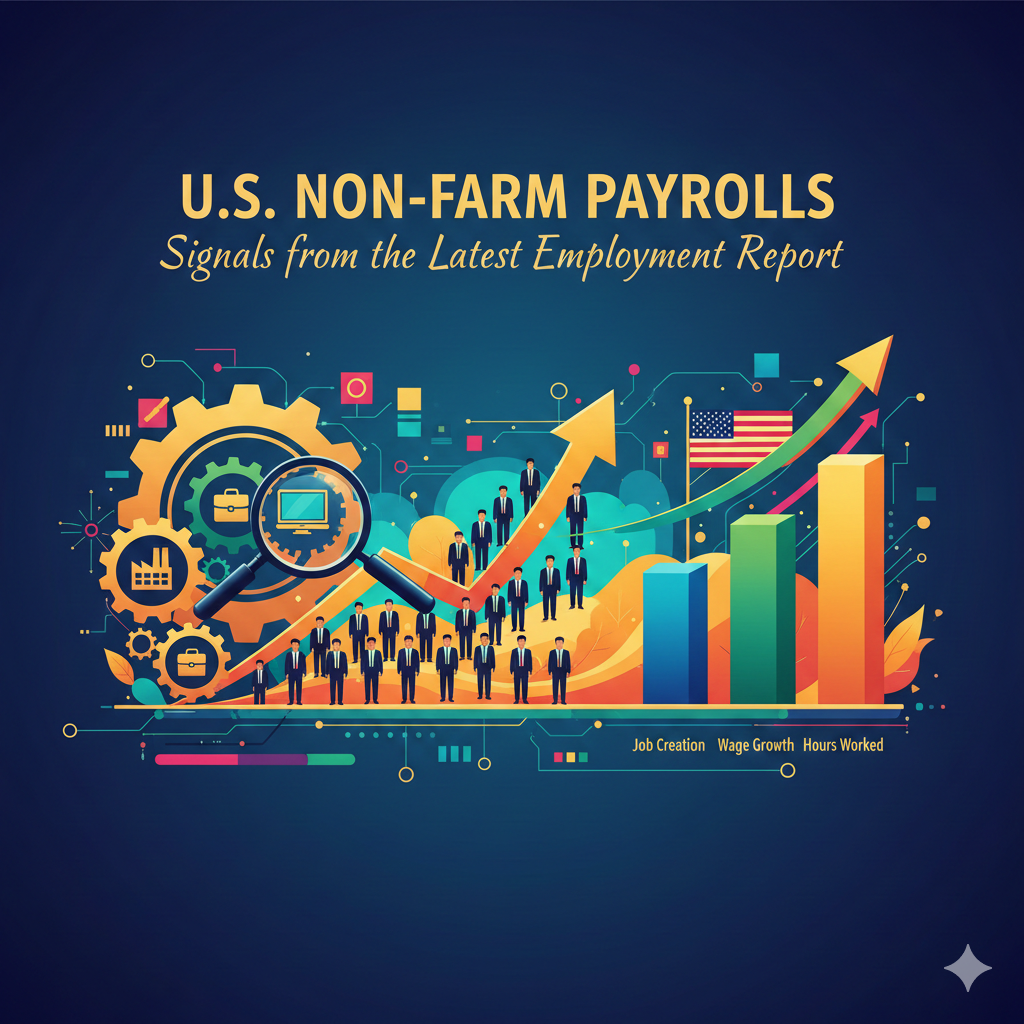
Interpreting U.S. Non-Farm Payrolls: Signals from the Latest Employment Report

The U.S. economy is watched closely by investors, policymakers, analysts, and businesses around the world, and one of the most influential indicators they monitor each month is the Non-Farm Payrolls (NFP) report. Although it may sound technical, the concept is straightforward: it measures the change in the number of workers the U.S. economy adds or loses, excluding specific categories like farm labor, household employees, and nonprofit workers. Despite how simple it sounds, the report is essential because it captures the heartbeat of the American labor market and provides clues about the broader direction of economic growth, inflation, and monetary policy.

To understand the significance of non-farm payrolls, it helps to think of the U.S. economy as a large engine. Employment is the fuel that keeps this engine running. When businesses hire more workers, it usually means they are seeing stronger demand, planning expansions, or expecting healthier economic conditions. Conversely, when hiring slows or declines, it can signal an economic slowdown, cautious business sentiment, or pressure within specific industries. This is why each monthly NFP release has the power to move financial markets, shift expectations for interest rates, and influence decisions made by the Federal Reserve.

In the most recent NFP report, the U.S. economy added 119,000 jobs. This represents a solid rebound after a slight decline in the prior month and came in above market expectations. Leading up to the release, analysts had forecast that job gains would be much more modest—around 50,000 new positions. That forecast reflected the belief that the labor market was cooling after several years of strong post-pandemic hiring. When the actual number came in more than twice the expected amount, it suggested that certain sectors of the economy were still showing resilience even in the face of higher interest rates and general economic uncertainty.

Digging into the details of the report reveals which sectors were responsible for the employment increase. The strongest job gains came from health care, which has been one of the most consistently expanding industries in the United States. Within health care, areas such as ambulatory services and hospitals saw significant hiring. This growth is hardly surprising. The U.S. population is aging, demand for medical services continues to climb, and the industry has struggled with staffing shortages for years. As a result, health-related jobs tend to remain stable even when other parts of the economy experience slowdowns.

Another sector that contributed to job growth was food services and drinking places, which includes restaurants, bars, cafes, and other hospitality businesses. This industry is especially sensitive to consumer spending patterns. When people feel financially confident, they are more willing to dine out. The sector was hit hard during the pandemic but has been recovering steadily. Continued hiring here indicates that consumer spending remains reasonably healthy, even if higher prices and cost-of-living pressures persist.

Social assistance was another bright spot, reflecting the ongoing need for support services, childcare workers, and community-based programs. As families continue to juggle work, rising expenses, and lingering disruptions in childcare availability, this sector plays a crucial role both socially and economically.

However, not all sectors performed well. Transportation and warehousing experienced job losses, reflecting a slowdown in shipping activity, logistics demand, and warehouse staffing. Over the past few years, this sector expanded rapidly due to the spike in online shopping and supply chain disruptions. As consumer behavior normalizes and businesses streamline operations, hiring has cooled and, in some cases, reversed.

Another notable point is the decline in federal government employment. Government jobs can fluctuate for many reasons, including budget constraints, administrative transitions, or broader hiring freezes. These declines reflect ongoing staffing adjustments within federal agencies.

The labor market is rarely uniform, and the latest data shows a patchwork of growing and contracting industries. Still, the net result—119,000 jobs created—points to a labor market that is slowing but still fundamentally stable.

One unique aspect of the recent data releases is the irregular timing of the reports. Normally, the NFP data is released on a predictable monthly schedule, but disruptions have occurred due to major government shutdowns and delays in the household survey portion of the report. The United States experienced the longest federal government shutdown in its history, which temporarily halted data collection, delayed release dates, and even resulted in the cancellation of one scheduled jobs report. These disruptions don’t change the underlying trends, but they do create uncertainty, especially for analysts who rely on timely data.

Looking ahead, forecasts suggest that job growth will moderate further over the coming months. TradingEconomics projections indicate that non-farm payrolls may average around 80,000 new jobs per month in upcoming quarters. This would represent a significant slowdown from the extremely strong post-pandemic labor recovery but would still indicate a functioning and stable economy. A slower pace of hiring is not necessarily a sign of weakness—it can also signal that the labor market is returning to a more sustainable, long-term level after the period of rapid post-pandemic catch-up.

Understanding the future of the labor market also means understanding inflation and interest rates. The Federal Reserve pays close attention to employment data when making decisions about interest rates. Strong job growth and rising wages can contribute to inflationary pressure, while slowing employment may reduce it. Because the Fed’s main objective is to maintain price stability while supporting employment, NFP data plays a crucial role in shaping monetary policy decisions.

When job growth comes in higher than expected, as it did in the most recent report, investors may interpret it as a sign that the economy is still running hot, potentially delaying interest rate cuts. On the other hand, slowing payroll growth could increase expectations for future rate reductions. This is why each NFP release tends to cause noticeable moves in the stock market, bond yields, and the value of the U.S. dollar.

In summary, non-farm payrolls are more than just a monthly statistic—they are a window into the broader health of the U.S. economy. The latest report, showing 119,000 new jobs, indicates resilience in key sectors such as health care, hospitality, and social services, while pointing to challenges in transportation, warehousing, and government employment. Despite disruptions in data reporting and signals of a cooling labor market, the underlying trends suggest that the U.S. economy remains stable even as it transitions into a slower, more sustainable phase of growth.
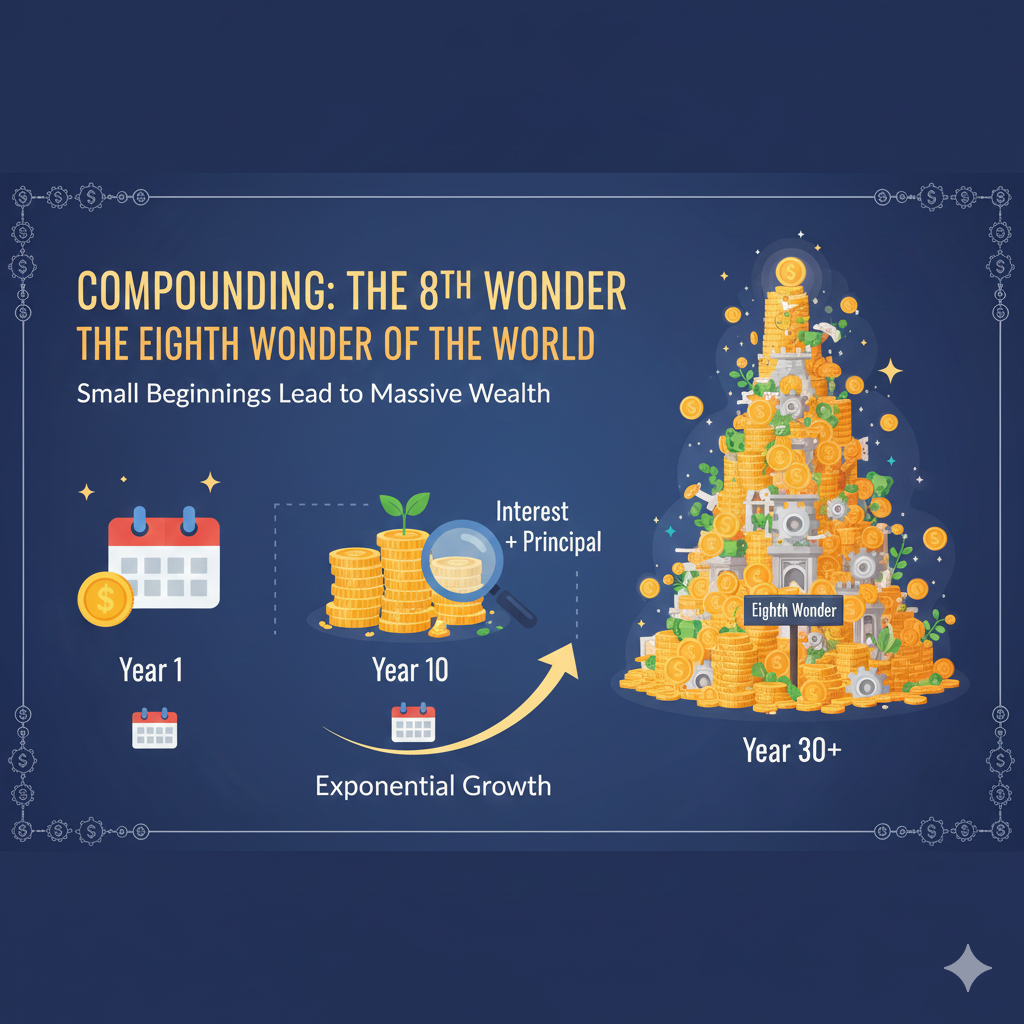
Why Compounding is Called the Eighth Wonder of the World

Most people know that investing money is important, but only a few truly understand why investing early and staying invested can completely change the result in the long run. The secret behind this difference is a concept called the power of compounding. Compounding may sound technical, but in reality, it is one of the simplest ideas in finance, and also one of the most powerful ones. It works quietly in the background and keeps increasing the value of your investment as time passes, if you allow it to work patiently and consistently.

What exactly is compounding?

Compounding means earning returns not only on the original money you invested, but also on the returns that your money has already earned. In simple words, the return keeps generating more return for you. Your money keeps creating its own income, and that income again starts earning more income. Over a long period, this multiplication becomes large enough to create a huge difference in wealth.

For example, if you invest money and earn some profit on it, the next year you earn a return not only on your original investment but also on the profit you made earlier. Over time, this cycle keeps repeating and your investment multiplies gradually. This is how a small amount can turn into a large amount if given enough time.

Why compounding grows money faster than simple interest

Many people confuse compounding with simple interest. They both increase your money, but the method is very different. Simple interest pays you interest only on the original principal amount, while compounding pays interest on principal plus accumulated interest.

This is why compounding creates exponential growth. In the beginning the growth looks slow, but gradually the curve starts rising faster and faster. The longer your investment continues, the bigger the growth becomes. Most long-term investors depend on this principle to build retirement savings or achieve future goals.

Starting early makes a huge difference

One of the most important ideas in compounding is time. Time is not just a number in investing. Time is a powerful factor that determines how large your investment can become. When you start early, your money gets more time to multiply, even if you are investing small amounts.

Imagine two people investing the same monthly amount for retirement. One begins investing at the age of 25 and the other starts at 40. Even though both invest the same total amount, the one who started early will end up with a much larger amount at retirement. The reason is simple: the early investor allowed compounding more years to work quietly in the background.

That is why financial advisors always say, “Do not wait to invest. 1 .The earlier you start, the better your results will be.”

Compounding works best with consistency

There is another important element along with time, and that is consistency. Many investors think investing requires a huge initial amount. But the truth is, regular investments, even if small, multiply significantly because of compounding.

This is where disciplined investing methods such as SIPs come in. A Systematic Investment Plan lets you invest small fixed amounts each month. These small contributions keep adding up and the returns get reinvested automatically. Because the process continues for years, the total value grows much faster than most people expect.

Consistency also protects you from changing your investment decisions emotionally. When you invest monthly, you follow a routine, and this routine helps you build wealth gradually.

Patience is the most powerful ingredient

Often people underestimate the importance of patience. When investing, what matters is not just how much money you put in, but how long you allow your money to grow. Many investors panic if the market falls, or withdraw money too early for short-term needs, and by doing this, they break the compounding cycle.

Compounding needs time and needs calm behaviour. If you interrupt the process by frequently withdrawing your investment, you lose a large part of its future potential. The longer the duration remains uninterrupted, the more surprising the final outcome becomes.

Why compounding helps beat inflation

Inflation slowly reduces the value of your money. So even if your money grows, if it grows slower than inflation, your actual purchasing power may reduce. Compounding helps your investment grow faster than inflation in the long run, especially if the investment is done in market-linked instruments such as mutual funds.

When returns are reinvested and allowed to grow over long periods, the overall growth rate often stays ahead of inflation. This means the value of your future wealth remains meaningful.

Compounding is ideal for long-term financial goals

Compounding is not something that shows major effects in one or two years. But when the goal is long-term, such as retirement, children’s education or building wealth for the future, compounding works extremely well.

Long-term mutual fund investing is based on exactly this idea. Most investors who see large results after 15 or 20 years are really benefiting from compounding rather than just their own contributions.

How to make compounding work for you

There are a few simple rules that make compounding effective:

Start investing early rather than waiting.

Keep investing regularly, even in small amounts.

Avoid unnecessary withdrawals from your investment.

Stay invested for a long duration.

Increase your contribution whenever possible.

Be patient and ignore short-term fluctuations.

If these principles are followed, compounding almost automatically takes care of wealth creation.

Small money becomes meaningful money

The biggest beauty of compounding is that you do not need a huge income to begin. Even a student or a young working professional can begin with the smallest amount. Over years, those small steps become a big financial advantage.

Many successful investors started with very little money, but they allowed compounding to do the heavy lifting. The money grew quietly with time because they did not stop the process.
.

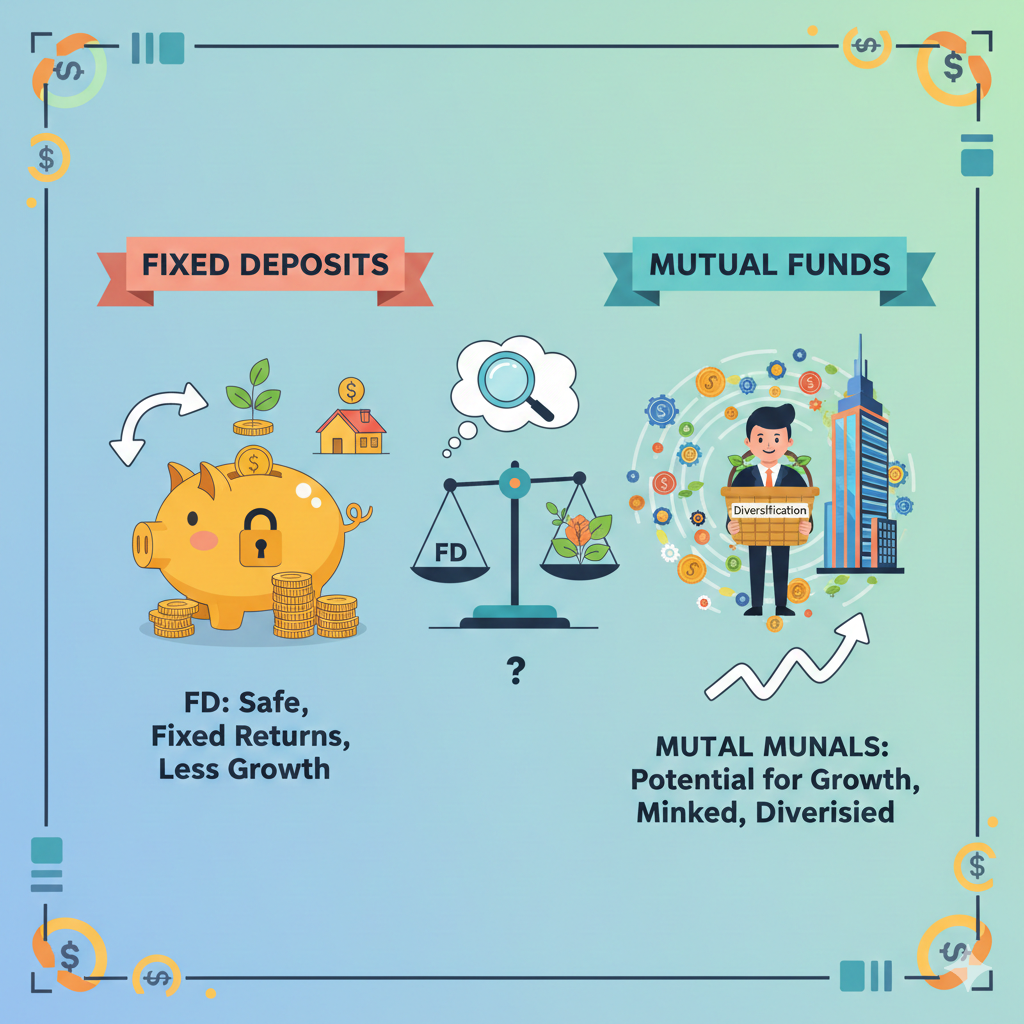
FD vs Mutual Funds – Understanding the Difference in a Simple Way

When it comes to saving and investing money, two of the most common options that people compare are Fixed Deposits (FDs) and Mutual Funds. At first glance, both appear safe and useful, but the truth is that they serve different purposes and work very differently. Understanding these differences helps you make better financial decisions based on your goals, time frame, and risk comfort.

What is a Fixed Deposit?

A Fixed Deposit is a type of investment offered by banks and some financial institutions. You deposit a certain amount of money for a specific period such as one, three or five years, and the bank promises to pay you a fixed interest rate throughout that time. Your return doesn’t change even if market conditions change.

People who prefer safety and guaranteed returns find Fixed Deposits appealing. Your capital is generally protected, and unlike market-linked instruments, you don’t see fluctuations in your money value. Although the interest rates may differ from bank to bank, the return is known in advance, which gives a sense of security.

What are Mutual Funds?

Unlike FDs, Mutual Funds are investment products that collect money from many investors and invest it into a diversified portfolio, which may include shares, government bonds, corporate bonds or other securities. The type of returns you receive in a mutual fund depends on how those underlying assets perform.

Mutual funds do not promise a fixed return. However, over a longer duration, certain types of funds—especially equity funds—have historically provided higher growth because they are linked to market performance. Investors can begin with either a lump sum or smaller regular payments called SIPs, which makes this investment convenient for beginners as well.

Return Potential and Risk Differences

One of the major differences between FDs and Mutual Funds is how returns are generated. Fixed Deposits give you a clearly known maturity amount, which is attractive if you dislike uncertainty. Mutual Funds, however, can fluctuate in value depending on market conditions. This means the returns may be higher, or lower, depending on what happens in the market during your investment period.

Safety in FDs is comparatively high. With mutual funds, the level of risk depends on which type of fund you invest in. Equity funds carry more risk because they depend on stock market movement, while debt funds invest in fixed income instruments and therefore carry relatively lower risk.

If someone is investing for only a short period and needs guaranteed returns, FDs seem like the safer option. But if the goal is long-term wealth creation, mutual funds may be more suitable because the potential long-term return is higher than Fixed Deposits.

Liquidity and Flexibility

Another important difference is how easily you can access your money. The money invested in a Fixed Deposit is locked for a specific tenure. Withdrawing earlier may be allowed, but the bank usually charges a penalty or offers lower interest, which reduces returns.

On the other side, most mutual funds are more flexible because you can withdraw money whenever needed, subject to fund rules. You may face an exit load in some cases if you withdraw too soon, but generally, they are considered more liquid than Fixed Deposits.

Mutual Funds also give flexibility in investing. You don’t need a large amount to start. Even a small SIP amount invested regularly can grow into a significant amount over time.

Taxation and Real Returns

Taxation also plays a big role in deciding which investment is better. Interest from FDs is added to your total income and taxed based on your income tax slab. This means people in higher income brackets end up paying more tax on FD interest, reducing the final return.

Mutual funds are taxed differently depending on how long they are held. For longer holding periods, the tax on long-term gains is generally lower than the tax on FD interest. Over time, this can mean mutual funds give better post-tax returns than FDs.

Also, inflation must be considered. Since FD rates are sometimes lower than inflation, the real value of your money can reduce after maturity. Mutual funds, especially equity-oriented ones, historically tend to beat inflation in the long run.

What Should You Choose?

Your decision should be based on personal financial goals, how long you want to invest, and how much risk you are willing to take.

Choose Fixed Deposits if:

you want guaranteed and safe returns

you don’t want the value of your investment to fluctuate

you are investing for the short or medium term

you are uncomfortable with market risks

you prefer certainty rather than chasing higher returns

Choose Mutual Funds if:

your goal is long-term wealth creation

you want higher potential returns

you are comfortable with market movements

you want flexibility, liquidity and tax efficiency

you can invest for several years

For many people, a balanced approach works best. Some part of money stays in FDs for stability and safety, while another part may be directed to mutual funds for long-term growth.

Final Thoughts

FDs and Mutual Funds are both useful investment tools, but they serve different needs. Fixed Deposits offer security, predictability, and peace of mind. Mutual Funds offer flexibility, tax advantages, and the possibility of higher returns over time.

If you want to stay safe and earn steady interest, Fixed Deposits might be the right choice. If you want your money to grow and you can tolerate some market fluctuation, Mutual Funds could be the more rewarding option in the long run.

The best strategy is often to combine both in a way that matches your financial goals, time horizon, and comfort with risk.

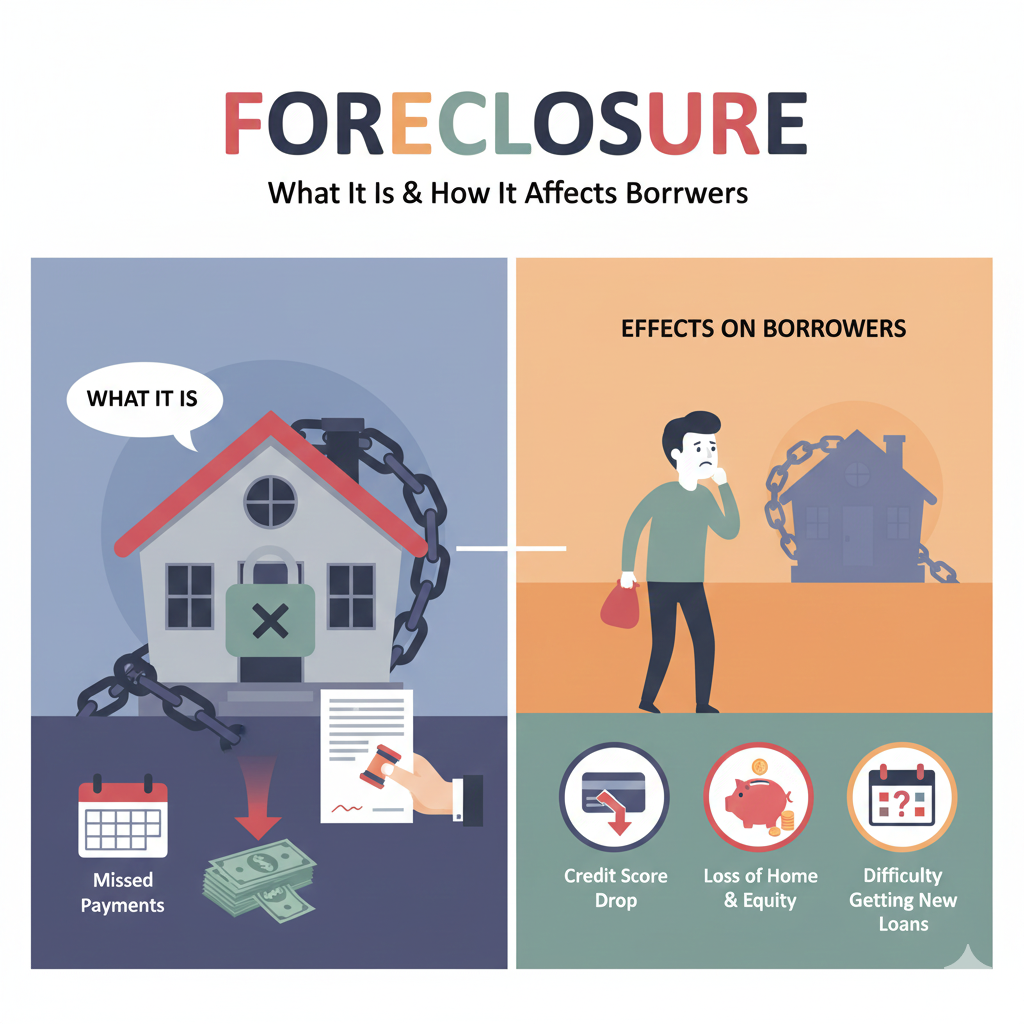
What Is Foreclosure and How Does It Affect Borrowers?

Owning a home is a goal that many people dream of. However, when a house purchase is made with a mortgage loan, the owner must make monthly payments to the lender. If those payments stop due to financial trouble or any other reason, the lender has the legal right to take the house back and sell it to recover the unpaid loan amount. This legal process is called foreclosure. Foreclosure is not something that happens overnight, and it usually follows a step-by-step procedure that gives the homeowner warnings and chances to correct the situation before losing their home.

Foreclosure is one of the most unfortunate financial experiences a household can face. It affects not only the financial future of the borrower but also their housing security. To understand foreclosure properly, we need to look at what leads to it, how the process works, and what the long-term consequences can be.


What exactly is foreclosure?

Foreclosure happens when a borrower fails to make their mortgage payments as agreed. When someone takes a home loan, they promise to repay it every month. The property itself becomes a security for that loan, meaning the lender has the right to take the property back if the borrower fails to pay.

So, foreclosure means the lender seizing the property and selling it. The sale amount is then used to pay the remaining loan balance, fees, and legal charges. If any extra money remains after everything is paid, it may go back to the borrower, though this rarely happens.


When does foreclosure start?

Foreclosure usually begins after several missed monthly payments. Many mortgage contracts allow up to three missed payments before a formal foreclosure notice is issued, but the exact rule depends on the agreement and state law.

In some cases, foreclosure may also occur if a borrower breaks another term of the mortgage agreement, such as failing to maintain insurance on the property or committing fraud. However, the most common reason is simply missing the required payments.


Foreclosure is a step-by-step legal process

Foreclosure has stages, and these stages generally look similar across most states, although exact rules vary. The stages often include:

1. Payment default

The borrower stops making payments for a certain number of months. The lender first sends reminders, late notices, and warnings.

2. Notice of default

If payments are not resumed, the lender issues a formal legal notice that foreclosure action may start.

3. Notice of sale

If the situation still does not improve, the lender publishes a notice that the property will be sold publicly.

4. Auction

The property is then listed for sale at a public auction. Interested buyers bid, and the highest bidder usually gets the property.

5. Bank ownership

If nobody buys the property during auction, the lender takes ownership. In this case, it becomes what is called a “bank-owned” or “REO” (Real Estate Owned) property.

6. Eviction

Once ownership legally transfers, the former homeowner may be asked to leave. If they do not leave voluntarily, forced eviction can occur.


Judicial vs Non-Judicial foreclosure

Different states in the United States have different foreclosure systems. Some states follow judicial foreclosure, while others allow non-judicial foreclosure depending on the mortgage contract.

Judicial foreclosure

In this method, the process must go through the court system. A judge reviews the case and authorizes the foreclosure. Because it requires legal proceedings, it usually takes longer and offers more time and chance to fight foreclosure legally.

Non-judicial foreclosure

In this type, the mortgage agreement already contains a “power of sale” clause, which gives the lender permission to sell the house without involving the court. It usually happens faster than judicial foreclosure.


What happens to the property after foreclosure?

Once the foreclosure is completed, the property goes up for sale. At an auction, potential buyers try to purchase the property. But if nobody is interested or the lender’s requirements are not met, the bank takes ownership. After that, the bank may list the house for sale on the regular real-estate market and try to recover the loan amount by selling it.

Properties that go through foreclosure often get labeled “bank-owned,” “foreclosed property,” or “REO property” on real-estate listings.


Impact on the homeowner

Foreclosure is a very serious outcome for the homeowner. The most immediate consequence is the loss of the home itself, but the effects go far beyond that. Losing a home can make it harder to find new housing, especially if the person has a damaged credit profile.

The major consequences include:

  • losing the house permanently
  • possible eviction from the property
  • a major drop in credit score
  • difficulty getting another mortgage
  • higher interest rates in future borrowing

Foreclosure stays on a credit report for years, which affects future loan approvals, rental agreements, and sometimes even employment background checks.


Why foreclosure hurts credit

A foreclosure signals to lenders that the borrower failed to manage an important financial responsibility. Because a mortgage is a long-term commitment, banks take foreclosure very seriously. It shows that the borrower defaulted on a large debt, and therefore might be risky to lend money to again.

This is why getting another mortgage later becomes difficult and interest rates tend to be higher when approved.


Is foreclosure avoidable?

Foreclosure often comes at the end of a long period of financial trouble. However, there are ways to prevent foreclosure, such as mortgage refinancing, loan modification, or negotiating payment options with the lender. Many lenders prefer finding a solution rather than going through the complicated, lengthy foreclosure process.


Foreclosure is hard but not impossible to recover from

Even though foreclosure creates serious challenges, it doesn’t mean a person can never become a homeowner again. With responsible financial behavior and rebuilding credit, many people eventually buy another home after some years.


Final Thought

Foreclosure is a legal and financial process that comes into play when a borrower fails to pay their mortgage. It results in the lender taking possession of the house and selling it to recover their money. The process includes warnings, notices, and legal steps, and its consequences can be long-lasting. Foreclosure harms credit, causes loss of property, and may lead to eviction—and it takes years to fully recover financially.

Still, foreclosure is not always the end of financial life. People can rebuild, repair credit, and start again. But ideally, foreclosure should be prevented early by communicating with lenders and seeking alternatives before payments stop.

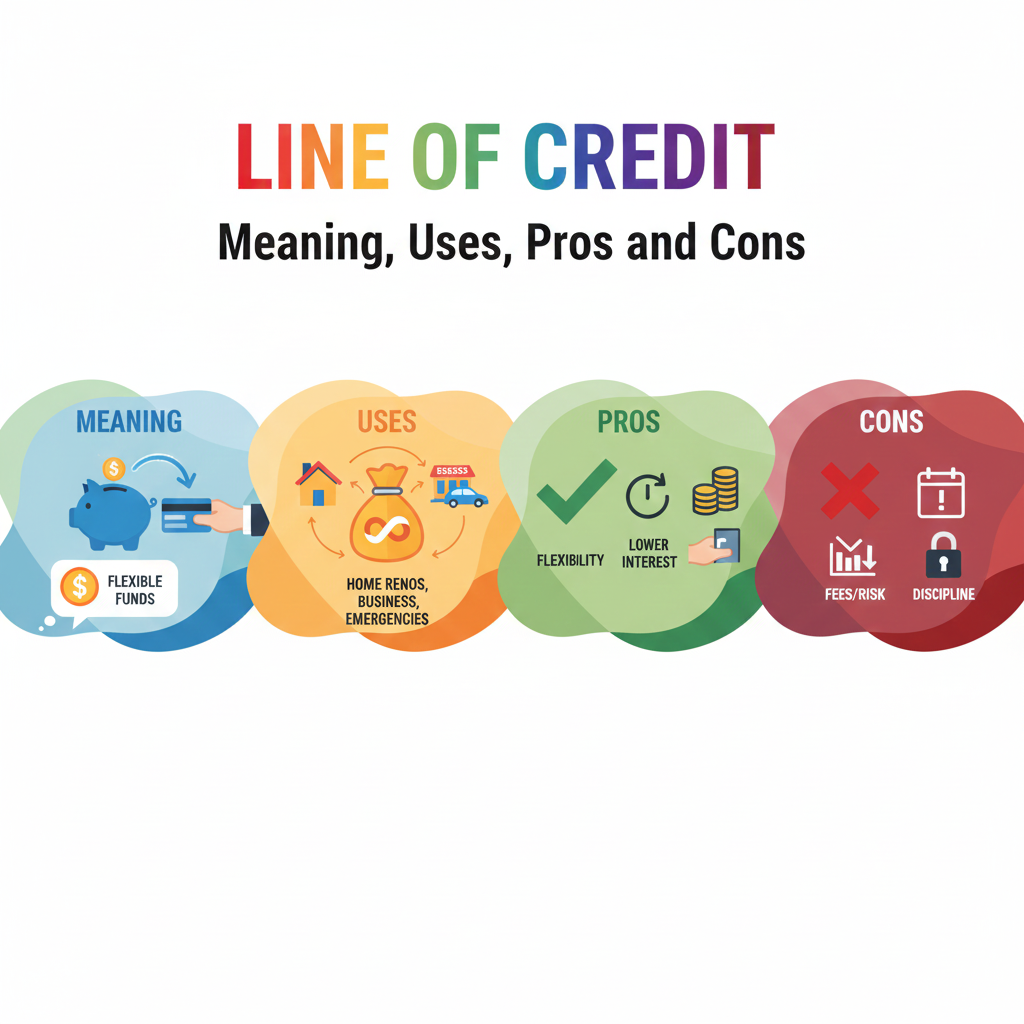
Line of Credit: Meaning, Uses, Pros and Cons

Money needs rarely stay the same in real life. Sometimes you suddenly need cash for home repairs, sometimes medical expenses appear out of nowhere, and sometimes you need funds for work, business, or personal reasons but you don’t want to take a full loan right away. In such situations, a line of credit, often called a LOC, becomes extremely useful. Instead of borrowing a large fixed loan all at once, a line of credit lets you borrow only the amount you need, and only when you actually need it.

This gives you more control and flexibility compared to traditional loans. To understand this better, let’s explore what a line of credit is, how it works, and why many people prefer it over regular borrowing options.


What is a line of credit?

A line of credit is a special borrowing arrangement offered by a bank or credit institution. You don’t receive the full amount at once like a typical loan. Instead, the bank gives you a maximum borrowing limit, and you are allowed to withdraw money from it whenever required.

Imagine that your bank gives you a ₹5,00,000 line of credit. You can borrow ₹20,000 one month, maybe ₹60,000 during an emergency, and maybe not borrow anything for months. The bank is simply approving that you can borrow up to ₹5,00,000 in total—but you choose how much to use and when.


How borrowing works

You are only charged interest on the amount you actually use—not the full approved limit. So if your limit is ₹5,00,000 but you borrow only ₹50,000, interest applies only on ₹50,000.

This is one of the biggest advantages. With a traditional loan, you get the whole amount and interest starts immediately on the entire sum. But with a line of credit, you borrow little by little based on your real requirement.


Secured vs Unsecured Lines of Credit

Lines of credit come in two types:

1. Secured line of credit

A secured LOC requires some form of collateral (e.g., house, property, investments). Because the lender has something they can claim if you don’t repay, you usually get:

  • lower interest
  • higher limit
  • easier approval

2. Unsecured line of credit

This type doesn’t need collateral, but you must have good credit history and a strong financial background. With no asset used as security, interest rates are usually higher.


When would someone need a line of credit?

Life doesn’t always go according to plan. Sometimes, you need money for unpredictable situations. A line of credit is perfect for times when you don’t know exactly how much money you will need in the future.

Examples:

  • medical emergencies
  • sudden home repairs
  • car breakdowns
  • educational expenses
  • business capital needs
  • temporary cash shortage

Instead of taking a fixed loan in advance, you borrow slowly over time—only as your needs come up.


Flexible borrowing

This flexibility makes a line of credit very attractive. You don’t need to run to a bank repeatedly every time you need money. Once the LOC is approved, you can draw funds anytime instantly.

Think of it like having a backup source of money always ready.


Only pay for what you use

One of the most consumer-friendly features of a line of credit is interest savings. With a regular loan, even if you don’t use the entire loan amount immediately, you still pay interest on it. But with a line of credit, unused funds don’t cost you anything.

So, if you withdraw only ₹30,000 out of a ₹3,00,000 limit, interest applies only on ₹30,000—not the full ₹3,00,000.


Interest rates can vary

Most lines of credit offer variable interest rates, meaning the interest rate may change depending on the bank or market conditions. This could be an advantage or disadvantage depending on timing, because sometimes interest becomes higher than expected.

So while LOCs offer flexibility and borrowing convenience, they can also carry uncertainty depending on interest rate changes.


Fees and charges

Some lines of credit include:

  • annual maintenance fees
  • account activation fees
  • withdrawal fees
  • transaction fees

Not every LOC has these charges, but many do, so understanding the terms clearly is important before agreeing to one.


Difference between a loan and a line of credit

A line of credit is very different from a traditional loan:

FeatureLoanLine of Credit
How money is givenEntire lump sum at onceWithdraw as needed
Interest startsOn total amount immediatelyOnly on borrowed amount
PaymentsFixed installmentFlexible repayment
PurposeMostly one-timeOngoing variable needs

This is precisely why people prefer LOCs for situations where expenses are not fixed in advance.


Disadvantages

Even though lines of credit offer freedom, they can be risky if you don’t control your spending. Some disadvantages include:

  • interest rate uncertainty
  • possible fees
  • temptation to borrow whenever possible
  • risk of long-term debt

Just like credit cards, easy borrowing might encourage overspending if the user is not disciplined.


Good for credit history

One advantage is that a line of credit helps build a good credit profile over time if payments are made properly. Borrowing and repaying responsibly shows banks that you manage money well, which increases your future creditworthiness.


Who should use a line of credit?

People who benefit most include:

  • homeowners
  • business owners
  • students
  • independent professionals
  • anyone with unpredictable expenses

Businesses especially use LOCs for operating costs because income and expenses are not always steady every month.


Conclusion

A line of credit is one of the most flexible borrowing tools available. It gives you instant access to funds without forcing you to borrow everything at once, and you only pay interest on the amount you actually use. It can be secured or unsecured, and each has different costs and eligibility requirements.

If used smartly, a line of credit becomes a reliable financial support system for unpredictable expenses and emergencies. But like any borrowing tool, it requires responsible use so you don’t fall into unnecessary debt. Choosing a line of credit should always be based on actual needs, repayment ability, and financial discipline.

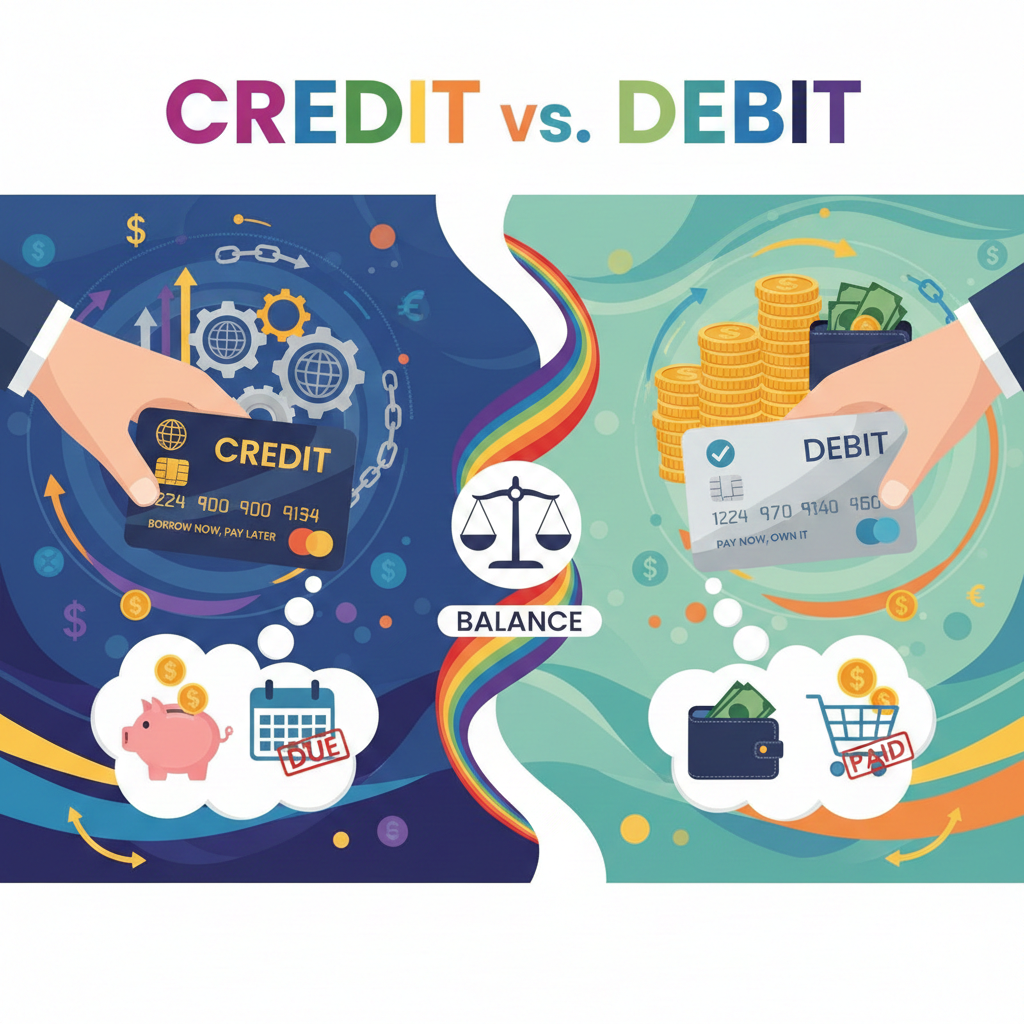
Difference Between Credit and Debit Cards

When we talk about everyday payments, two popular methods most of us use are debit cards and credit cards. On the surface, they may look very similar. Both are made of plastic or metal, both have a card number, and both are swiped, tapped, or inserted into a machine while making a payment. Because of these similarities, many people assume that they work the same way. But actually, how money moves behind the scenes is very different. Understanding how debit cards and credit cards function helps you manage your finances more wisely and avoid unnecessary debt.

Let’s explore the differences in a simple, human-readable way.


How debit cards work

A debit card is directly linked to your bank account, usually your savings or checking account. When you make a payment using a debit card, the money goes out of your account instantly or within a very short time. So, if you buy something worth ₹500, that ₹500 is immediately deducted from your bank balance.

This also means you can only spend the money you currently have. If your bank balance is ₹2000, you can only spend up to ₹2000 or less. It automatically keeps you away from overspending because the bank does not allow you to spend more than what is already available unless your bank has given you overdraft facility. Therefore, a debit card is considered a more controlled and safer option for everyday buying, especially if you prefer living within your income and want to avoid debt.


How credit cards work

A credit card works differently. When you pay using a credit card, the bank pays the amount on your behalf at that moment. You are basically borrowing money for a short time. After that, every month, the bank sends you a credit card bill showing how much you owe. There is usually a billing cycle, like 30 days, and you get a due date for paying the bill.

If you pay the entire bill on time, you don’t have to pay interest. But if you pay only the minimum amount or skip the payment, interest will be charged. The interest on credit cards is usually higher compared to normal loans or EMIs. That’s why credit cards should be used wisely, because late payments can become expensive.

However, credit cards also give you a lot of flexibility. You don’t need to have money at the time of purchase. You get some extra time to arrange funds, which is useful especially during emergencies or when big expenses suddenly arise.


Which one helps build credit score

Debit cards do not affect your credit score at all. Whether you use them regularly or not, they don’t help build a credit history.

Credit cards, on the other hand, help you build credit history if used responsibly. Every on-time payment shows lenders that you handle borrowed money carefully, which helps improve your credit score. A good credit score is very useful if you plan to take a home loan, car loan, education loan, or even apply for a mortgage in the future.

So, if someone wants to build or strengthen their credit profile, using a credit card wisely is a good option.


Interest and fees

Debit cards usually do not charge any interest because you are spending your own money. There might be small charges such as ATM fees, annual fees, or international usage fees, but generally, debit cards are low-cost payment tools.

Credit cards may charge interest if the bill is not paid on time. This is an important difference. Purchases made using a credit card become debt until paid back. And if you delay payments frequently, interest can increase rapidly.

The trick here is simple: credit cards are safe as long as you pay your full bill every month.


Spending control

Debit card usage automatically controls your spending because the moment your balance becomes zero, your card stops working. This prevents unnecessary shopping or impulse purchases.

Credit cards, however, let you spend money that you don’t currently have. Sometimes this becomes tempting and leads to overspending. That’s why banks decide a credit limit for each user according to their income, spending behaviour, and credit score.

If used responsibly, credit cards can benefit you. But if used casually, spending beyond income can create debt problems.


Emergency usage

Debit cards are excellent for daily expenses such as groceries, shopping, or fuel, but they limit you to your available money. If there’s a sudden emergency such as medical expense or travel need, a debit card may not be enough unless your bank balance is high.

Credit cards are extremely helpful during emergencies because they allow you to pay first and arrange funds later. This temporary flexibility supports you when life suddenly throws unexpected expenses.


ATM Withdrawals

Most debit cards allow you to withdraw cash from ATMs anytime.

Credit cards also allow ATM withdrawals but usually charge high interest and cash advance fees. Therefore, withdrawing cash from a credit card should only be done during serious emergencies.


Rewards and Cashback

Credit cards usually offer cashback, points, rewards, air miles, lounge access and special discounts.

Debit cards do not offer as many benefits. Some debit cards give small reward points, but the benefits are limited compared to credit cards.


Which card is better?

Both are useful but for different purposes.

Debit card is better when:

  • you want to avoid debt
  • you prefer spending only what you have
  • you don’t like monthly billing
  • you want easy ATM access

Credit card is better when:

  • you want to build credit history
  • you need flexibility to pay later
  • you want rewards or cashback
  • you want emergency backup support

Final Thoughts

To sum up, debit cards help you stay within your budget since the money comes directly from your bank account. They are safe for everyday spending and don’t lead to debt. Credit cards, on the other hand, give you borrowing power and help build credit history, but they require disciplined repayment and financial responsibility.

Learning how both cards work helps you select the right option for each situation. Many people actually use both: debit cards for daily essentials and credit cards for bigger or planned purchases. The key is understanding how each works so you can control your money instead of letting money control you.

A Beginner’s Complete Guide to Understanding the Stock Market and How It Really Works

Many people hear about the stock market when a major index rises sharply, or during a financial downturn, or whenever experts predict that “the markets are nervous.” But what exactly is the stock market? Why does it play such a large role in business, investing, and even everyday life? Although the term sounds complex, the basic idea behind the stock market is surprisingly understandable once it’s broken down into simple concepts.

The stock market is essentially a marketplace where the ownership of companies is exchanged between investors. When companies need money for expansion, innovation, or new projects, they can offer a portion of their ownership to the public in the form of shares. In return, they may benefit from rising share prices, potential profits, and sometimes dividend payments.

Even though many think of financial experts, brokers, or Wall Street traders when picturing the market, anyone with a basic understanding of investing can take part in stock trading today through online platforms. That accessibility is part of the reason the stock market is considered one of the most common ways for individuals to build long-term wealth.


A marketplace made of multiple exchanges

One of the biggest misunderstandings about the stock market is the idea that it’s a single location. Instead, the stock market is made up of several stock exchanges and electronic trading networks spread across different countries. For example, in the United States, the two most well-known exchanges are the New York Stock Exchange and the Nasdaq. Similar exchanges exist in India, Europe, Asia, and almost every major economy.

Each exchange lists different publicly traded companies and provides a regulated environment where buyers and sellers meet. Modern stock exchanges operate mostly through digital trading systems, which means transactions happen in a fraction of a second rather than through traditional shouting or hand signals, as was common in earlier decades.


The primary market and why companies go public

Before a company’s shares become available for public trading, the business must first offer them for sale on what is known as the primary market. This usually happens through something called an initial public offering, or IPO. During an IPO, investors purchase shares directly from the company, and the money raised helps the business expand.

Going public allows a company to access a large amount of capital that might be difficult to get through traditional loans. In exchange, the company gives up a portion of its ownership to investors who now share in its success (or failure). From a business growth perspective, this system fuels innovation, helps new industries emerge, and keeps the global economy moving forward.


The secondary market – where most investing really happens

Once shares are listed, they become available for everyday trading. This is what people usually refer to as “the stock market.” In the secondary market, investors buy and sell shares among themselves. The company whose shares are being traded does not receive money from these transactions; instead, one investor sells ownership to another investor.

Prices fluctuate constantly during trading hours as investors react to news, earnings results, economic projections, and future expectations. When buyers are more interested in owning a company than sellers are in giving up their shares, the stock price tends to rise. When more sellers want to sell and fewer buyers are interested, the price falls.


What does buying a stock really mean?

When someone buys a stock, they are purchasing a share in the company’s ownership. That ownership generally comes with the possibility of receiving dividends, which are a portion of company profits shared with investors. Not all companies pay dividends, but many established firms do.

Shareholders also benefit when the value of the company increases. If the business grows and becomes more profitable, the market price of its shares often rises. Investors can then sell their shares at a higher price than they paid and make a profit.

Some shares provide voting rights, allowing investors to vote on company matters like leadership changes or major decisions. While individual investors usually hold only a tiny portion of voting power, institutional investors may influence corporate policies significantly.


The stock market provides liquidity and confidence

A major advantage of the stock market is liquidity. That means shares can usually be bought or sold easily, at fair prices, and without waiting months like one might for large assets such as real estate. Liquidity gives investors confidence that they can convert their investments into cash whenever necessary.

This constant availability of buyers and sellers is what keeps prices efficient and markets functioning smoothly. Without liquidity, investing would become slow, risky, and less appealing.


How the stock market benefits the economy

The stock market has a crucial job in the global financial system. It helps capital flow from investors toward businesses that need funding. When companies have access to money through stock sales, they can increase production, expand into new markets, invest in technology, and hire more workers. In this way, stock markets indirectly support job creation, innovation, and economic growth.

Additionally, the market helps distribute financial resources more efficiently. Investors evaluate companies based on their potential, and businesses that appear promising are rewarded with more investment. That means capital moves toward ideas and industries that have the greatest ability to grow and contribute to the economy’s future.


Market indexes show overall performance

To understand how well the stock market is performing, investors look at stock market indexes, which represent a collection of major companies. These indexes act like scorecards that show whether markets are rising or falling.

If indexes go up, it generally indicates optimism, strong business activity, and improving economic conditions. If they fall, it may suggest that investors are worried about slow growth, financial uncertainty, or global risks.


Emotions and expectations drive market behavior

One important aspect of the stock market is that prices are not based only on what companies earn today. Investors constantly think ahead and try to predict future results. This means stock prices often move according to expectations, confidence levels, or concerns about the future.

Because of this, markets sometimes rise even when economic news is average, or fall despite strong earnings. Human emotions such as fear and excitement can influence buying and selling patterns, contributing to short-term volatility.


Why understanding the market matters

Even people who never buy a single stock are influenced by the stock market. Pension funds, retirement accounts, insurance companies, and mutual funds rely heavily on stock investments. A rising market often benefits savings and retirement plans, while market downturns can affect long-term financial security for millions of people.

Understanding the fundamentals of the stock market doesn’t require advanced knowledge—it only requires knowing how ownership works, how company performance relates to share prices, and why demand and supply shape the market every day.

Sanchar Saathi: Complete Guide to Blocking Lost Phones and Preventing Mobile Fraud in India

Technology plays a huge role in our lives today, especially mobile phones. Almost everything—from banking to personal communication—happens on smartphones. Because of this dependence, mobile safety, fraud protection and identity security have become extremely important topics for ordinary users. Understanding this need, the Government of India introduced an important digital platform called Sanchar Saathi. It has been created by the Department of Telecommunications with a very clear goal: to protect Indian mobile users and make telecom services safer, transparent and citizen-friendly.

In this detailed human-friendly explanation, we will understand what Sanchar Saathi is, how it works, why it matters, its features, and how it helps every mobile user in India. All information here is based on the official Sanchar Saathi features and purpose, written in easy language.


What is Sanchar Saathi?

Sanchar Saathi is a citizen-friendly telecom platform created by the Department of Telecommunications under the Government of India. It has been designed as a single centralized service where users can:

  • manage their mobile connections,
  • verify the authenticity of devices,
  • report stolen phones,
  • check mobile numbers linked to their identity,
  • and complain about harassment or fraud attempts.

In short, it is a security and awareness platform that gives more control to citizens over their mobile identity.

The platform also helps the government track illegal phones, stop cyber fraud, and prevent misuse of mobile networks. Instead of going to different departments for different services, people can now perform many telecom-related tasks in one place.


Why was Sanchar Saathi created?

Before this platform existed, many problems were frequently reported such as:

  • stolen phones being reused on mobile networks,
  • fake calls pretending to be banking or government officials,
  • international scam calls appearing as local Indian numbers,
  • unknown mobile SIM cards registered using someone’s identity,
  • counterfeit mobile phones being sold without proper details.

These problems resulted in major financial fraud and identity misuse. Many people were facing mental stress due to scam calls and cybercrime. To solve these issues, a digital portal was needed that could allow verification, reporting, and tracking in a simple and transparent way. Sanchar Saathi is designed exactly for this reason.


Feature 1: Block Lost or Stolen Mobile Devices

One of the most useful features of Sanchar Saathi is device blocking. If someone loses their phone, they usually worry not only about the cost of the phone but also about personal data, banking apps, identity documents and stored contacts. When a phone gets stolen, criminals often misuse it for illegal activities.

Sanchar Saathi provides a simple option where you can block your phone using its IMEI number. Once blocked, the device becomes useless across all telecom networks in India. This means even if a new SIM is inserted, the phone will not work. The system prevents stolen mobiles from getting activated again, discouraging theft and misuse.


Feature 2: Check if a Mobile is Genuine

Many people buy used phones or second-hand phones from shops or online platforms. Unfortunately, fake or cloned devices also exist in the market. These phones may not meet security or network standards and could be illegally imported or previously stolen.

Sanchar Saathi allows you to check the authenticity of a mobile using its IMEI number. If the phone has a suspicious IMEI or if it has already been reported stolen, you immediately receive a warning. This protects users from buying illegal or fraudulent devices and encourages safe purchases.


Feature 3: Know How Many Mobile Numbers Are Registered Under Your Name

Identity misuse is one of the biggest security problems in India. Many people discovered that mobile numbers were issued using their Aadhaar or other identity documents without their knowledge. These numbers were later used in illegal activities like cyber fraud or blackmail.

Sanchar Saathi has made this problem very easy to handle. A simple feature allows any user to check all active mobile numbers that are registered with their identity. If the platform shows a number that doesn’t belong to you, you can request disconnection or mark it as suspicious.

This increases transparency and prevents misuse of identity. It also reduces the chances of cybercrime being carried out using someone else’s identity.


Feature 4: Report Fraud and Suspicious Communications

People across India frequently receive scam calls and messages pretending to be from banks, government offices or mobile companies. Many completely innocent people end up sharing personal details and lose money. These scams happen through:

  • voice calls,
  • SMS,
  • WhatsApp,
  • fake links,
  • malicious apps,
  • or false promises.

Sanchar Saathi includes a dedicated module called “Chakshu” that allows users to report such suspicious incidents. The complaint system helps telecom authorities and cyber departments track scammers, shut down fraudulent numbers and prevent future attacks.

This reporting system gives more power to citizens. Instead of simply ignoring suspicious messages, people can actively take part in preventing cybercrime.


Feature 5: Report Fake International Calls

Sometimes people receive international calls that appear to be Indian numbers. This technique is used by criminals to trick users by making them believe the call is local or official. These calls are often involved in financial frauds or impersonation scams. Sanchar Saathi includes a facility where users can report such fake international calls. When reported, telecom authorities identify illegal routes and take action against the source of these calls.


Why Sanchar Saathi matters

India has more than a billion mobile users, which makes telecom security extremely challenging. Earlier, solving such issues required visiting telecom offices, filing police complaints and a long waiting period. Sanchar Saathi simplifies all of this by allowing online reporting and instant verification.

By using this platform, Indian citizens can protect:

  • digital identity,
  • mobile data,
  • personal communication,
  • and financial safety.

Most importantly, it creates awareness about cybercrime and encourages users to act responsibly while using mobile services.


A modern step for safer digital India

Sanchar Saathi is a major step toward a safe, transparent and secure telecom ecosystem. It combines technology, security and public participation. It not only helps individuals but also contributes to national digital safety. With increasing cyber threats and online scams, such platforms play a major role in creating a safer digital environment.

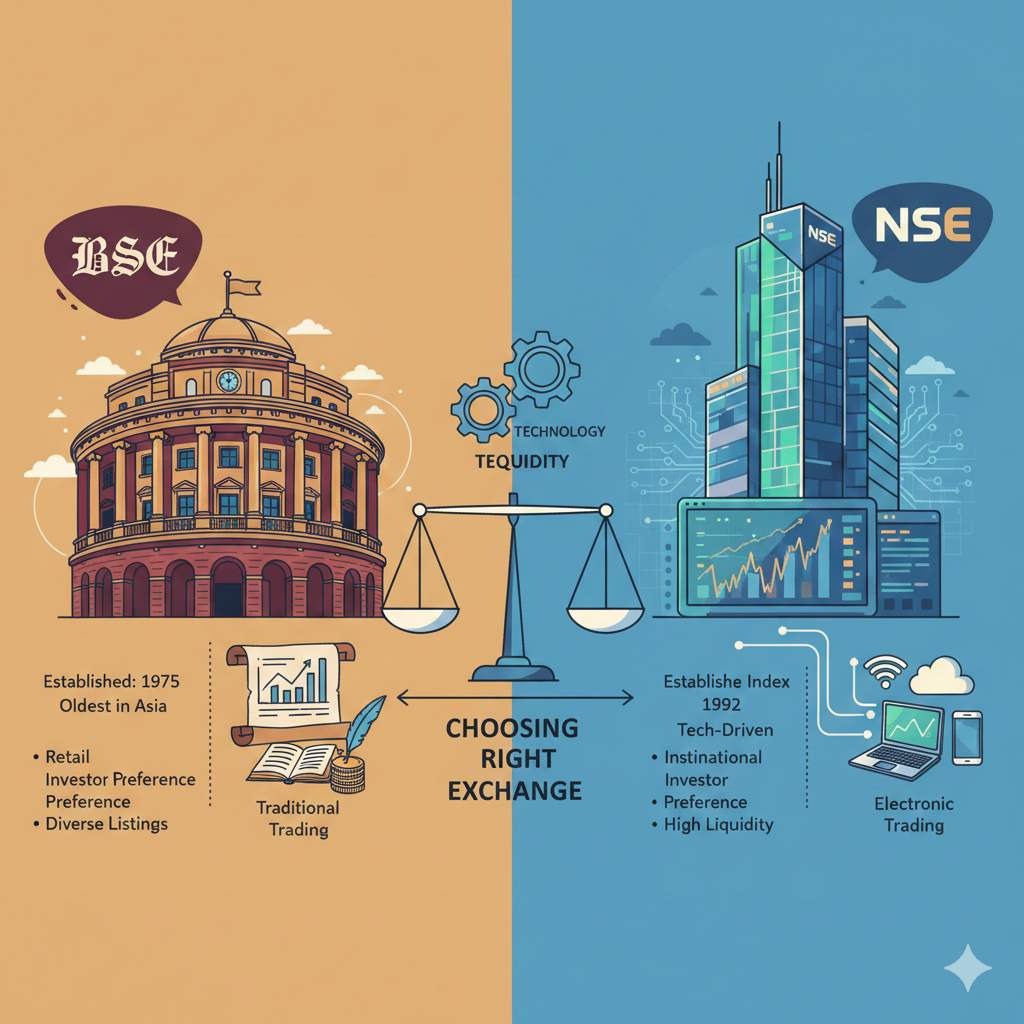
BSE vs NSE: Key Differences, Market Strengths, and Investor Benefits Explained

When people in India talk about the stock market, two names always appear at the top — BSE (Bombay Stock Exchange) and NSE (National Stock Exchange). Both are major stock exchanges that allow investors to buy and sell shares, but they function differently in many aspects such as history, market size, technology, liquidity, and the type of investors they attract. Understanding these differences is important, especially if you are planning to invest or trade in the Indian markets.

This article explains the key differences between BSE and NSE in a simple, human-written way, based entirely on the known structure and content of the original resource, but rewritten in an easy and comprehensive format.


1. History and Establishment

The first major difference between BSE and NSE is their age and historical background.

BSE, established in 1875, is not just India’s oldest exchange — it is the oldest stock exchange in Asia. It started as a physical marketplace under the banyan tree near Mumbai’s Town Hall where brokers gathered to trade. Over decades, it evolved into a central trading place for thousands of companies across India. Its long history gives it recognition, legacy, and trust among traditional investors.

In contrast, NSE is relatively new. It was founded in 1992 and began trading in 1994. NSE was born at a time when India was modernizing its financial markets after liberalization. It came with a clear goal — to bring transparency, technology, and nationwide access to stock trading. From day one, NSE introduced electronic trading, something that transformed how markets operate in India.

So, the key difference here is:

  • BSE = Oldest, legacy-driven, historic exchange
  • NSE = Modern, technology-first, fast-growing exchange

2. Benchmark Indices: Sensex vs Nifty

Every stock exchange uses an index to represent the performance of the overall market. In the case of India:

  • BSE is represented by the Sensex
    This index includes 30 of the largest and most stable companies across different sectors. Sensex is one of the oldest indices in the world and is widely used to measure the Indian market’s strength.
  • NSE is represented by the Nifty 50
    This index includes 50 major companies and is considered more diversified because it covers a wider range of sectors compared to Sensex. For many traders, Nifty is the most actively followed index in India due to its liquidity.

Because Nifty includes more companies, many traders believe it gives a slightly broader view of the market, while Sensex offers a more focused, stable snapshot.


3. Number of Listed Companies

Another major point of difference lies in the number of companies listed on each exchange.

BSE has more than 7,000 listed companies, making it one of the largest exchanges globally in terms of listings. This includes large-cap, mid-cap, and significantly more small-cap and micro-cap companies.

On the other hand, NSE has around 1,600 to 1,800 listed companies. While the number is smaller, NSE hosts many of India’s biggest and most actively traded firms.

In simple terms:

  • BSE = More companies, huge variety
  • NSE = Fewer companies, but higher trading participation

If someone wants to explore a wide pool of stocks, especially small and mid-sized firms, BSE offers more options. However, the most active market participants, including institutional traders, tend to prefer NSE.


4. Liquidity and Trading Volume

This is where NSE stands out strongly.

NSE consistently has higher liquidity and trading volume compared to BSE. This means:

  • Orders get executed faster,
  • Price differences are smaller,
  • Slippage is reduced,
  • Traders experience smoother market operations.

For example, if a trader wants to buy or sell a large quantity of shares quickly, NSE usually handles it better due to its high number of active buyers and sellers.

While BSE also has a deep market, its trading volume is much lower, which makes it comparatively less favorable for high-frequency or high-volume traders.

This is a big reason why:

  • Traders prefer NSE, especially for intraday and derivatives.
  • Long-term investors use both, depending on the stock availability.

5. Technology and Trading Mechanisms

NSE has always been considered India’s technology leader in the stock market ecosystem.

  • A fully automated electronic trading system
  • Nationwide access to brokers and investors
  • Modern risk management practices
  • A robust online order-matching mechanism

Before NSE came in, much of BSE’s trading was done through an open-outcry system. Although BSE quickly adopted electronic trading after NSE’s arrival, NSE’s early head start helped it dominate the technology-driven trading landscape.

Even today, NSE’s systems are viewed as:

  • Faster
  • More efficient
  • More reliable during high-volume sessions

However, BSE has also upgraded significantly. Its trading platform, BOLT, is fast and efficient, and BSE even launched BSE StAR MF, one of the largest mutual fund distribution platforms in India.


6. Investor Preference: Which One Is Better?

Investors and traders choose exchanges based on their goals:

BSE is preferred by:

  • Investors who want access to a wider variety of stocks
  • Those looking at many small-cap and mid-cap opportunities
  • People who rely on long-term investing, where liquidity is not the biggest concern

NSE is preferred by:

  • Active traders (intraday, derivatives, options)
  • Institutions like banks, mutual funds, and foreign investors
  • Anyone who needs high liquidity and fast execution

Most companies today are listed on both exchanges, so investors can pick either one to trade the same stock. But when it comes to derivatives trading, NSE has a massive edge — it handles almost all derivatives volume in India.


7. Products Offered

Both exchanges offer:

  • Equity trading
  • Equity derivatives
  • Currency derivatives
  • Commodity derivatives
  • ETFs
  • Bonds
  • SME platforms

However, NSE dominates the derivatives segment, which is one of the most actively traded product categories in India.


Conclusion: BSE vs NSE — Which Should You Choose?

Both exchanges play a crucial role in India’s financial system, but they serve slightly different needs.

  • If you want high liquidity, fast execution, and vibrant derivatives trading, the NSE is the go-to choice.
  • If you want more stock variety, especially among small-cap companies, BSE offers broader listings.
  • For long-term investors, both exchanges work equally well because many major companies are listed on both.

Ultimately, the best approach is to choose the exchange that supports your investing style. Most traders today prefer NSE for speed and liquidity, while many investors still appreciate BSE for its heritage and wide selection of companies.

Dividends Made Simple: A Clear Guide for New and Experienced Investors

Dividends are one of the most familiar terms in the world of investing. Anyone who owns stocks or is considering buying them has likely come across the concept, yet many investors still don’t fully understand what dividends represent, how they work, or why companies choose to pay them. Dividends can be a meaningful part of long-term wealth building, offering steady income while also signaling a company’s financial strength. To grasp the full importance of dividends, it helps to look at what they are, why companies issue them, and what they mean for investors.

At its core, a dividend is simply a portion of a company’s profit that it chooses to return to its shareholders. When a business earns money, it can either reinvest those earnings into the company to fuel future growth, or it can distribute a part of those earnings to the people who own its shares. Dividends reflect the shareholder’s slice of the company’s ongoing success. They are a way for companies to reward investors for their support and confidence.

Companies usually announce dividends through their board of directors. Before any payout is made, the board meets to decide how much money will be distributed per share, and on what schedule. Most dividend-paying companies follow a predictable rhythm—quarterly dividends are the most common, especially among large, stable corporations. However, some companies may pay annually, semi-annually, or even issue “special” one-time dividends when they have excess cash. The amount and frequency depend entirely on the company’s financial health, profit levels, and long-term strategy.

One important point to remember is that dividends are never guaranteed. Even companies with long records of paying consistent dividends can cut or stop payments if they face financial headwinds. For example, unexpected economic slowdowns, falling profits, or major investments may require a company to redirect its cash away from shareholders. Still, well-established firms—such as those in utilities, banking, or consumer goods—tend to maintain regular payouts because doing so reassures investors of their stability.

Investors often view a consistent dividend as a sign of a strong and reliable business. If a company can afford to distribute profits on a regular basis, it usually suggests that the business generates steady earnings. On the other hand, when a company reduces or eliminates its dividend, it can be interpreted as a warning sign. Markets typically react strongly to dividend cuts because they may signal deeper financial trouble.

Not all dividends are paid in the same way. The most common form is the cash dividend, where shareholders receive direct payments—either deposited in their accounts or reinvested into more shares through dividend reinvestment plans (DRIPs). Cash dividends are popular among retirees and income-focused investors because they provide predictable cash flow. Another form is stock dividends, where instead of cash, the company issues additional shares to shareholders. This increases the number of shares an investor owns but does not immediately provide cash. Stock dividends are often used when companies want to reward investors without lowering their cash reserves.

To receive a dividend, investors must own the stock before a specific date called the ex-dividend date. This is one of the most important concepts in dividend investing. If you buy shares on or after the ex-dividend date, you are not entitled to the upcoming payment. The right to receive the dividend belongs to whoever owned the shares the day before. This system helps companies and stock exchanges clearly identify who should receive the next payout.

Dividends also have a direct effect on a company’s stock price. After a dividend is paid, the stock price usually drops by approximately the same amount. This happens because when a company pays a dividend, it is transferring part of its value to shareholders in the form of cash or stock. For instance, if a company pays a dividend of ₹5 per share, the stock price may fall by roughly ₹5 on the ex-dividend date. This doesn’t indicate anything negative—it’s simply a reflection of the value moving from the company to investors.

While dividends are a popular method of earning passive income, not all companies choose to pay them. Growth-oriented companies, especially in technology or emerging industries, often reinvest all their earnings back into the business. Their focus is typically on rapid expansion, research, product development, or entering new markets. Instead of sharing profits now, these companies aim to increase their value so that shareholders can benefit later through rising stock prices. For investors who prioritize long-term growth rather than immediate income, such companies can still be attractive despite not paying dividends.

On the other hand, companies in more mature industries have fewer opportunities for aggressive expansion. Because they generate steady profits but may not have many new investment opportunities, they often choose to distribute a portion of their earnings to shareholders. These firms form the backbone of “dividend investing,” a strategy focused on building a portfolio of reliable, income-generating stocks.

Dividend yields are another essential aspect investors consider. The dividend yield represents how much a company pays in dividends relative to its share price. A higher yield may seem appealing, but it’s not always a good sign. Sometimes a high yield occurs because a company’s stock price has fallen sharply due to financial problems, making the yield look artificially high. Balanced, stable yields are generally considered healthier indicators of sustainable dividends.

For long-term investors, dividends can play a powerful role in wealth compounding. When dividends are reinvested to purchase additional shares, an investor’s holdings grow steadily over time. As the number of shares increases, so does the amount of future dividends earned. Over decades, this snowball effect can significantly boost overall returns—even more than capital appreciation alone.

However, dividends also involve tax considerations. In many countries, dividend income is taxed differently from regular income or capital gains. Some regions offer tax advantages on long-term dividend income, while others classify dividends as regular taxable earnings. Because tax rules differ from place to place, investors usually examine the after-tax return before making dividend-based investment decisions.

Despite their benefits, dividends are just one part of the bigger investment picture. Some investors prefer growth stocks, while others prioritize consistent income. The choice depends on personal financial goals, risk tolerance, and time horizon. What remains constant is that dividends offer a clear, tangible way for companies to share their success with shareholders—a relationship that has shaped investment strategies for generations.

In summary, dividends represent a company’s decision to distribute part of its profit to shareholders. They signal financial strength, offer income, and help investors build long-term wealth. While not every company pays dividends, those that do often provide stability and predictability in an unpredictable market. Whether an investor is seeking passive income, steady returns, or a strategy to compound wealth over time, understanding dividends is an essential part of smart investing.