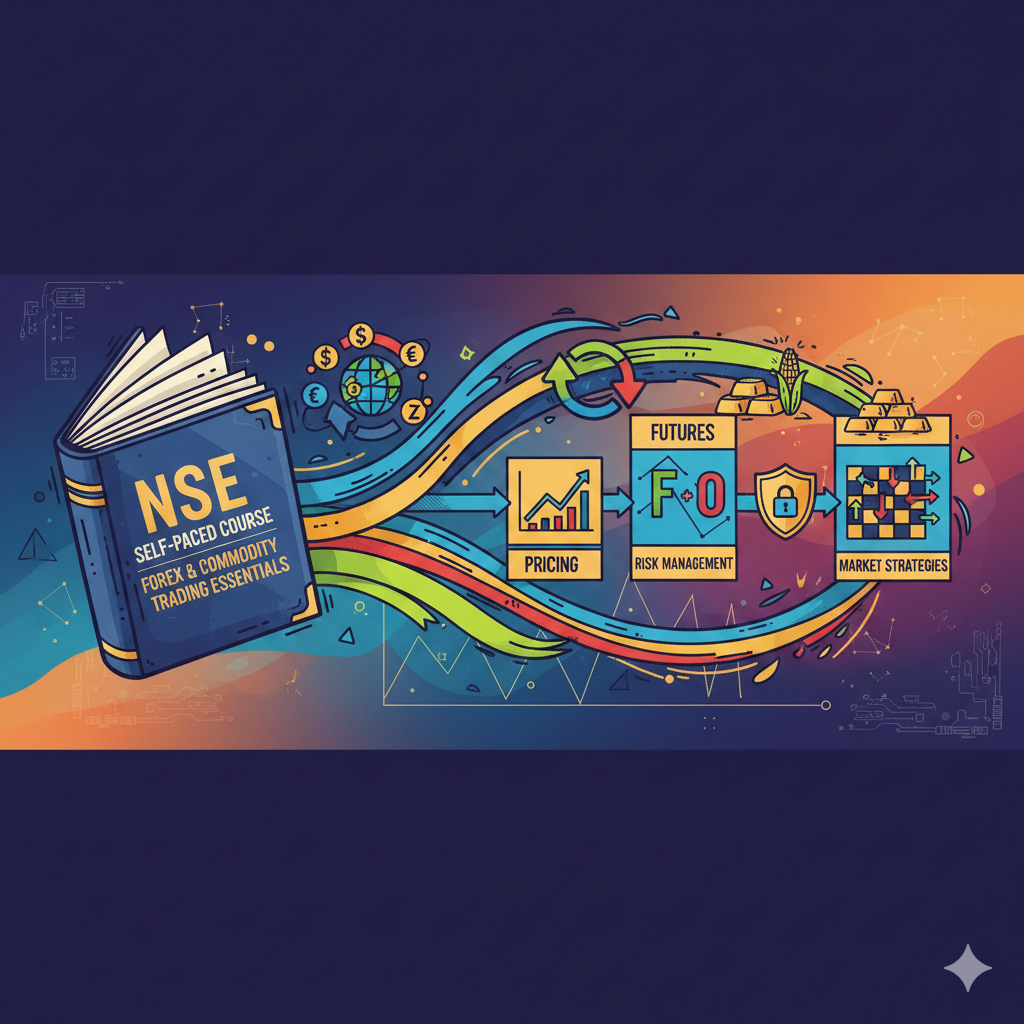
The financial markets today offer countless opportunities for individuals who are willing to learn, adapt, and build skill-based knowledge. Among them, the forex and commodity markets stand out due to their global relevance, high liquidity, and potential for consistent returns when handled with discipline. Understanding how these markets work, how instruments are priced, and what factors drive price movements can give traders and investors a major edge.
To help learners gain this expertise, the National Stock Exchange (NSE) offers a structured and practical Forex and Commodities Training Program. Designed as a beginner-friendly yet detailed learning experience, the course focuses on the fundamentals, trading mechanisms, and risk management principles that govern currency and commodity markets. This article explains the course in a human-friendly, comprehensive way, covering its structure, content, objectives, and benefits.
A Flexible Course Designed for Modern Learners
One of the strongest features of this program is its flexibility. Unlike traditional classroom-based courses, the NSE training is entirely online and self-paced. This means learners can access the content anytime, progress at their own speed, and revisit concepts whenever needed.
The course is around ten hours long, which is ideal for individuals who want focused, high-quality learning without committing to lengthy schedules. Another highlight is that the certification awarded at the end of the course comes with lifetime validity. There is no expiry, no renewal requirement, and no additional steps needed to maintain the certificate. For working professionals, students, and market enthusiasts, this format removes time pressure and makes learning both convenient and stress-free.
Understanding the Purpose of the Program
The core aim of the NSE Forex and Commodities Training Program is to simplify the functioning of two dynamic markets—forex and commodities—while also showing how they are interconnected. Many traders look at these markets separately, not realizing that global commodity prices can influence currency values and vice versa. For example, oil prices often impact the currencies of oil-exporting and oil-importing nations.
Through structured modules, the course teaches participants how to interpret these relationships and use them in real-world trading scenarios. It also provides a foundation for identifying new trading opportunities, managing risk in volatile environments, and making informed financial decisions instead of impulsive or emotional ones.
Detailed Coverage of Futures and Options
A major portion of the program covers futures and options—two of the most widely used derivative instruments across global markets. Beginners often find these instruments intimidating, mainly because of terms like strike price, premium, payoffs, hedging, and arbitrage. The course breaks these concepts down into simple explanations and real-world examples.
Learners explore how futures contracts are created, how prices are determined, and how traders can use these instruments to protect their portfolios. For instance, a business that imports goods can use currency futures to hedge against exchange rate fluctuations. Similarly, commodity futures can help traders lock in prices to avoid losses during volatile market phases.
Options, being more flexible than futures, also get dedicated attention. The course explains the difference between call and put options, how premiums work, and how options can be used not just for speculation but also for controlled-risk strategies. These insights help participants develop a solid base for understanding more advanced strategies later on.
Deep Dive into the Commodity Market Structure
The commodity market is one of the oldest financial markets in the world, dealing with raw materials like metals, energy products, and agricultural goods. However, many new traders lack clarity on how commodity pricing works, what instruments are available, or how trades are settled. The course addresses all these gaps.
It covers capital requirements for trading commodities, explains trading instruments available on exchanges, and walks learners through the entire lifecycle of a commodity futures contract—from order placement to clearing, margin requirements, daily settlements, and final expiry.
Risk management in commodities is treated with high importance because commodity prices can fluctuate sharply due to global events, supply shortages, geopolitical tensions, or weather patterns. By understanding how risk is measured and controlled, participants become better equipped to handle market volatility.
Essential Concepts of the Forex Market
The forex market is the largest and most liquid financial market globally, operating 24 hours a day across different time zones. Yet, most beginners know only the basics—currency pairs and exchange rates. The program goes much deeper.
It explains how currencies are quoted (for example, USD/INR), what determines exchange rate movements, and how global macroeconomic developments such as interest rate changes, inflation data, or geopolitical events influence currency strength.
Learners are introduced to different exchange rate systems such as fixed, floating, and managed floating systems. The course also clarifies the difference between spot markets and forward markets and explains how currency forwards are used by businesses and traders to plan for future obligations.
These lessons help participants interpret currency charts more confidently and understand the reasons behind daily moves in major currency pairs.
Trading Infrastructure and Regulatory Framework
Trading in financial markets involves more than simply placing buy and sell orders. It requires a deep understanding of how exchanges operate, how trades are cleared and settled, and what risk management systems protect traders.
The program thoroughly explains the trading infrastructure that powers both forex and commodity markets. This includes margining systems, mark-to-market settlements, clearing corporations, and risk control mechanisms.
The course also touches on the regulatory environment that governs these markets. Commodity and currency trading is supervised by specific authorities, and understanding their rules helps traders operate within legal boundaries and avoid compliance issues. Even taxation elements related to commodity trading are discussed to ensure learners have a complete picture of the financial ecosystem.
Who Can Benefit From This Program?
One of the strengths of the NSE training program is its inclusiveness. It does not require participants to have prior financial knowledge or market experience. The course is suitable for:
- Aspiring traders and investors
- Working professionals in finance, IT, BPO, and banking
- Brokers and sub-brokers
- Students exploring financial markets
- Anyone curious about forex or commodities
Because the program breaks down complex topics into easy-to-understand lessons, it serves both beginners and those who want to refresh their trading fundamentals.
Building Practical, Market-Ready Skills
By the end of the course, learners develop the ability to analyze price movements, understand fundamental and derivative concepts, and identify trading opportunities in both commodities and currency markets.
The focus is not just on theory but also on practical market understanding—how prices behave, how risks develop, and how traders can position themselves smartly. With trading becoming more accessible today, this kind of structured learning helps individuals avoid costly mistakes and build disciplined trading habits.