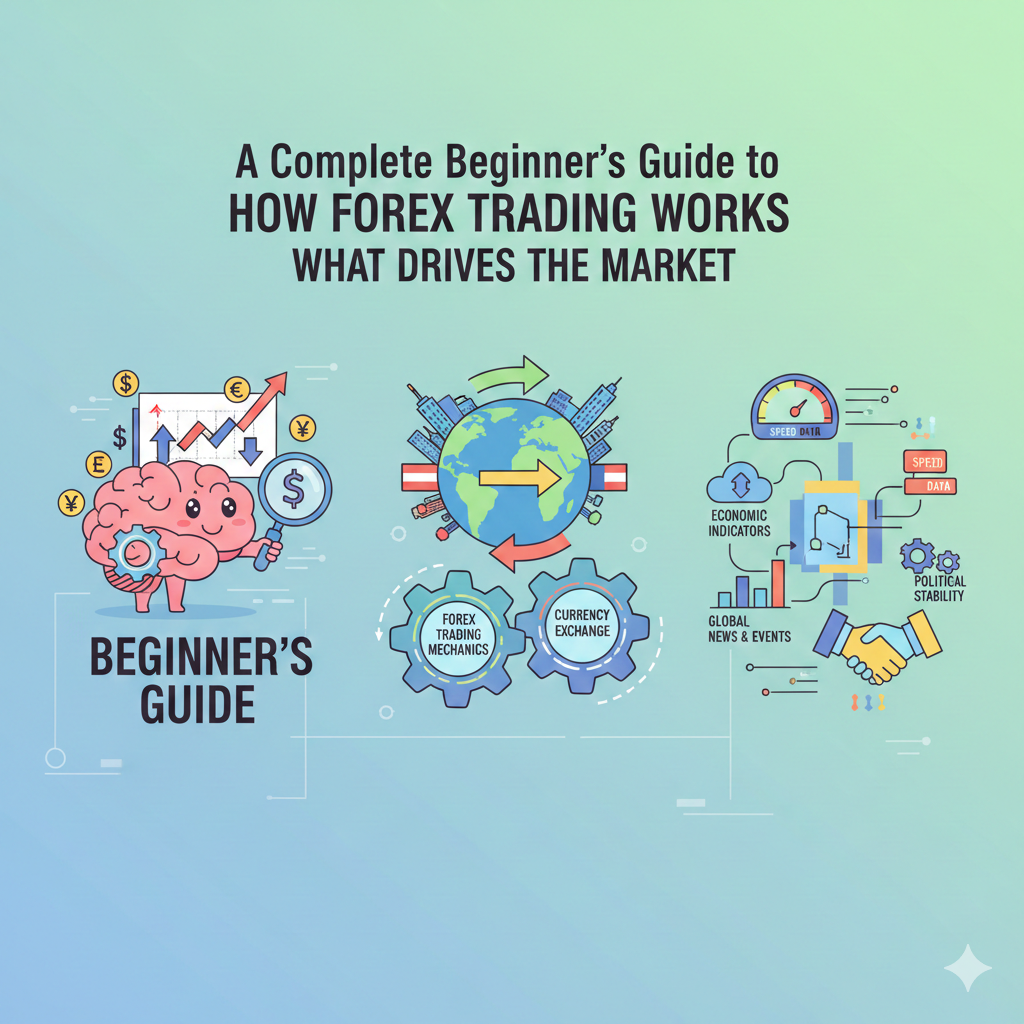
Forex trading—often called FX trading—is one of the most dynamic and fascinating ways to participate in global financial markets. At its core, forex trading is the process of exchanging one currency for another. While that may seem simple on the surface, the forex market is a massive, fast-moving ecosystem shaped by global economics, political events, business flows, and investor sentiment. It operates continuously throughout the week, connecting traders across continents in a market valued at trillions of dollars each day.
To understand forex properly, it helps to start with the basics. Every forex transaction involves two currencies because you’re always buying one while simultaneously selling another. These combinations are known as currency pairs, such as EUR/USD or GBP/JPY. When you open a trade, you are essentially betting on how one currency will perform relative to the other. If you expect the euro to strengthen against the US dollar, you would buy EUR/USD. If you believe the opposite will happen, you would sell the pair. The price you see quoted represents how much of the quoted currency is needed to buy one unit of the base currency.
One of the reasons forex attracts so many participants—from global corporations to individual traders—is its enormous size. According to industry surveys, the forex market records daily trading volumes around USD 7.5 trillion, making it the largest and most liquid financial market in the world. Liquidity matters because it allows traders to buy and sell quickly, often at very competitive prices. This fluidity also reduces the likelihood of getting “stuck” in a trade, a problem sometimes seen in less liquid markets.
Another major attraction of forex is that it operates 24 hours a day, five days a week. The market follows the opening times of global financial centers: Sydney opens first, followed by Tokyo, then London, and finally New York. As one region ends its trading day, another begins, creating an almost seamless flow of activity. For traders, this means they can choose trading times that suit their schedules and react instantly to breaking news, such as economic data releases, geopolitical developments, or central-bank decisions.
Forex trading also commonly involves leverage, which is a powerful yet risky tool. With leverage, a trader can control a large position using only a small portion of capital. For example, with 1:30 leverage, you can open a USD 30,000 position with just USD 1,000 in margin. . A small market movement in the opposite direction of your position could deplete your account quickly. This is why understanding margin requirements, risk management, and trade sizing is essential before jumping into leveraged forex transactions.
Economic indicators such as inflation, employment data, GDP growth, and interest-rate decisions can have a powerful impact on currency prices. Central banks, especially those of major economies like the U.S., Eurozone, Japan, and the U.K., play a major role because they control monetary policies that affect currency values. Political stability, elections, trade agreements, and international conflicts can also cause significant fluctuations, sometimes creating sharp price movements within seconds. Traders must therefore keep an eye on global news and economic calendars to stay ahead of major market drivers.
There are different styles of forex trading depending on a trader’s goals, experience, and risk tolerance. Some people prefer day trading, where positions are opened and closed within the same trading day to avoid overnight market exposure. Others choose swing trading, which involves holding positions for days or even weeks to capture medium-term price movements. Long-term investors might use position trading, relying more on fundamental analysis than short-term price fluctuations. Regardless of the style, successful forex traders often develop a well-structured strategy, test it, refine it, and follow it consistently.
A big part of forex trading involves selecting the right currency pairs to trade. Major pairs—such as EUR/USD, USD/JPY, GBP/USD, and USD/CHF—tend to have the highest liquidity and tightest spreads. These pairs are favored by many traders because they typically offer more predictable price behavior and lower trading costs. Cross-currency pairs like EUR/JPY or GBP/CAD can provide broader opportunities and sometimes higher volatility, while exotic pairs (for example, USD/TRY or EUR/ZAR) can be even more volatile and carry higher spreads. Choosing the right pair depends on your strategy, risk appetite, and familiarity with global economies.
Managing risk is arguably the most important part of forex trading. Because leverage and volatility can create large swings, traders must protect their capital by using tools such as stop-loss orders, take-profit levels, proper position sizing, and disciplined risk-to-reward ratios. Many traders risk only 1–2% of their trading capital on a single trade to ensure survival during losing streaks. Emotional control is another crucial factor. Impulsive decisions, over-leveraging, or chasing losses can rapidly result in significant financial damage.
Technology has made forex trading more accessible than ever. Modern trading platforms allow traders to execute orders quickly, analyze market charts, study price patterns, and automate strategies using algorithms. Educational resources, market research, webinars, and demo accounts allow new traders to practice without risking real money. While forex is open to beginners, it does require patience, discipline, and ongoing learning to navigate effectively.
In addition to speculation, forex also plays a vital role in global trade and business. Companies that operate internationally must constantly exchange currencies to pay suppliers, receive payments, and manage risks related to currency fluctuations. Banks, hedge funds, asset managers, and governments also participate in the forex market for various financial and policy reasons. This diverse set of participants ensures that forex remains active and deeply interconnected with the global economy.
Despite its benefits, forex trading involves meaningful risks. Sudden market movements due to unexpected news events can cause rapid losses. High leverage can magnify even small unfavourable shifts in price. Spreads may widen during low-liquidity periods, such as during holidays or major announcements. Traders must remain cautious, stay updated, and treat forex like a serious financial activity rather than a shortcut to quick riches.
In summary, forex trading offers exciting opportunities thanks to its liquidity, accessibility, global reach, and potential for profit. At the same time, it demands responsibility, knowledge, and risk awareness. With the right strategy, discipline, and understanding of how currencies behave, forex can be an engaging market that rewards careful planning and thoughtful execution.
One thought on “A Complete Beginner’s Guide to How Forex Trading Works and What Drives the Market”
Comments are closed.